
Green tribunal imposes Rs 5,000 fine for throwing religious items into Yamuna

After clean Ganga project it is time to be serious about saving the Yamuna river

GN Bureau | January 13, 2015
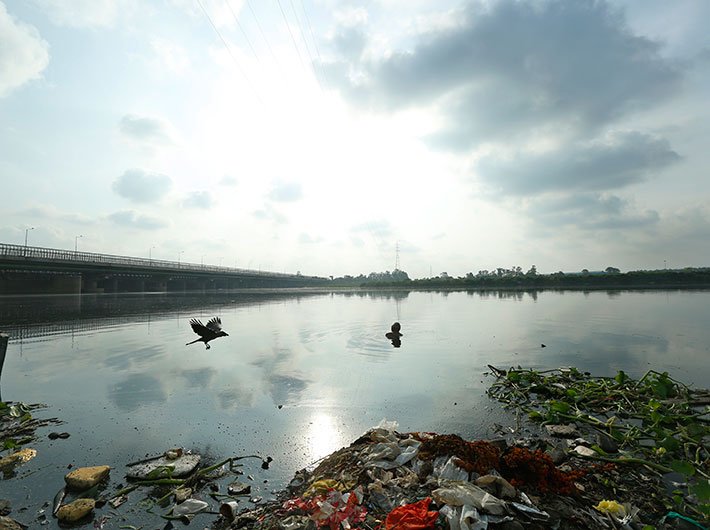

Polluted river Yamuna in Delhi

After the clean Ganga programme announced by prime minister Narendra Modi, the National Green Tribunal on Tuesday took a small step and decided to set up a committee to plan on cleaning up River Yamuna. In the meantime, it has ordered the administration to impose fine on those who throw religious items into the Yamuna.

Those caught in the act of littering will have to pay Rs 5000.

The decision has been taken as the NGT took the view that discarding religious items in Yamuna is choking the river's ecosystem.

Since the inception of the National Ganga River Basin Authority, 76 schemes at a total cost of Rs 5,004.19 crore for cleaning the rivers have been sanctioned in 48 towns in the states through which the Ganga passes. The Union government has been implementing Yamuna Action Plan (YAP) for cleaning of Yamuna river with assistance from Japan International Cooperation Agency, without much success.

The NGT order to collect fines from people who throw items into the river means there is ban on throwing of these items. Despite explicit messages being put up by various agencies and ban on throwing religious items into the river, Indians continue to indulge in such practice.

In 1993, a two-phase plan document was signed by India and Japan. Under the first two phases of Yamuna Action Plan, the cleaning of polluted Yamuna is being carried out along with the level of the biological oxygen demand of Yamuna. A total of 286 schemes including 39 sewage treatment plants have been completed in 21 towns of Uttar Pradesh, Haryana and Delhi to clean Yamuna river since 1993.

The pollution abatement works implemented by the central and state governments have helped in improving the water quality in some locations and checking the pace of deterioration in others. The water quality of river Yamuna is less than the desired level in some stretches due to sewage treatment capacity and lack of fresh water in the river.

Comments


Other News

Cabinet passes resolution applauding PM on term record

The Union Cabinet on Wednesday passed a resolution marking June 10, 2026, as a historic milestone in the journey of Indian democracy applauding Narendra Modi for becoming the longest-serving elected PM of the country. By establishing a record of 4,399 days of continuous service as an elected PM, he has s

Testing the teachers, moving the goalposts

A teacher was appointed in 1999, before the Right to Education (RTE) Act came into force, and appointed under the rules that existed at that time. She gave the necessary test, passed it, passed the interview, and was appointed. Over the next 26 years, she taught thousands of children, faced transfer orde

`Focus on infra, reforms, digital connectivity has created strong foundation for growth`

In a step towards the operationalisation of the Bharat Audyogik Vikas Yojana (BHAVYA), union minister of commerce & industry Piyush Goyal launched the BHAVYA Portal on Monday in New Delhi.   Addressing the gathering, Goyal said that the BHAVYA scheme will adopt a competit

Govt, RBI announce major reforms to attract FPI

The finance ministry on Friday announced a series of measures aimed at enhancing the ease of investment for individual Persons Resident Outside India (PROIs) and Foreign Portfolio Investors (FPIs), and to attract stable long-term foreign capital flows.   Building on the recent in

Lessons in climate adaption from world’s largest inhabited river island

Majuli Island, perched between the Brahmaputra River to the south and east, the Subansiri River to the west, and a branch of the Brahmaputra to the north, has been severely affected by recurrent flooding and intense riverbank erosion. Despite its global importance in acquiring UNESCO tentative status for

Careless whispers and the impossible trinity

Time can never mend, the careless whispers of …    As the RBI marches ahead, for the upcoming monetary policy meeting this June, whispers from the corridors echo around several policy options to defend the rupee – by deploying forex reserves, raising in





Archives

Current Issue

Opinion

Facebook Twitter Google Plus Linkedin Subscribe Newsletter

Twitter