
The affidavit filed in Delhi high court seems to hide many facts

Pankaj Kumar | May 13, 2015
Ministry of health’s affidavit in Delhi high court in response to a public interest litigation (PIL) of Center for Public interest litigation (CPIL) is a piece of document that hides more than it seeks to disclose.
The case relates to allegations against health minister J P Nadda and that he was behind the ouster of vigilance official Sanjeev Chaturvedi to save his trusted officials involved in serious corruption in AIIMS.
The CPIL had urged high court to pass an order restraining Nadda from taking any decisions in several cases initiated by Sanjeev Chaturvedi as CVO of the premier health institute.
A detail scrutiny of the affidavit reveals that several points made by Nadda and his ministry are far from the truth. Governance now has several documents which reveal contradictions.
Corruption charges
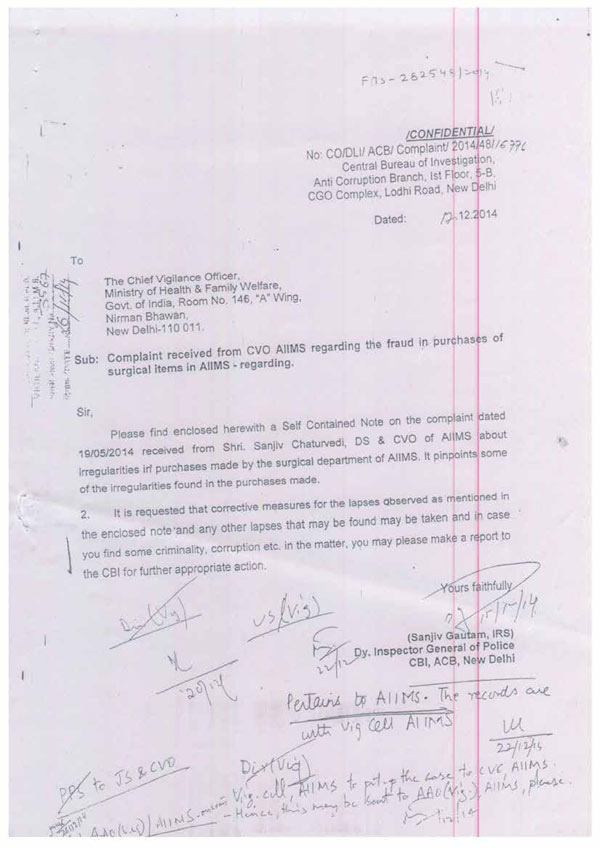
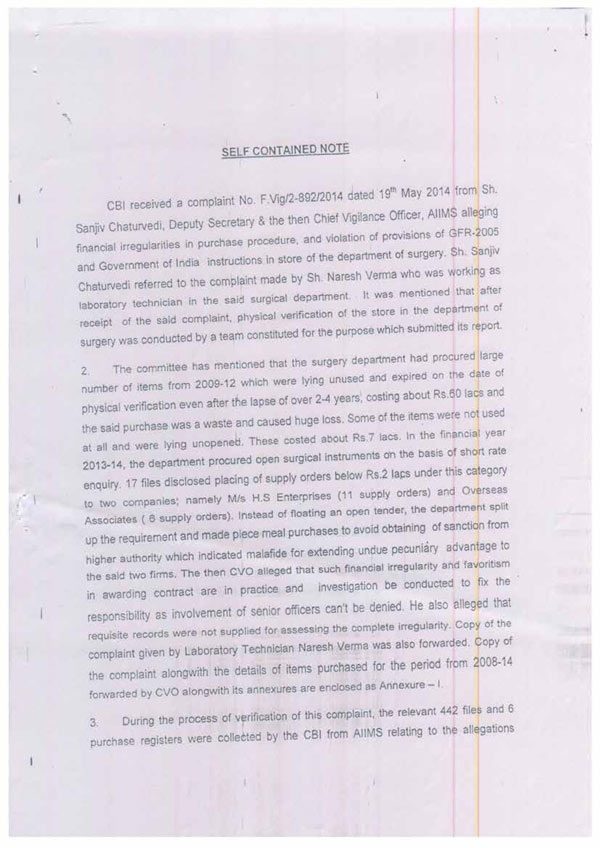
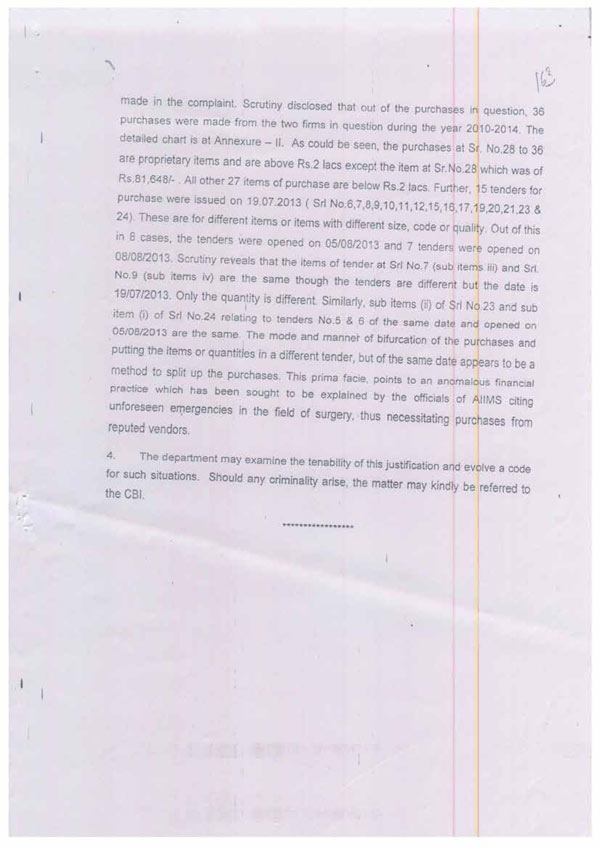
Director of AIIMS M C Mishra was allegedly found guilty of corruption while he was working as head of the department of surgery. This matter was referred to central bureau of investigation (CBI). The allegations were of favoritism to particular suppliers and flouting of financial procedure.
CBI in its letter has clearly mentioned that a report regarding corruption against present director of AIIMS has been sent to the central vigilance officer (CVO) of the ministry on February 17, 2014. But in the affidavit the health minister is denies receiving any CBI investigation report.
Missing files
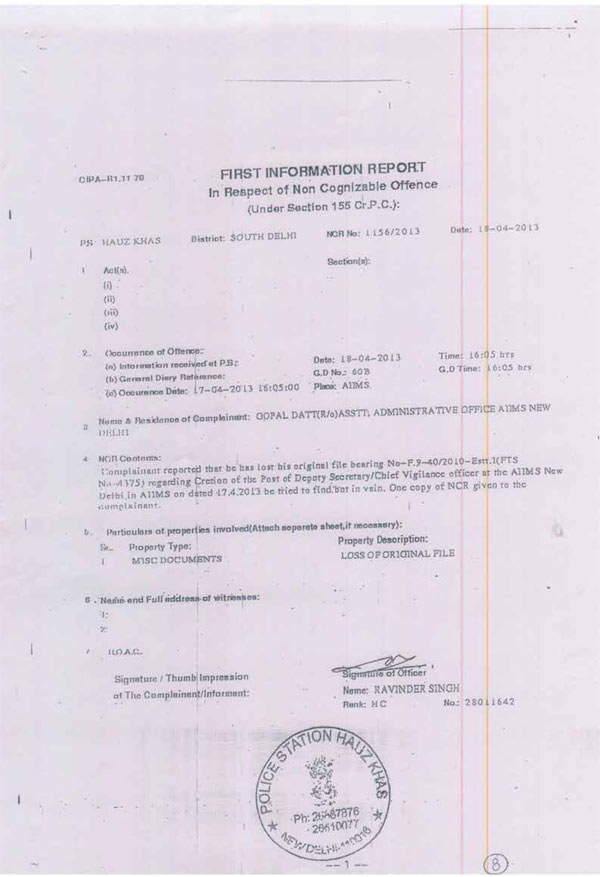
Another contradiction is about missing files in relation to the post of central vigilance officer of AIIMS. In his affidavit Nadda has alleged that Sanjeev Chaturvedi was behind the disappearance of the file.
However, Dr Harshwardhan, who was Nadda’s predecessor, had approved major penalty and departmental charge sheet against Vineet Chaudhary for his role in making file disappear. Thus Nadda contradicts his own cabinet colleague and blames Sanjeev Chaturvedi for the disappearance of the file.
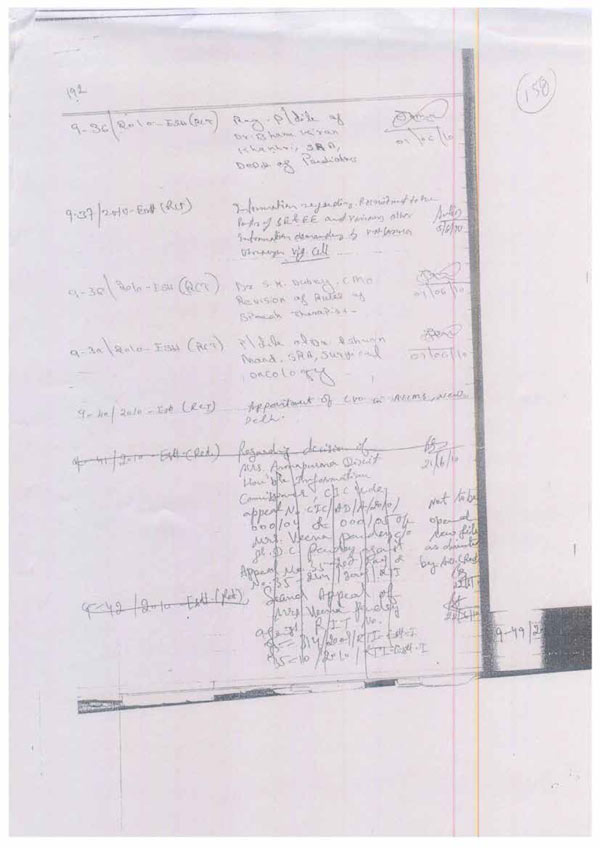
Nadda further claimed that no such file regarding creation of the post of CVO existed while institute’s records show that file bearing no-F.9-40/2010-Estt (on the subject of appointment of CVO of AIIMS) has been mentioned in the file tracking system and these records show that the last location of the missing file was in Vineet Chaudhary office on September 12, 2012.
Health ministry too in its reply has termed the action of PMO (regarding their direction dated 23.11.2012 of not removing Sanjeev Chaturvedi from the post of central vigilance officer till the proposal is personally examined by cabinet secretary) standing parliamentary committee (regarding commitment made to them on June 8,2012 by then health secretary and clearly mentioned in the letter of parliamentary committee on September 20.2012 and June 6,2013 and issue of missing file related to the creation of post of CVO) their joint secretary Vishwas Mehta (who had mentioned on files that all the statutory approvals were completed in appointment of CVO and the said note was approved by then health secretary) all as erroneous.
Others called liars
Nadda and health ministry took the stand in public domain that Sanjeev Chaturvedi was removed because of lack of prior approval of CVC on August 14, 2014. But they intimated the same to the CVC that approval of General BODAY and IB was not taken. The CVC which is also a party in the said PIL by Prashant Bhushan has replied in its affidavit which further exposes the ministry. CVC said that prior approval was neither taken in case of Sanjeev Chaturvedi nor in case of entrusting his charge to the CVO of health ministry.
Ministry further violated the vigilance manual by appointing Manoj Jhalani as additional in charge of CVO AIIMS. As per para 2.6.1 of vigilance manual the autonomous institute has to forward a panel of its officers to the administrative ministry which then forward it to the CVC for approval. While in this case, the panel was directly sent by the ministry to the CVC and it consisted three of its own joint secretaries working in the ministry and not the officers of the AIIMS, while in all other autonomous organizations under the ministry, the CVO is an officer of that organization only.
Digital payments have become a reflex for urban India, but the confidence earned in paying has not yet carried over to borrowing. That is the central finding of `How Urban India Pays Report 2026`, released by Pahlé India Foundation in collaboration with Amazon Pay. Based on a survey of 5,149 consu
Commerce and industry minister Piyush Goyal has called upon businesses in India and the United Kingdom to translate the opportunities created by the India-UK Comprehensive Economic and Trade Agreement (CETA) into expanded trade, investment, partnerships and job creation. Addressing the Bu
The Gandhian movement in India, after Gandhi’s death, failed, says Ramachandra Guha, and blames Vinoba Bhave for it. But the movement found new, fertile grounds around the world and succeeded in bringing about a change in South Africa, the US and elsewhere. It is high time it returned home. Of cour
Tavleen Singh, noted journalist and political commentator, has turned to fiction, with her debut novel ‘The Actor’ (HaperCollins India). Set in the near future, it has a superstar, Amit Singh, turning to politics, when the political landscape is dominated by prime minister Guru Gaynendraj
The union cabinet, chaired by prime minister Narendra Modi, on Tuesday approved the setting up of a Special Purpose Vehicle (SPV), called Integrated Transport & Logistics Authority (ITLA), to strengthen research, planning, appraisal, monitoring and impact assessment within the broad domains of Transp
Foundational Literacy and Numeracy (FLN) are often described as the building blocks of education. Yet, their significance goes well beyond a child’s ability to read a sentence, write a response or solve a basic mathematical problem. These foundational skills shape how children understand the world,










