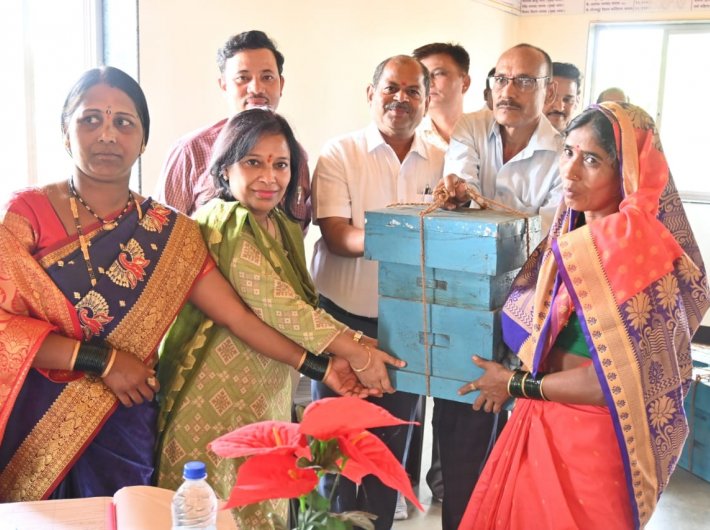
At a time when climate change, preservation of nature and ecological balance and reducing fertilizers and chemicals in agriculture and food are drawing huge attention, a forest village in Maharashtra is taking strides to become a model ‘Madhache Gaon’ (honey village). The aim is to increase the honey bee population, produce organic honey and generate rural employment for Atmanirbhar Bharat.
Tiny honey bees, among the most essential little creatures in the universe, are so important for ecology and environment that human beings would not be able to survive without them – if they all die, so would we.
Honey bees are responsible for most of the food we eat as they pollinate crops and cross pollination increases crop yield by 35-40%. Without bees we will have no food to eat or minimal food sources at a huge cost. That is why Albert Einstein, the great theoretical physicist, had said, “If the bee disappeared off the face of the Earth, man would only have four years left to live.”
But the population of honey bees in the country has gone down drastically. The increased use of chemicals, insecticides, fertilizers pesticides, drought, habitat destruction, nutrition deficit, air pollution and global warming have affected them adversely: they don’t get the flora and nectar.
To address the situation, the central government launched a Honey Mission in 2017-18. Later prime minister Narendra Modi in his radio address, ‘Mann ki Baat’, spoke about the Sweet Revolution, highlighting the importance of bee farming for the development of agriculture and to double farmers’ income.
In a first in the country, under ‘Azaadi ka Amrit Mahotsav’, the Maharashtra government’s Khadi and Village Industries Board (KVIB) is working to develop honey tourism inside the thick forests of Mahabaleshwar.
The pilot project called ‘Madhache Gaon’ (village of honey) has been started in Manghar village at Satara district, near Mahabaleshwar, under the state Honey Centre Scheme (Madha Kendra Yojana). The forest village is a natural honey bee cluster with 80% of its population into bee keeping.
The project started with distribution of seeds and plantation of flora for bees. Under the scheme 50% subsidy for beehives and other materials is provided to farmers with training and technical support. Honey bee boxes as per bee variety used for production for honey are provided to bee keepers. The boxes contain bee colonies of 25,000 workers bees including two twin bees are provided to bee keepers. The government buys back honey from bee keepers and processes it at its collection cum processing centre after which Madhuban organic honey is sold at Rs 400 per kg through the online platform Amazon. KVIB now plans to start selling Madhuban honey at all divisional headquarters.
The idea behind the pilot project is to expand the government’s existing scheme in a holistic manner. In line with the aim of promoting honey tourism, KVIB will now set up an exhibition and sales centre in the village to ensure good returns to farmers and rural people. A gallery will be set up to provide information on bee keeping, importance of bees and their role in preserving environment. In addition to apiculture, collecting and processing honey the project will also include honey by-products like beeswax, bees venom, royal jelly, propolis, honey Chayawanprash, honey cubes, honey candies and honey chocolates.
“The mandate given to the Directorate of Honey at Mahabaleshwar is to preserve nature, produce honey and generate employment activity,” says Anshu Sinha, CEO, Maharashtra State Khadi and Village Industries Board, the brain behind ‘Madhache Gaon’. “At KVIB we have the mandate to provide a platform to rural entrepreneurs for marketing of their goods. The scheme gives the guarantee of buyback to villagers who do bee keeping and collect honey. They have the choice of selling honey back to us. We have been giving the best price. The honey is processed by us at our directorate, certified and sold by us.” This is holistic, integrated approach is providing livelihood with organic farming preserving biodiversity and nature, increasing the number of honey bees as well as increasing their income by developing ancillary products, says Sinha.
“This is the most profitable agri business for farmers. While doing this work they are also preserving nature.”
Bipin Jagtap, deputy CEO, MSKVIB, adds, “Just as tigers ensure balance in the ecosystem, honey bees do the pollination of most plants, fruit plants, flowers and agriculture crops and other forest trees and therefore form very important part of food chain. For that reason we are focusing on honey bees to maintain our ecosystem and biodiversity. This will also provide employment opportunities to rural people.”
He adds that as the village is located deep in the forest where crops cannot be grown, the location makes it the right pace for the collection of organic honey. The village also qualifies as the pilot project as it has won awards in various government schemes. In days to come, the state government plans to expand the project to all hilly areas and forest region of the state such as Gadchiroli, Sindhudurg, Amravati and Kolhapur.
“The Madhuban brand of GoM’s KVIB belongs to the bee keepers. We are the first throughout the country to guarantee buy back from apiaries,” says Jagtap.
KVIB is now working on the project ‘Maha Khadi’ to provide an offline and online platform for sale of all products of rural entrepreneurs.