India, Japan to build Asia-Africa corridor to checkmate OBOR

India and Japan would not confine their proposed Asia-Africa corridor merely to connectivity

shankar

Shankar Kumar | May 23, 2017 | New Delhi

#Gandhinagar   #Shinzo Abe   #Asia-Africa   #growth corridor   #Japan   #African Development Bank   #Narendra Modi   #OBOR  
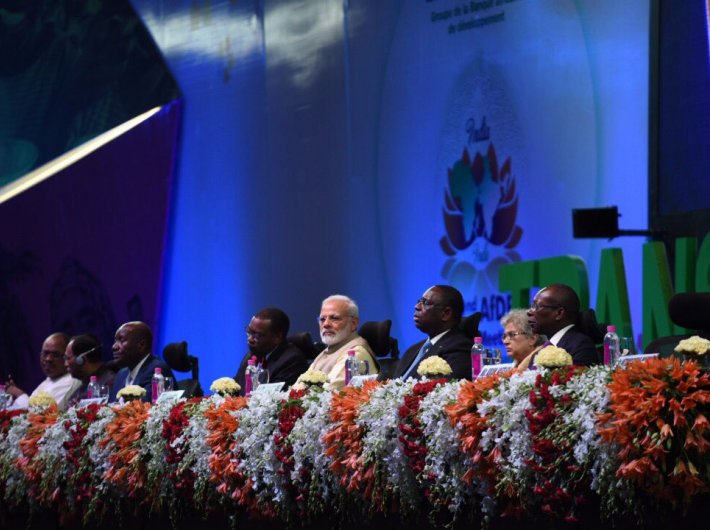
Narendra Modi at the opening ceremony of the 52nd annual meetings of African Development Bank (Photo: Twitter/@MEAIndia)


While India and China are pitted against each other in South Asia and the Southeast Asian region, and the former’s refusal to participate in Beijing held summit on One Belt One Road (OBOR) initiative was a low point in their bilateral ties, New Delhi is now preparing an initiative that will rub salt in China’s wound. India and Japan are planning to develop a corridor that would connect South Asia with Africa. 

A hint in this regard was given by prime minister Narendra Modi while inaugurating the 52nd annual meeting of the African Development Bank in Gandhinagar in Gujarat on May 23. The prime minister talked about “Asia-Africa growth corridor” and India and Japan’s concerted effort to rope in the US for its effective implementation, a subtle move to turn the corridor into an answer to China’s OBOR initiative.
 
At the inception stage now, the corridor will link South Asia with Africa through Chabahar Port in Iran being developed by India with support from Japan. Before this could happen, experts suggest that India and Japan with help from African Development Bank would develop infrastructure to connect coastal countries like South Africa, Mozambique, Madagascar, Tanzania, Kenya, Somalia and others with land locked African nations such as Ethiopia, Rwanda, Chad, Botswana, Malawi, Zambia and Zimbabwe. These issues were broached by officials of India and Japan first in Tokyo and later in February this year in New Delhi where India, US and Japan officials had gathered for a trilateral meet.
 
In the last annual meeting between India and Japan held in Tokyo in November 2016, Modi and his Japanese counterpart Shinzo Abe had discussed their joint initiative on connectivity and other infrastructure related projects in Africa.
 
“I gladly recall my detailed conversation with prime minister Abe during my visit to Tokyo. We discussed our commitment for enhancing growth prospects for all. In our joint declaration, we mentioned an Asia-Africa Growth Corridor and proposed further conversations with our brothers and sisters from Africa,” Modi said while addressing AFDB meeting, also attended by presidents of Benin and Senegal and vice president of Cote D’lvoire.
 
OBOR is mainly connectivity project, but India and Japan would not confine their proposed Asia-Africa corridor merely to connectivity.  “They also want to develop irrigation related infrastructure along with power stations and fertilize plants in Kenya, Uganda and other African nations,” a senior government functionary told Governance Now, adding that India would invest more in the agriculture sector.
 

Comments


Other News

Why civilization is a precarious thing

The Decline of Hindu Civilization: Lessons from the Past By Shashi Ranjan Kumar Rupa Publications, 416 pages, Rs 995

End of an era: BJP poised to rule Mumbai after 25 years

The BJP-led Mahayuti alliance was set for a decisive victory in the Maharashtra municipal corporation elections, consolidating its dominance across Maharashtra’s urban landscape. As per the latest trends from the vote counting on Friday afternoon, the state`s ruling coalition was leading in 19 of the

Startup India initiative: A decade of building India’s innovation backbone

* With over 2 lakh DPIIT-recognised startups as of December 2025, India stands firmly as one of the world’s largest startup ecosystems. * A decade of Startup India has built a full-lifecycle support system spanning ideation, funding, mentorship, and scale-up. * Around 50% of DPIIT-r

How toll policies are redefining the highway journeys

With the phenomenal growth in National Highways, queues at toll plazas used to affect commuters. However, over the last decade, tolling has undergone a major technological transformation, bringing faster movement and significant ease for road users. Building on this progress, year 2025 saw further people-c

From vulnerabilities to empowerment: Building resilience for small and marginal farmers

India’s small and marginal farmers are at the centre of a paradox in agrarian economy. They are the backbone of the food economy, but they are the most vulnerable stakeholders within agricultural economy. Among the 126 million farmers in India today, nearly makes 86% operate on small and marginal hol

Concerns over Mumbai air pollution ahead of Marathon

Environmental organisation Awaaz Foundation has flagged serious concerns over deteriorating air quality in Mumbai and the potential health risks it poses to participants of the Tata Mumbai Marathon scheduled for January 18. It has urged civic and pollution control authorities to conduct advance air quality


Archives

Current Issue

Opinion

Facebook Twitter Google Plus Linkedin Subscribe Newsletter

Twitter