
The economic forecast by the finance ministry notes that the country’s ‘long run’ potential growth is around 8-10 percent
GN Bureau | February 26, 2016
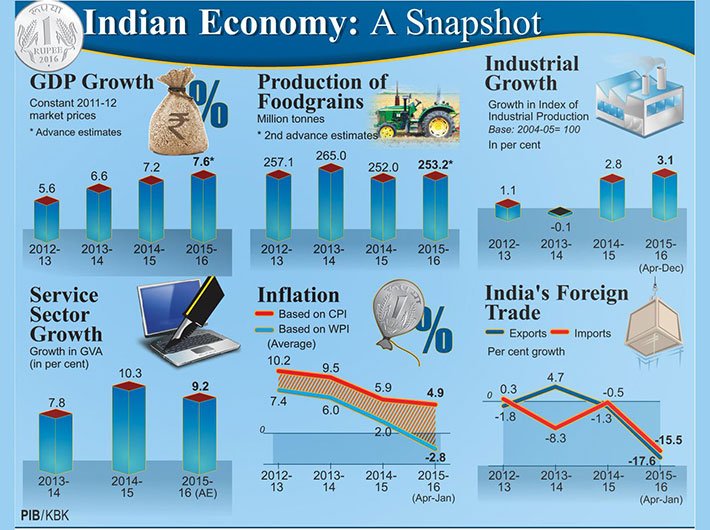

The Indian economy may grow in the range of 7 to 7.75 percent, according to economic survey 2015-16. The real gross domestic product (GDP) growth rate in the first half of the fiscal grew by 7.2 percent. This was also the growth rate in 2014-15. A summary of the survey issued by the press information bureau states that the country’s macro-economy is stable, “founded on the government’s commitment to fiscal consolidation and low inflation”.
READ: Despite growth, formal sector job shrinks
It talks about 4 ‘R’s – recognition, recapitalisation, resolution, and reform – required to comprehensively resolve the twin balance sheet challenge of public sector banks (PSBs) and some corporate houses.
READ: External debt in safe limits, export slowdown to continue
The settlement of the Minimum Alternate Tax (MAT) imposed on foreign companies reflects the restoration of stability and predictability in tax decisions, the economic survey says. The survey highlights the opening of over 200 million bank accounts under Pradhan Mantri Jan-Dhan Yojana (PMJDY), direct benefit transfer programme and the use of JAM trinity (Jan-Dhan, Aadhaar and mobile) for other government programmes and subsidies.
READ: Hunger, starvation still persist: Economic survey
The economic forecast by the finance ministry notes that the country’s ‘long run’ potential growth is around 8-10 percent. Realising this potential, the survey says, requires a push on at least three fronts. “First, India has moved away from being reflexivity anti-markets and uncritically pro-state to being pro-entrepreneurship and skeptical about the state. But being pro-industry must evolve into being genuinely pro-competition. Similarly, skepticism about the state must translate into making it leaner. It emphasises that the key to creating a more captive environment will be to address the exit problem which affects the Indian economy,” the survey says.
READ: Addition of record power generation, focus on renewable energy development
Second, the survey calls for major investments in health and education of people to exploit India’s demographic dividend to optimal extent. Third, it says that India cannot afford to neglect its agriculture, the report says.
READ: Uneven distribution of subsidies, requires rectification of anomalies
September 12 marks the International Day for South-South Cooperation, commemorating the 1978 Buenos Aires Plan of Action (BAPA). Forty-eight years later, its central proposition remains relevant: countries of the Global South can draw on their own knowledge, experience and innovations to address shared d
As India prepares to host the 18th BRICS Summit this weekend, and as prime minister Narendra Modi is set to hold a bilateral meet with president Xi Jinping, China’s growing global influence and the changing dynamics of India-China relations will be under focus. But to understand where China is head
This year marks 20 years of BRICS, with India set to host the grouping’s leaders’ summit this weekend. The anniversary offers an opportune moment to assess BRICS’ growing importance at a time when the effectiveness of global governance and the credibility of multilateralism are under in
Triumph of the Indian Republic: My Life, My Struggles By Ram Nath Kovind Rupa Publications, 400 pages, Rs 795 All our presidents so far stand out, each for a different reason. Ram Nath Kovind, the 14th president of India, from 2017 t
Pathbreakers: How 10 Visionary Leaders Transformed India by award-winning journalists By Sucheta Dalal and Debashis Basu Rupa Publications, 304 pages, Rs 695
In a significant gain for citizen protection in the digital economy, the Department of Telecommunications (DoT) has helped prevent suspected cyber fraud losses of more than ₹5,000 crore through its Financial Fraud Risk Indicator (FRI) within fifteen months of its launch on May 22, 2025. This money did











