
INS Vagir to give fillip to Navy: Admiral Hari Kumar

Says underscores coming of age of India’s shipbuilding industry and the maturing of defence ecosystem

geetanjali

Geetanjali Minhas | January 23, 2023 | Mumbai

#Atmanirbhar Bharat   #Indian Navy   #Defence  


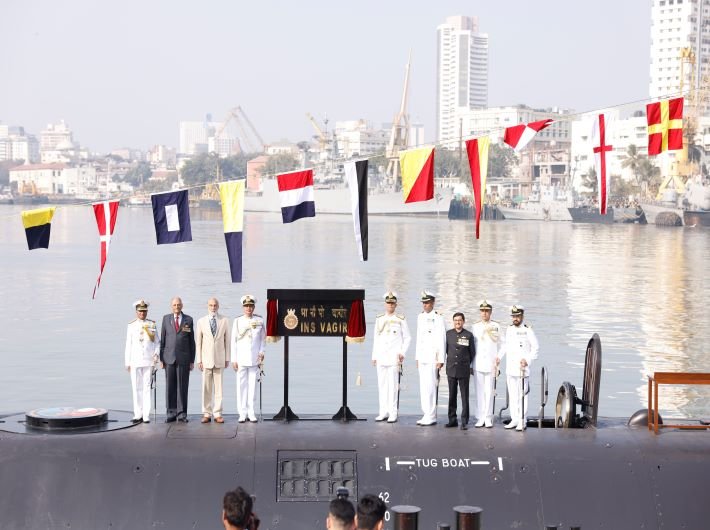
The Indian Navy commissioned its fifth stealth Scorpene class Submarine INS Vagir on Monday at the Naval Dockyard, Mumbai in the presence of Admiral R Hari Kumar, Chief of the Naval Staff.

Vagir was launched on November 12, 2020, under Project 75 (P75) and post completion of sea trials it was delivered to the navy on December 20, 2022. Vagir has the distinction of having the lowest build time among all indigenously manufactured submarines till date. INS Vagir would form part of the Western Naval Command’s Submarine fleet and would be another potent part of the Command’s arsenal.

Mazagon Dock Shipbuilders Limited (MDL) Mumbai in collaboration with Naval Group of France is building six Scorpene Class submarines.

The Scorpene Submarines are extremely potent platforms having advanced stealth features and equipped with both long range guided torpedoes as well as anti-ship missiles. These submarines have state of the art SONAR suite and sensor suite permitting outstanding operational capabilities.
 
Flag Officer Commanding-in-Chief, Western Naval Command V Admiral AB Singh, MDL chairman and managing director V Admiral Narayan Prasad (Retd) and other senior civil and military officials were present during the commissioning ceremony. The crew of the erstwhile ‘Vagir’, a Russian origin Foxtrot Class Submarine which was decommissioned in 2001, were special invitees for the ceremony and the then commissioning Commanding Officer R Admiral  K Raja Menon (Retd) was also present.

Chief of Naval Staff (CNS) Admiral R Hari Kumar said that INS Vagir will give a significant fillip to the Indian Navy’s operational might and serve as a potent deterrent for any adversary.

Highlighting that Vagir is the third submarine inducted into the Navy in a short span of 24 months, he said, “This underscores coming of age of India’s shipbuilding industry and the maturing of our defence ecosystem. It is also a shining testimony to the expertise and experience of our shipyards to construct complex  and complicated platforms and serves to reinforce Indian Navy’s unequivocal commitment and steadfast resolve to be a fully ‘AatmaNirbhar’ force by 2047.”

Complimenting the commissioning crew, the CNS said, “It gives me every confidence that each one of you will ‘do your duty and do it well’, and that Vagir will serve the Nation with pride and élan guided by the highest traditions of the Navy.”

The Indian Navy said: “Vagir means Sand Shark and represents stealth and fearlessness, two qualities that are synonymous with the ethos of a submariner. The motto of the submarine, ‘Saahas Shaurya Samarpan’, epitomizes the core values of Courage, Valour and Dedication.

“The commissioning of Vagir is coinciding with ‘Azadi ka Amrit Mahotsav’ celebrations. The commissioning of this indigenous submarine once again denotes the drive and focus towards AatmaNirbhar Bharat,” it said.
 

Comments


Other News

AI: Code, Control, Conquer

India today stands at a critical juncture in the area of artificial intelligence. While the country is among the fastest adopters of AI in the world, it remains heavily reliant on technologies developed elsewhere. This paradox, experts warn, cannot persist if India seeks technological sovereignty.

RBI pauses to assess inflation risks, policy transmission

The Reserve Bank of India (RBI) has begun the new fiscal year with a calibrated pause, keeping the repo rate unchanged at 5.25 per cent in its April Monetary Policy Committee (MPC) meeting. The decision, taken unanimously, reflects a shift from aggressive policy action to cautious observation after a signi

New pathways for tourism growth

Traditionally, India’s tourism policy has been based on three main components: the number of visitors, building tourist attractions and providing facilities for tourists. Due to the increase in climate-related issues and environmental destruction that occurred over previous years, policymakers have b

Is the US a superpower anymore?

On April 8, hours after warning that “a whole civilisation will die tonight,” US president Donald Trump, exhibiting his unique style of retreating from high-voltage brinkmanship, announced that he agreed to a two-week ceasefire with Iran. The weekend talks in Islamabad have failed and the futur

Machines communicate, humans connect

There is a moment every event professional knows—the kind that arrives without warning, usually an hour before the curtain rises. Months of meticulous planning are in place. And then comes the call: “We’ll also need a projector. For the slides.”   No email

Why India is entering a ‘stagflation lite’ phase

India’s macroeconomic narrative is quietly shifting—from a rare “Goldilocks” equilibrium of stable growth and contained inflation to a more fragile phase where external shocks are beginning to dominate domestic policy outcomes. The numbers still look reassuring at first glance: GDP


Archives

Current Issue

Opinion

Facebook Twitter Google Plus Linkedin Subscribe Newsletter

Twitter






