
Supreme Court judge strength to go up by four to 37

The move to allow the apex court to function more efficiently and effectively ensuring speedy justice

GN Bureau | May 6, 2026

#Supreme Court   #Judiciary   #Cabinet  


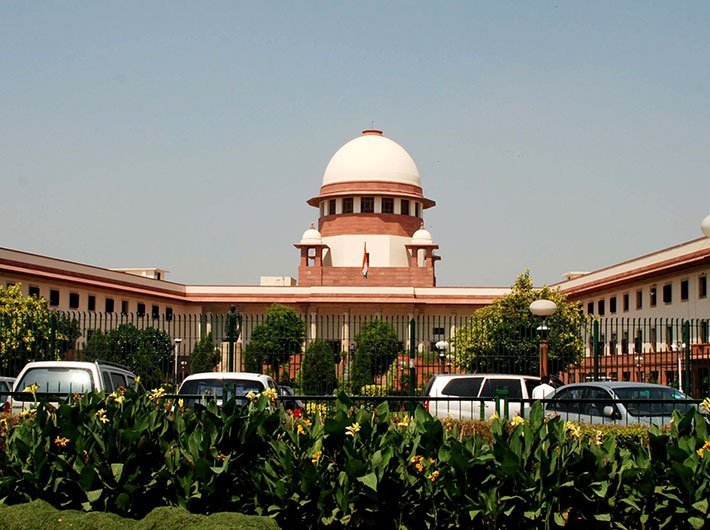
The strength of the Supreme Court is set to go up from 33 judges to 37 judges, paving the way for a more efficient and speedier justice.

The Union Cabinet on Tuesday approved the proposal for introducing The Supreme Court (Number of Judges) Amendment Bill, 2026 in Parliament to amend The Supreme Court (Number of Judges) Act, 1956 for increasing the number of Judges of the Supreme Court of India by 4 from the present 33 to 37 (excluding the Chief Justice of India). 

 
The increase in the number of Judges will allow the apex court to function more efficiently and effectively ensuring speedy justice. 
 
The expenditure on salary of Judges and supporting staff and other facilities will be met from the Consolidated Fund of India. 
 
Article 124 (1) in Constitution of India inter-alia provided “There shall be a Supreme Court of India consisting of a Chief Justice of India and, until Parliament by law prescribes a larger number, of not more than seven other Judges…”. 
 
An act to increase the Judge strength of the Supreme Court of India was enacted in 1956 vide The Supreme Court (Number of Judges) Act 1956. Section 2 of the Act provided for the maximum number of Judges (excluding the Chief Justice of India) to be 10.
 
The Judge strength of the Supreme Court of India was increased to 13 by The Supreme Court (Number of Judges) Amendment Act, 1960, and to 17 by The Supreme Court (Number of Judges) Amendment Act, 1977. The working strength of the Supreme Court of India was, however, restricted to 15 Judges by the Cabinet, excluding the Chief Justice of India, till the end of 1979, when the restriction was withdrawn at the request of the Chief Justice of India. 
 
The Supreme Court (Number of Judges) Amendment Act, 1986 further augmented the Judge strength of the Supreme Court of India, excluding the Chief Justice of India, from 17 to 25. Subsequently, The Supreme Court (Number of Judges) Amendment Act, 2008 further augmented the Judge strength of the Supreme Court of India from 25 to 30.       
 
The Judge strength of the Supreme Court of India was last increased from 30 to 33 (excluding the Chief Justice of India) by further amending the original act vide The Supreme Court (Number of Judges) Amendment Act, 2019.

Comments


Other News

Wisdom stories that don’t preach but encourage reflection

The Foundation Of A Fulfilling Life: Lessons from Indian Scriptures Deepam Chatterjee Aleph Books, 264 pages, Rs 899  

Citizens of the Bay: Why BIMSTEC matters now

The international order is drifting into a dangerous grey zone as the very powers that built today`s multilateral system begin to chip away at it. The United States has increasingly walked away from global rules and forums when they no longer suit its interests, while China has rushed to fill the vacuum on

PM salutes armed forces on one year of Operation Sindoor

Prime minister Narendra Modi on Thursday saluted the courage, precision and resolve of the armed forces on the completion of one year of Operation Sindoor.   The PM said that the armed forces had given a fitting response to those who dared to attack innocent Indians at Pahalgam.&

BJP set to capture West Bengal

The political map of the country is set to be redrawn with the BJP set to win the West Bengal assembly elections, apart from Assam and the union territory of Puducherry. In Kerala, meanwhile, the Congress-led UDF is set to regain power. The filmstar Vijay-led TVK has emerged as the front-runner in Tamil Na

Beyond LPG: Is PNG ready for India’s next cooking fuel transition?

India, the second-largest importer and consumer of LPG after China, faces growing pressure due to supply constraints. Most of India`s LPG imports transit through the Strait of Hormuz, a focal point of global turmoil. Given that LPG forms the backbone of household kitchens and the restaurant industry, any s

Maharashtra adopts hybrid model for Census 2026 data collection

The government has initiated preparations for Census 2026 in Maharashtra, introducing a hybrid approach that combines optional self-enumeration with comprehensive door-to-door data collection to ensure complete coverage across the state.   According to senior officials, the Self-


Archives

Current Issue

Opinion

Facebook Twitter Google Plus Linkedin Subscribe Newsletter

Twitter







