
Jaitley argues why Aadhaar is money bill

Finance minister reiterates ‘pith and substance’ argument in Rajya Sabha

GN Bureau | March 16, 2016

#money bill   #supreme court   #law   #parliament   #arun jaitley   #UIDAI   #Aadhaar   #economy  
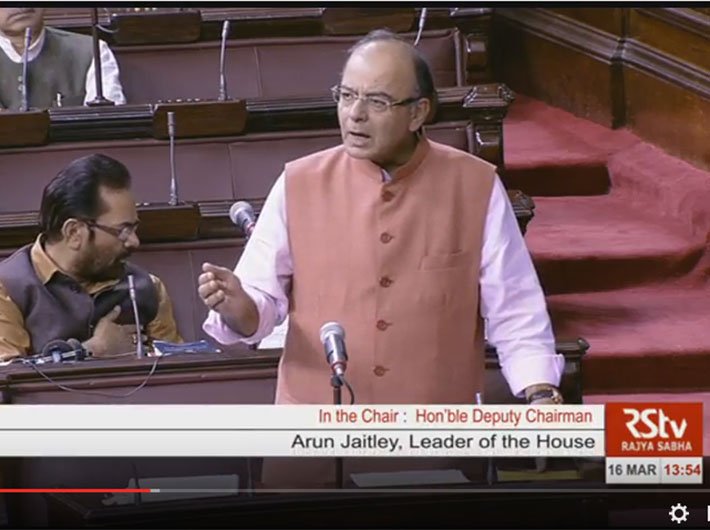
Finance minister Arun Jaitley in Rajya Sabha

 The Rajya Sabha witnessed the kind of debate it has not seen at least in recent decades as it took up for consideration the Aadhaar bill on Wednesday. Essentially, the opposition in the upper house was uncomfortable with the classification of the bill as a ‘money bill’ on which it will have no say.

 
That is why Sitaram Yechury of CPM repeatedly asked the chair if the bill was “introduced” in the house or “moved”, and deputy chairman PJ Kurien had to clarify that being a money bill, it was merely “transmitted” from the lower house.
 
 
The opposition asked finance minister Arun Jaitley to explain on what grounds it was termed a “money bill”. In reply, Jaitley went on to make a pitch for the bill – presenting salient points, giving full credit to the previous UPA regime for the conception of Aadhaar – but when pressed to clarify the classification, he repeated the argument he had made a fortnight ago in the lower house.
 
Jaitley maintained that in “pith and substance” the bill was about subsidies, hence related to the consolidated fund of India, and thus fully satisfying the criteria for a money bill laid down in Article 110 of the constitution. “Government money is spent on subsidies. You insist on the identity of the person (beneficiary) and this law is about how to identify that person.”
 
The constitution, however, uses the term ‘only’ – the bill has to be only and exclusively about the consolidated fund. Replying to that argument from the opposition, the finance minister cited the first Lok Sabha speaker, Ganesh Vasudev Mavalankar, who (Jaitley said) had ruled very clearly that the only law that would satisfy that criterion would be a single section law. In other words, Jaitley argued that any bill solely related to the matters concerning the consolidated fund of India would also have administrative machinery in it and that does not disqualify it as a money bill.
 
Jaitley compared the old UPA bill – about giving the legal backing to the UIDAI set up by an executive order – and the new Aadhaar bill. His argument was that the former was primarily about setting up an authority, and hence not a money bill per se, whereas the latter was essentially about plugging subsidy leakage and hence a money bill – even if it also has other provisions about privacy and other matters related to the process of saving subsidy.
 
He also added that going by the constitutional criteria it is the Lok Sabha speaker’s decision to call a legislation ‘money bill’ and “no authority of this land can challenge it”.
 

Comments


Other News

AI: Code, Control, Conquer

India today stands at a critical juncture in the area of artificial intelligence. While the country is among the fastest adopters of AI in the world, it remains heavily reliant on technologies developed elsewhere. This paradox, experts warn, cannot persist if India seeks technological sovereignty.

RBI pauses to assess inflation risks, policy transmission

The Reserve Bank of India (RBI) has begun the new fiscal year with a calibrated pause, keeping the repo rate unchanged at 5.25 per cent in its April Monetary Policy Committee (MPC) meeting. The decision, taken unanimously, reflects a shift from aggressive policy action to cautious observation after a signi

New pathways for tourism growth

Traditionally, India’s tourism policy has been based on three main components: the number of visitors, building tourist attractions and providing facilities for tourists. Due to the increase in climate-related issues and environmental destruction that occurred over previous years, policymakers have b

Is the US a superpower anymore?

On April 8, hours after warning that “a whole civilisation will die tonight,” US president Donald Trump, exhibiting his unique style of retreating from high-voltage brinkmanship, announced that he agreed to a two-week ceasefire with Iran. The weekend talks in Islamabad have failed and the futur

Machines communicate, humans connect

There is a moment every event professional knows—the kind that arrives without warning, usually an hour before the curtain rises. Months of meticulous planning are in place. And then comes the call: “We’ll also need a projector. For the slides.”   No email

Why India is entering a ‘stagflation lite’ phase

India’s macroeconomic narrative is quietly shifting—from a rare “Goldilocks” equilibrium of stable growth and contained inflation to a more fragile phase where external shocks are beginning to dominate domestic policy outcomes. The numbers still look reassuring at first glance: GDP


Archives

Current Issue

Opinion

Facebook Twitter Google Plus Linkedin Subscribe Newsletter

Twitter






