How AI is reshaping the world of strategic communication and partnerships and why the irreplaceable human touch will always steer the ship
There is a moment every event professional knows—the kind that arrives without warning, usually an hour before the curtain rises. Months of meticulous planning are in place. And then comes the call: “We’ll also need a projector. For the slides.”
No email trail. No prior mention. Just five words and a room full of expectation.
We have lived that moment. And what rescued the morning was not a scheduling tool, a CRM dashboard, or any generative Artificial Intelligence model. It was the quiet, unglamorous art of human communication: a calm call to the venue coordinator, a candid exchange with the technical team, and a reassuring conversation with the presenter. The projector arrived. The event went off without a hitch.
We recount this not as nostalgia, but as context because we are now living through a period when the tools of our profession are being fundamentally reimagined by AI, and the central question before every communications and partnership professional is this: what exactly is being reimagined, and what must remain unchanged?
At its core, communication is not an information problem. It is a relationship problem.
The Scale of Transformation
The scale of transformation is staggering. The global AI market, valued at $621 billion in 2024, is projected to reach $2.74 trillion by 2032. Nearly 97% of business leaders expect to increase AI spending. Even within communications, conversational AI is growing at over 23% annually, enabling real-time sentiment tracking, multilingual engagement, and predictive insights at a scale no human team could match.
These are not projections from speculative futurism. They represent decisions already being made in boardrooms, government communications departments, and NGO partnership cells across India and the world. AI-powered tools are already monitoring social platforms in real time, detecting shifts in public mood before a crisis festers. They are translating diplomatic communications across twelve languages simultaneously. They are analysing stakeholder sentiment at a scale no team of analysts could match.
For the communications and partnership professional, this represents not a threat, but an extraordinary amplifier.
The Paradox at the Heart of it All
But the story becomes more interesting when we move beyond the numbers. A 2026 study found that while practitioners rate AI’s importance highly, their confidence in using it effectively remains low. This is not merely a skills gap—it is a signal of something deeper. Strategic communication cannot be reduced to tools alone.
Because while AI excels at processing information, communication is ultimately about meaning, trust, and context.
When a Phone Call Changes Everything
Consider a second, quieter moment. A banking institution that had previously collaborated with us reached out again. In today’s world, this could have been a polished, data-rich email generated in minutes. Instead, the relationship manager picked up the phone.
Not to pitch. Not to negotiate. Simply to ask: “How has the year been?”
The conversation lasted twenty minutes. No agreements were signed. But when the formal email followed, it arrived not as a cold outreach—but as a continuation of a relationship. The partnership that followed was stronger for it.
No algorithm designed that moment. No system decided that a human voice was the right instrument. That was judgement—the quiet, cultivated intelligence that defines great partnership-building.
What AI Cannot Replicate: The EPOCH Framework
To understand this boundary more clearly, researchers have begun to map what AI still cannot replicate. The MIT Sloan EPOCH framework identifies five distinctly human capabilities: empathy, presence, judgement, creativity, and hope. These are not soft skills. They are strategic ones. Empathy is the ability to feel with another person, not merely model their preferences. Presence is the ability to read a room in real time. Judgement is values-driven decision-making in moments of uncertainty. Creativity is not recombination, but true originality. And hope is the ability to inspire others toward something that does not yet exist.
Human vs. AI: A Complementary Capabilities Map
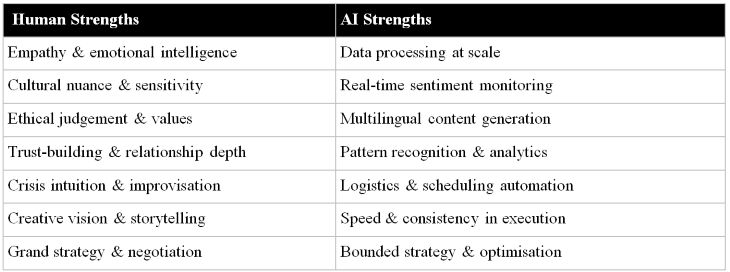
These are the capabilities that define world-class communicators.
The Risks of Getting This Balance Wrong
None of this is to romanticise the status quo or to suggest that AI's risks are negligible. The 2024 Ketchum Communications Trends Report warned explicitly of the dangers of misinformation, algorithmic bias, and the tendency of automated systems to misinterpret cultural context generating messaging that can feel, at best, impersonal, and at worst, offensive.
There is also a warier consumer on the other side of the screen. Research consistently shows growing resentment toward organisations that replace genuine human responsiveness with synthetic facsimiles. When a stakeholder reaches out in a moment of distress during a reputational crisis, a sensitive negotiation, or a moment of institutional uncertainty and receives back a chatbot's approximation of empathy, trust erodes. Sometimes irreversibly.
The lesson is not to avoid AI. It is to deploy it with the same deliberateness one would apply to any strategic instrument: knowing when it amplifies, and knowing when it diminishes.
"82% of employees crave more human connection as AI use grows. 83% believe AI will make uniquely human skills even more critical, not less." — Workday Research
The Way Forward: Augmented, Not Replaced
What the most effective organisations are discovering is a model of collaborative intelligence—where AI handles the repetitive, data-heavy, and analytical dimensions of work, while humans focus on what cannot be automated: building trust, exercising judgement, and shaping relationships.
This is particularly true in India. Here, partnerships are rarely transactional. They are built over conversations, introductions, shared context, and the memory of showing up when it mattered. In such an environment, the ability to read nuance and build trust is not an advantage—it is foundational.
Closing: The Staff and the General
There is a useful metaphor in strategic leadership circles: AI serves as the staff; humans remain the generals. The staff processes information, models scenarios, and optimises pathways. The generals decide what matters, what is worth pursuing, and how to bring people along.
The communicators and partnership professionals who will define this decade are not those who resist AI, nor those who surrender to it. They are the ones who use it as a force multiplier—while doubling down on what no machine has mastered: the ability to listen deeply, to respond with judgement, and to make another human being feel genuinely understood.
That projector got arranged not because a system found a solution. It got arranged because someone stayed calm, picked up the phone, and spoke—in the only language that has ever truly mattered.
Human to human.
Vishakha Sharma is Communications Executive, and Sonal Jain is Head: Communications and Partnerships, at Pahlé India Foundation.













