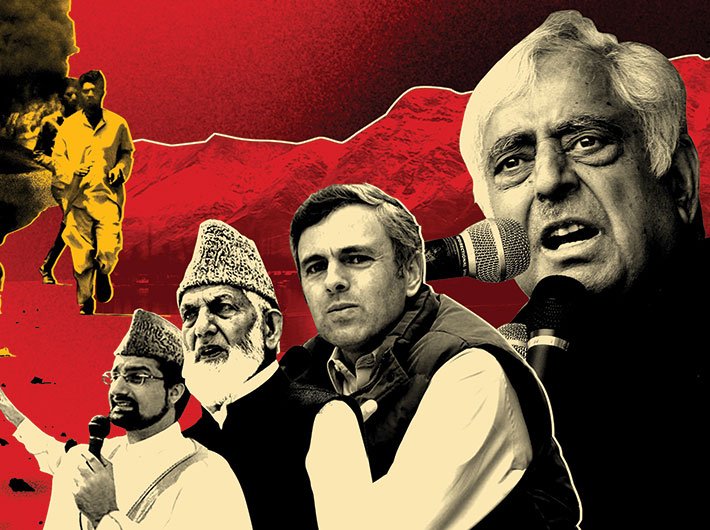
In Kashmir, people have been locked up for years for speaking up against India. This hypersensitivity is overdone
India cannot make up its mind: it grows fast sometimes, and slows down from time to time. Its growth rate has varied from 5 per cent a year in 1984-94 to 6.7 per cent a year in 1994-2000, 5.7 per cent in 2000-06 and 7.5 per cent in 2006-14. But whether India raced ahead or dawdled, Jammu and Kashmir always lagged behind. Its SDP growth rate was 2.9 per cent in the first period, 4.8 per cent in the second, 4.1 per cent in the third and 5.4 per cent in the last period.
In 1982-83, income per head of Jammu and Kashmir was 12 per cent higher than the Indian average; in 2013-14 it was two-thirds of India’s. I doubt if any other state has done worse. Only its name is three times as long as India’s.
Jammu and Kashmir has a new government. It is in alliance with the new government in Delhi, and consequently has more freedom of manoeuvre, which it has been using in innovative ways. The chief minister of Jammu and Kashmir caused a sensation when he thanked the Hurriyat, Pakistan and militants for allowing “a conducive atmosphere” for the elections – in other words, for not scaring people away from the voting booths. Patriotic Indians, to use a respectful term, found this offensive; in their view, thanks were due to the Indian soldiers who scared anti-Indians into passivity. Those gunmen were equally present during previous elections, but that did not induce the Kashmiris to vote. Nor could they prevent the terrorist acts after the recent elections.
Ubiquity of Indian soldiers would not have induced the Kashmiris to vote if they had not had prior assurance of the anti-Indians’ inactivity. I have no clue how it was done. But something occurred before the elections. The anti-Indians decided to change their tactics and let the people vote; they conveyed to the people of Kashmir through informal channels that they could go ahead and vote without fear of being shot or blown up. Perhaps, they encouraged people to vote. I doubt if our armed forces or intelligence agencies had any idea of this; at any rate, it did not leak out before the election. So patriotic Indians need to do some more thinking.
Should the chief minister have thanked anti-Indian forces? He felt understandably grateful that they let the people vote his party into power. He could have been diplomatic and conveyed his thanks through the informal channels that the anti-Indians used to encourage people to vote. The terrorist attack on the police station in Kathua might suggest that his thanks were premature. But the incident also perhaps carries the message that the anti-Indians have the freedom to strike when they choose, and that our armed forces have little control on law and order.
Patriotic Indians are unlikely to take this message on board: it is too humiliating. So Kashmir will continue in its state of ubiquitous presence of the Indian army and itinerant terrorism. But there is a small chance that patriotic Indians will cease to be obtuse, and read the message: that anti-Indian forces would like to reach a modus vivendi in which they can live a freer life in Kashmir even while Indian forces stay on. As of now, the Indian forces can pick up any Kashmiri, brand him terrorist, and lock him up indefinitely. Anti-Indians are sending the implicit message: allow us to be anti-Indian in thought and speech, and we will stop violent attacks on you Indians and your hangers-on. At any rate, that is the message that Mufti Muhammad Sayeed seems to have heard. He has said that all separatist leaders should be released, though he has hitherto hesitated to do so.
That message had not occurred to me. I did not know that people had been locked up for years for just saying, “Indians, go home.” That sort of thing used to happen when the British were occupying India; they locked up thousands, including my father and my brother, for asking them to leave. I thought that that kind of intolerance ended with our independence in 1947. I have, for example, expressed unkind views about the powers in Delhi. It never entered my mind that the government could jail me for it. Indira Gandhi imprisoned a lot of people just because she did not like them; but I thought that kind of oppression had ended with her defeat and repeal of Emergency. It has not. Indians can openly express many dissident views. But dissatisfaction with the way India is governed becomes treason, especially when expressed by people on the borders. I think this hypersensitivity is overdone; Indians should be free to abuse India if it is a real democracy. If we stop being so thin-skinned, we may learn something from the criticism that would make us a better people.
(The article appears the April 16-30, 2015, issue)