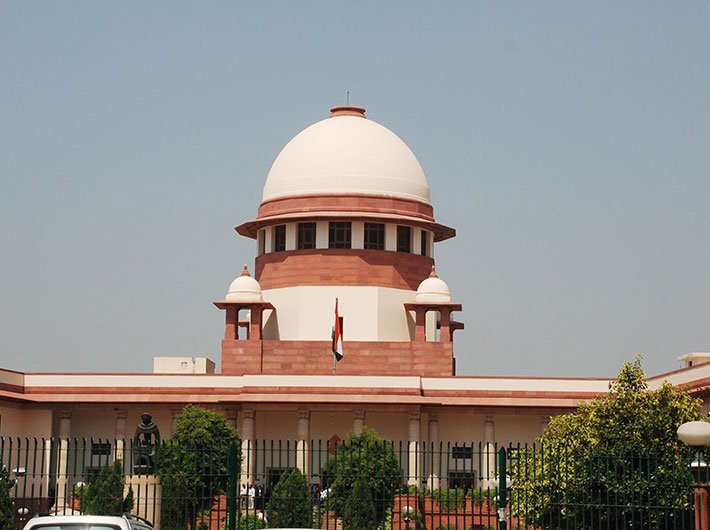
Judicial appointments bill: SC refuses to hear PILs

Bench calls petition "premature" but allows it to be filed 'on the same ground' later

deevakar

Deevakar Anand | August 25, 2014


The supreme court (SC) on Monday refused to accept a bunch of four PILs filed last week questioning the constitutional validity of the National Judicial Appointments Commission bill (NJAC), 2014 and the 121st amendment bill that would give it a constitutional standing.

The bill that seeks to scrap the three-decade-old collegium system of selection of judges of the apex court and the high courts (HC) has been passed by the lok sabha and the rajya sabha earlier this month and awaits the president’s nod.
 
A constitutional bench headed by justice AR Dave and comprising justices J Chelameswar and AK Sikri, which heard the PILs for over an hour said it could not accept the petitions “at this stage” as it was “premature” for them to interfere.

While this putts off an immediate confrontation on the issue, the court has left the door open for a hearing at a “later stage”.

"We are of the view that the petitions are premature. It is open for the petitioners to approach the court at a later stage on the same ground," the bench observed.

The PILs were filed by former additional solicitor general Bishwajit Bhattacharya, advocates RK Kapoor and Manohar Lal Sharma and supreme court advocates on record association (SCAORA) for declaring the NJAC as unconstitutional.

During the hearing, eminent SC lawyer Fali S Nariman argued before the court that the NJAC in its present form was not constitutionally valid as it erodes the independence of judiciary, and the parliament has passed the bill even before the 212st amendment has happened.

Attorney General Mukul Rohatgi counter-argued that the court cannot interfere as the bill and the constitutional amendment are in the legislative process right now.
One of the petitioners, ex-solicitor general Bishwajit Bhattacharya, however, said the court can interfere even at this stage and cited a 1978 reference.

Under the collegium system, in place since 1993, the SC judges have so far been selected by a panel comprising the CJI and four senior judges of the same court. In case of the high court judges, appointments are made after a collegium of the particular HC proposes the name, which then is cleared by a three member SC collegium headed by CJI. One of the other two judges in the panel should be associated with that particular HC in the past.

What the new system proposes is a six-member body consisting of the chief justice of India (CJI), two senior-most judges of the SC, union law minister, and two other eminent persons picked by a panel comprising the prime minister, leader of the opposition and the CJI. If any two of the members of the panel veto a selection, it will not go through.

The issue is likely to lead to a major standoff between the judiciary and the executive in the coming day.


Comments


Other News

RBI pauses to assess inflation risks, policy transmission

The Reserve Bank of India (RBI) has begun the new fiscal year with a calibrated pause, keeping the repo rate unchanged at 5.25 per cent in its April Monetary Policy Committee (MPC) meeting. The decision, taken unanimously, reflects a shift from aggressive policy action to cautious observation after a signi

New pathways for tourism growth

Traditionally, India’s tourism policy has been based on three main components: the number of visitors, building tourist attractions and providing facilities for tourists. Due to the increase in climate-related issues and environmental destruction that occurred over previous years, policymakers have b

Is the US a superpower anymore?

On April 8, hours after warning that “a whole civilisation will die tonight,” US president Donald Trump, exhibiting his unique style of retreating from high-voltage brinkmanship, announced that he agreed to a two-week ceasefire with Iran. The weekend talks in Islamabad have failed and the futur

Machines communicate, humans connect

There is a moment every event professional knows—the kind that arrives without warning, usually an hour before the curtain rises. Months of meticulous planning are in place. And then comes the call: “We’ll also need a projector. For the slides.”   No email

Why India is entering a ‘stagflation lite’ phase

India’s macroeconomic narrative is quietly shifting—from a rare “Goldilocks” equilibrium of stable growth and contained inflation to a more fragile phase where external shocks are beginning to dominate domestic policy outcomes. The numbers still look reassuring at first glance: GDP

Labour law in India: A decade of transition

The story of labour law in India is not just about laws and codes, but also about how the nation has continued to negotiate the position of the workforce within its economic framework. The implementation of the Labour Codes across the country in November 2025 marks a definitive endpoint in the process. Yet


Archives

Current Issue

Opinion

Facebook Twitter Google Plus Linkedin Subscribe Newsletter

Twitter