
Kejriwal’s AAP creates history in capital – again

Political startup trounces BJP, repeats record seats and vote share after 2015

GN Bureau | February 11, 2020

#CAA   #Congress   #BJP   #Amit Shah   #Narendra Modi   #AAP   #Aam Aadmi Pary   #Arvind Kejriwal   #election   #Delhi   #NRC   #assembly  
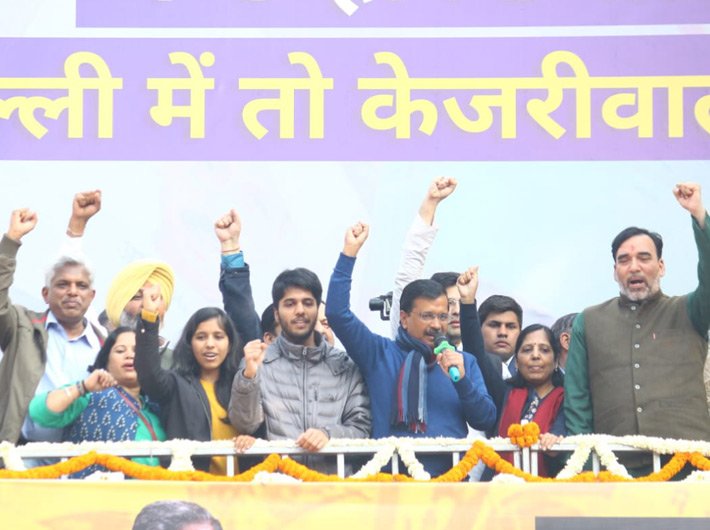
Delhi chief minister Arvind Kejriwal addresses supporters on Tuesday evening. (Photo courtesy @AamAadmiParty)

The Aam Aadmi Party (AAP) led by Arvind Kejriwal rewrote the political playbook of the country, by repeating the stunning performance of 2015, as it won 62 of the 70 seats in Delhi assembly, leaving the mighty BJP in single digits again in spite of the latter’s high-decibel, carpet-bombing campaign amid the polarizing CAA-NRC debate.

Kejriwal’s party performed a tad below the last time, when it had secured 67 seats and 56 percent vote share when Narendra Modi had newly become prime minister and his popularity was quite high. Still, garnering more than half the votes and sweeping nearly all seats is an incredible performance in Indian electoral history. Doing so twice hints at a new model of politics.

If it’s a new model, its cornerstone is literally Aam Aadmi, the common man, as the AAP focused relentlessly on improving health and education infrastructure and making these crucial services accessible to the lower middle class. In the run-up to the polls, he added freebies like subsidy for electricity and free city bus rides for women.

Surprisingly, the same party had fared badly in the May 2019 Lok Sabha elections, coming even third in some constituencies, after the Congress – which drew a blank again. That too should be surprising as the grand old party ruled Delhi for three consecutive terms from 1998, under Sheila Dikshit who passed away last year.

The BJP had relied heavily on the popularity of its national leadership and high-profile leaders like Uttar Pradesh chief minister Yogi Adityanath, whereas its local leadership, especially state unit president Manoj Tiwari, failed to connect with the local voters.

The elections were held amid strong opinions, for and against, the Citizenship Amendment Act (CAA) and the proposed National Register of Citizens (NRC), on which the BJP banked too heavily. The outcome may trigger a rethink or at any rate a calibration in the ruling party’s strategy.

Comments


Other News

New pathways for tourism growth

Traditionally, India’s tourism policy has been based on three main components: the number of visitors, building tourist attractions and providing facilities for tourists. Due to the increase in climate-related issues and environmental destruction that occurred over previous years, policymakers have b

Is the US a superpower anymore?

On April 8, hours after warning that “a whole civilisation will die tonight,” US president Donald Trump, exhibiting his unique style of retreating from high-voltage brinkmanship, announced that he agreed to a two-week ceasefire with Iran. The weekend talks in Islamabad have failed and the futur

Machines communicate, humans connect

There is a moment every event professional knows—the kind that arrives without warning, usually an hour before the curtain rises. Months of meticulous planning are in place. And then comes the call: “We’ll also need a projector. For the slides.”   No email

Why India is entering a ‘stagflation lite’ phase

India’s macroeconomic narrative is quietly shifting—from a rare “Goldilocks” equilibrium of stable growth and contained inflation to a more fragile phase where external shocks are beginning to dominate domestic policy outcomes. The numbers still look reassuring at first glance: GDP

Labour law in India: A decade of transition

The story of labour law in India is not just about laws and codes, but also about how the nation has continued to negotiate the position of the workforce within its economic framework. The implementation of the Labour Codes across the country in November 2025 marks a definitive endpoint in the process. Yet

Time for India to build genuine resilience in energy security

There is a strip of water barely 33 kilometres wide between Iran and Oman that connects the Persian Gulf to the rest of the world`s oceans. For most of India`s history, it was a distant geographic fact. Since late February, it has been a kitchen problem.   The Strait of Hormuz. T


Archives

Current Issue

Opinion

Facebook Twitter Google Plus Linkedin Subscribe Newsletter

Twitter






