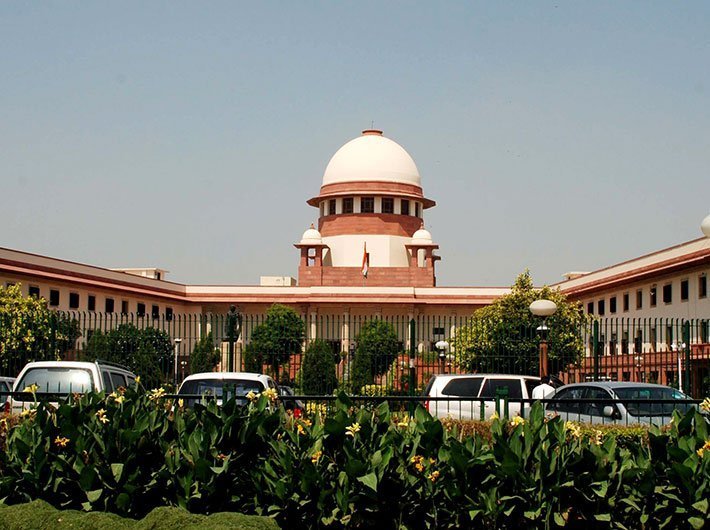
Justice delayed is justice denied. That is what William British prime minister Ewart Gladstone said two centuries ago. It remains relevant in India today. This principle is held in high regard and focuses on the right to a speedy trial by expediting the legal system, but the Indian judiciary is going through a heavy logjam. Swift justice appears elusive. The problem of a logjam of cases in the Indian judicial system is acute and chronic.
Millions of cases pending before the judiciary defeat the very purpose of the institution. It would be surprising to know that there are about 73,000 cases pending before the Supreme Court of India and some of them have been pending for close to half a century. Nearly 76 percent of India’s prison population is made up of undertrials, according to a January 2022 report. Is it the slow process of justice or the requirement of revamping the Civil Procedure Code (CPC) which is weakening the principle of justice?
The latest edition of ‘Checks and Balances’, an online discussion with experts on governance challenges hosted by Sweta Ranjan, focuses on the judicial lockdown.
[You can watch this and previous episodes of Checks and Balances here: https://www.youtube.com/channel/UC-fTSP7yn4ZTD9EAHDCqq3Q]
During the discussion, Ramakant Sharma, chairman, Bihar State Bar Council, said, “There are multiple concerns. The infrastructure has not increased in accordance with the growth of population. The reason for backlog and pendency of the cases is shortage of judges. There is an acute shortage of judicial officers in the lower judiciary. There is no remedy for civil matters. It is so delayed that if a person files a suit, his next generation will get the result.”
Nivedita Nirvikar, a senior advocate who has been appointed by the Patna high court on several occasions as advocate commissioner, firmly believes that filling up the infrastructure gap is the key to getting rid of the backlog. She said that the poor planning of the resources and unprofessional attitude in the appointment of judges has led to this situation. She said, “In the lower Judiciary there are 6,000 posts vacant, in the higher judiciary 400 – even in the Supreme Court four positions are vacant. Initially, according to our database, 50 judges were required for a population of one million whereas we have only 20 judges. In the Allahabad High Court, there is a vacancy of 160 judges. There is a requirement for the evolution of a system.”
In 2018 India's central planning body the NITI Aayog released the data on the pending cases. It said that with the current pace of clearing the case it will take 324 years to clear the backlog – that too, if new cases are not filed. To curb this problem, 1,734 fast-track courts were set up in 2000 for delivering speedy justice. But it failed to deliver desirable results.
Anurag Kumar, former Assistant Solicitor General of India and senior advocate with the apex court, said that the fast-track courts deliver timely results and can fill the gap. He said, “During the corona pandemic we have worked virtually. Setting up a system of virtual hearing may help in clearing the backlog sooner.”
While the sluggish pace of justice is one problem, another is the problem of undertrial inmates. Two years ago, a report suggested that more than 1,200 undertrials had already served half of the punishment by being in jail their alleged offences qualified them for. What is more tragic is that 49 percent of these undertrials fall in the age bracket of 18-30 years. When will the young men and women undertrial inmates languishing in jails see the light of the day? They are behind bars, waiting for justice, and the court is yet to pronounce them guilty.
To fix the abysmal delivery of justice, Ramakant Sharma said there is a need to reform the colonial-era CPC which is still being followed. Like the police reform there is a need to start the talk on this as well. He said, “Besides resolving issues like appointment of judges, lack of judicial officials and poor physical infrastructure there is a dire need to revamp the entire CPC.”