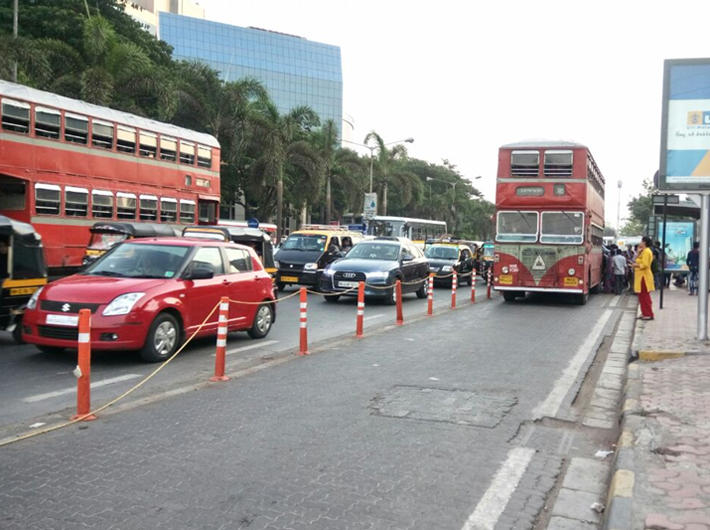
Authorities urged to get data to measure if projects will reduce traffic congestion
With infrastructure projects worth over Rs 75,000 crore slated to be commissioned in 2024, Mumbai Mobility Forum (MMF), a think tank consisting of transport and urban planners, architects, economists, engineers and civic activists in the city, has written to the authorities of MMRDA, MCGM, GM’s of Western and Central Railways , BEST, Mumbai Police Commissioner, chief minister and deputy chief minister calling for a study of traffic counts on city roads.
In 2024, Mumbai is expected to see opening of projects including Metro 3, Coastal Road, MTHL, including its extended arm up to Worli and 5th and 6th track between Khar and Borivali by Western Railways.
The think tank working towards improving transport infrastructure in Mumbai has been asking the implementing authorities to conduct a statistical study which will provide the authorities an accurate measure these projects will have in reducing traffic congestion and ease of mobility for people using different modes of transport.
The survey would include videographed traffic counts during peak hours on the city’s 8-10 most crowded roads three times on a working day across eastern and western highways. The survey will be conducted exactly at the same time and period before and after commissioning of the projects to see if the average speed of vehicles of cars, buses, trucks and two wheelers has gone up from 10 km to 15 km.
Transport analyst and economist Ashok Datar of MMF said that four large projects, some of which costing over Rs 20 000 crore each, initiated about 7 to 8 years ago to improve mobility in Mumbai, are now ready for implementation. Some of these projects totalling Rs 70,000 crore are expected to be commissioned in next 6-8 months, a rare occasion when so much infrastructure is available in a single year.
“What is going to be impact of these projects on daily commute and overall mobility and whether it reduces any traffic congestion through mathematically proven manner? We proposed a study for Mumbai as a whole through traffic counts on highly congested 10 roads before the start of these projects and an identical study six months after completion of all projects. We feel this method is a reliable and accurate measure of impact of these projects in reducing traffic congestion and ease of mobility to all people using various modes. In view of many such projects on a grand scale being taken all over India, such timely studies are invaluable. This can be a pilot for other cities,” said Datar.
A few week ago MMRDA had appealed through the media calling for opinions of experts and consultants on how to overcome acute traffic congestion in the BKC area. “In response to this we at MESN (Mumbai Environmental Social Network) submitted a report on a highly successful exclusive bus lane that was conducted instantly as successful pilot in 2016. For this we conducted statistical analysis of vehicle throughput, speed and passenger throughput by buses and cars in remaining lanes on a ‘before and after basis’ providing a statistically reliable and precise data,” said Trupti Amritwar Vaitla, trustee, MESN.
“We believe that with investments for Mumbai fructifying in 2024, it deserves a measure to quantify the impact of these large investments now rather than wait till it is too late. Hence it is a unique opportunity to study statistically ‘before and after impact’ now followed by another after stabilising of these projects. We approached all the senior government officials and ministers concerned for this reliable low cost and with quantitative measurements of the impact of such large projects so that we can learn to improve the design of such projects in the future,” added Datar.
He further noted that advertisements and hoardings by the highway authorities proclaiming the Mumbai–Delhi commute in 10 hours or Mumbai-Nagpur in 5 hours considers a driving speed of 150 kms per hour, which is unsafe.
Ajit V Shenoy, another forum member, said that buses and local trains are the affordable mediums for most people. Today BEST has 1,200 buses of its own and 1,600 buses are wet leased. “Instead of upgrading, the number of BEST buses has come down. When we delved deeper we saw BEST does not have a proper plan. We have been for undertaking to be headed by a technocrat for 6-7 years and not by an IAS officer for 3 years as is the case at present.”
He added that in 1947, roads were carrying 18% passenger share and Railways was carrying 80% share. Now it is totally opposite. Rather than increasing the number of tracks it is better to increase speed of trains to 180-200 km.
The forum suggested that along with having a Pedestrian Planning Cell in BMC, a study on pedestrian flow in different areas to provide facilities needs to be conducted in Mumbai. Shenoy noted that cars are allowed 130-180 seconds to pass at signals, while pedestrians have to pass in mere 10 seconds.
Shenoy also said MMRDA needs to develop satellite towns to decongest Mumbai and also use information technology. “Today a person living in Badlapur has to come all the way to Mumbai to attend court. That should not be the case.”
Architect Pranav Naik said that BMC has never spent any money on footpaths and funds have only come from private sector and designed as per their preferences. He said project viability is not being considered.
He said that more 50% of all road accidents involve pedestrians for whom footpaths are not there. He said that for the last 10 years they have been asking BMC to provide Rs 2,000 crore every year for 5 years to lay footpaths all across the city, but there is no response.
Naik, who commutes to work on bicycle, said that there are no routes for the rising number of bicycles because our lawmakers feels bicycles are only for children. “Bicycle routes are circular, made only for children to ride and only 300-350 long. The original coastal road plan had 500 metre circles on the route. There is not continuous path to travel by bicycle.” He called for having segregated or protected cycle lanes.