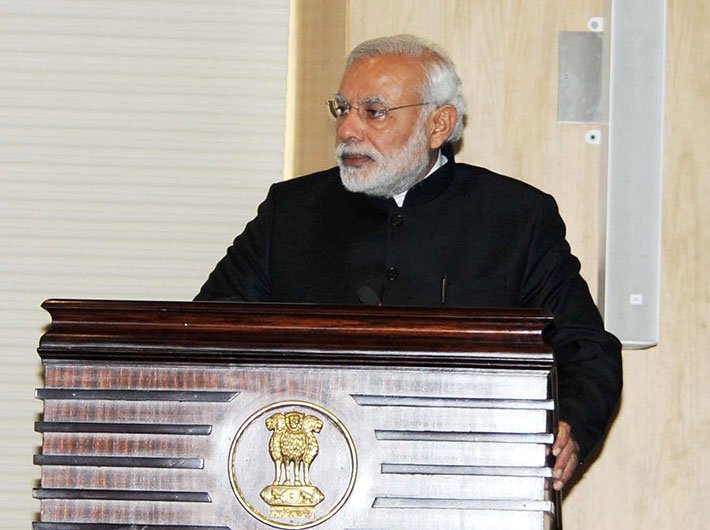
Silence is a weapon whose efficacy can only be realised in the battleground of ethics and morality. It proves highly ineffective or even counterproductive when used as a substitute for chicanery. Nobody knows it better than prime minister Narendra Modi who used this weapon most potently as the chief minister of Gujarat. He played the victim and kept silent when harangued by the UPA government on various cooked-up and flimsy charges. Modi’s silence was perceived to be a weapon of a morally superior warrior caught in the labyrinth of deceit and falsehood created by his immoral adversaries.
The context, however, has drastically altered since he took over as the prime minister. He can no longer play the victim. And he can use silence as an evasive tactic to his own detriment. In the past two months, Modi has spoken on a number of issues except those that grossly undermined his credibility and moral standing.
It is nobody’s case that Lalit Modi’s liaison with either Sushma Swaraj or Vasundhara Raje deserves to be treated as a national crisis. Nevertheless, it is a moral crisis which needs to be addressed urgently and effectively. A national crisis can be deferred and used to make the nationhood more coherent as Greece has successfully demonstrated. But a moral crisis corrodes the spirit of the nation and injects cynicism among people.
It would be wrong to treat the Lalit Modi episode as an aberration and the media’s conduct as TV anchors-driven megalomania. The crisis seems all pervasive in governance. The BJP governments in Madhya Pradesh, Chhattisgarh, Rajasthan and Maharashtra are mired in serious controversies. The charges of collusive collaboration of the chief ministers of these states with racketeers cannot simply be wished away. The mysterious deaths of those linked with the Vyapam scandal in Madhya Pradesh will continue to haunt Modi till the issue is credibly settled.
On the other hand, there seems to be a crisis at the centre where different organs of the government are working at cross-purposes. The trust deficit between the home ministry and the information and broadcasting ministry has spiralled into a serious crisis leading to the denial of permission to the Maran-owned Sun TV channels. That it led to a situation where the attorney general indicted the home ministry in the supreme court for indiscretion tells a tale of evident drift in governance.
This trust deficit is not limited to an isolated instance but forms a pattern. We heard of ‘Jayanthi tax’ – a word coined by Modi to connote insidious corruption creeping into clearance of projects by the then UPA environment minister Jayanthi Natarajan. As of now, environment minister Prakash Javadekar has been withholding clearance of projects across the national capital region for reasons best known to him. The methods are not dissimilar to those practised by the UPA.
The delay in appointments of the heads of crucial PSUs and nationalised banks, and the cold war between the finance ministry and the RBI are clear signs of a government that is losing the political narrative woven by the BJP in the pre-election phase. The government seems to be frantically battling on many fronts and squandering away its trust and credibility. In such a situation, Modi’s silence would assume the eloquence of a deafening din.
Modi has often been liberally referring to Mahatma Gandhi in his political projects. It would be prudent if he learns how Gandhi used silence as an effective weapon against the mighty British empire. His silence was spiritually nourishing and deployed against incredibly powerful, immoral and deceitful enemies; but never against his own people.
[email protected]
(The article appears as the opening comment in July 16-31, 2015 issue)