Is banning ‘sardar jokes’ a waste of time or a necessity to stop ethnic stereotypes?
Harvinder Kaur Chowdhury, a single mother and government lawyer, is waging a battle against seemingly innocuous ‘sardar jokes’. At one time, she used to be tolerant towards people making her community a butt of their jokes. But after her husband’s death 26 years ago, her tolerance had touched the limit; she had turned to protesting against such humour. Her staunch attitude against such jokes would gather insensitive remarks from some people who would say, “Sardarni pagal ho gayi hai (Sardarni has gone mad)”.
Those who faced her wrath for cracking a sardar joke on her would invariably end up branding her as a cantankerous woman. “My hands were full. I had to juggle between bringing up children and a competitive profession. I was already overworked and these jokes only made it worse for me.”
Being a single parent, at times she would pick up her kids from school and, to save time, bring them along to the court. Some of her apparently insensitive colleagues would again make fun of her. “They would use this [bringing children] to crack yet another sardar joke, and say ‘Iske toh barah baj gaye hai, tabhi layi hai bachey yahan’.”
Fed up of insensitive people around her, many a time Harvinder wrote to the judicial authorities about it. She also tried to sensitise those with whom she came in contact daily. However, nothing changed. When her son started complaining of harassment at school for being a Sikh, she felt that it was time for concrete action. “He would refuse to eat food, cry all day and make excuses to avoid school,” she says.
“I started an online forum early last year seeking ban on such jokes which were causing harassment to Sikhs. Many Sikhs responded and also shared their experiences,” she says. Based on the feedback, she filed a petition before the supreme court on August 22 last year.
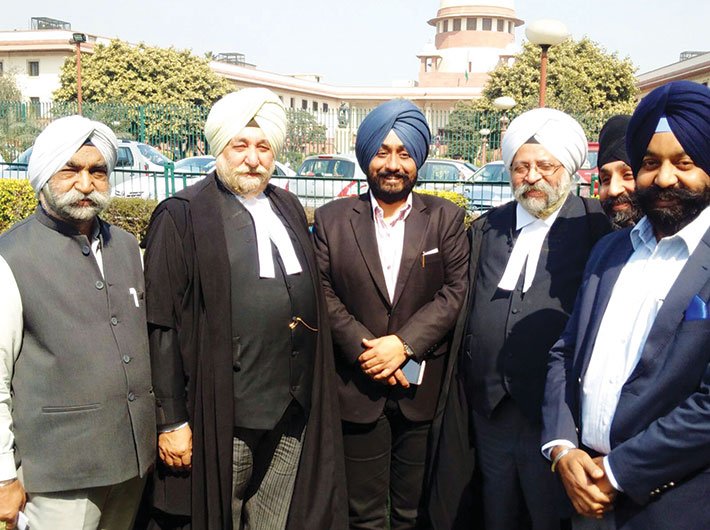
Harvinder’s petition triggered a nationwide campaign against harassment in the name of humour. It also started a debate with many arguing that Sikhs should take these jokes in their stride while others sought a ban. The Delhi Sikh Gurdwara Management Committee (DSGMC), which is an autonomous organisation managing gurdwaras in the national capital, and also runs hospitals, old-age homes and colleges, has supported the supreme court petition.
“Distasteful jokes that hurt a community and portray a picture of Sikhs being stupid have to stop. You cannot crack jokes on a person belonging to an SC or ST community because that will land you in jail. You can’t even make fun of Muslims like that. Can you? It is the fear of law that we want to create in people. They cannot get away with hurting our sentiments and culture,” says DSGMC’s legal advisor Jaswinder Singh Jolly.
Jolly claims that the advent of the internet has made situation worse: today there are about 5,000 websites that are making money in the name of ‘Santa Banta’ jokes.
Papalpreet Singh, general secretary of the Sikh Youth Front, also supports the ban. He says, “Some insults affect you physically and some your soul. These community-specific jokes that are forwarded via Facebook, WhatsApp and other social media networks have left no stone unturned in torturing Sikhs mentally.”
He alleges that websites like santabanta.com have played havoc with the community’s sentiments. ‘Santa Banta’ refers to two fictitious Sikh characters in most popular ‘sardar’ jokes on the internet.
“There are obscene jokes in the name of ‘Santa Banta’ too. Why can’t they use any other names? Why does it always have to be a sardar?” Singh asks.
Going a step further, some people are now also objecting to the portrayal of Sikhs in Bollywood. Parbinder Singh Chandok, president of a Mumbai-based NGO called Sikh Brotherhood International, had raised objection to a scene from the film Shabd released in 2005. In this scene, the lead actor of the film was trying to cheer up an upset actress by saying, ‘There was once a sardar.’ This made the actress burst into laughter. The organisation took strong objection to it and finally the producers Pritish Nandy Communications Limited had to delete the scene from the film and also issue a written apology to the community.
Chandok says that people have to start thinking about why so many young Sikhs prefer to cut their hair and remove their turbans – the apparent signs of their identity – than continue to face harassment in the name of humour.
“Kids try to initially ignore these jokes but, after all, they are kids; how much can they handle? At least, if there is a law, our kids will be spared,” says Chandok.
Advocate Jolly claims that in some rare cases Sikh children who are bullied in schools because of their identity have taken the extreme step of ending their lives.
In the first hearing on the petition on October 30, the apex court asked the DSGMC to prepare by March 31 draft guidelines for the proposed ban on Sikh jokes – it surely came as a shot in the arm for the community. The DSGMC’s special committee dealing with the issue has sought public opinion on the draft which can be sent to [email protected].
Asked if the ban seems feasible, Jolly says, “We are proposing (in the draft) a watch-out committee in educational institutions to check such activities and also guide students on difference between humour that makes everyone laugh and the one that makes some people laugh but hurts others.”
He however says the proposed ban, in no way, demands sending people to jail for cracking a joke. “We only want a law that will help people who face harassment in the name of humour,” he explains.
It’s ironic that the sardar jokes owe their origin to the tales of bravery of the Sikh community who were fighting the British in pre-independent India. For example, the so-called 12 o’clock jokes so commonly cracked on Sikhs, have their origin in an era when Nadir Shah had invaded India, plundered its rich temples and killed thousands of Sikhs and Hindus and taken many women as slaves. Parminder Pal Singh, DSGMC spokesperson, says the Sikhs decided to attack Nadir Shah’s camp to free the captives. “But since they were outnumbered by his huge army, they decided to attack his camp only in the night at around 12 o’clock and free as many women as possible. This is how they saved many lives and also the dignity of the women. The story makes the entire Sikh community proud even today but it has now become a joke for many, making us look like fools.”
READ INTERVIEW: THE ORIGINAL SANTA-BANTA SPEAK OUT
In the past too, the Sikh community had expressed its anger on the jokes. In 2007, the Lucknow Gurdwara Prabandhak Committee had lodged a complaint against a top businessman for disseminating Sikh jokes through his firm’s mobile internet services. The same year a bookseller was arrested in Mumbai for selling Sikh joke books.
The Sikh community’s petition has put ‘ethnic’ humour under lens. The sardar jokes may be the oldest ones but with the explosion of social media, the virtual world is agog with jokes about many linguistic, regional and religious communities. Internet users share innumerable jokes about stereotyped Bengalis, Tamils, Keralis and Biharis.
Censorship on humour?
A section of commentators feel that much is made out of a little joke, and this kind of humour is not meant to be taken seriously. For example, the new-generation stand-up comedians feel that a ban on sardar jokes will eventually lead to censorship on humour at large.
Stand-up comedian Jerin Ephrem, says, “When I think of a joke for my audience, I don’t think about who I am going to offend. I only think if it’s funny or not. If sardars want a ban on such jokes, then tomorrow some other community will also ask for the same. Kids are sensitive and I agree in schools there should be a system to keep a check on such behaviour so that little ones are not hurt. But as adults, one should take such jokes in stride. Indians need to relax a little.”
However, his friend Bhavneet Singh, also a stand-up comedian, says he supports the call for ban on sardar jokes. “I think it is long overdue. Being a sardar, I know the ban is somewhere necessary as I have myself faced hell during school days, but as a comedian, I feel that if a law is made, then it should not be misused. Tomorrow people should not be put behind bars just for sharing a light-hearted joke without any ill intentions.”
[email protected]
(This article appears in April 1-15, 2016 issue)