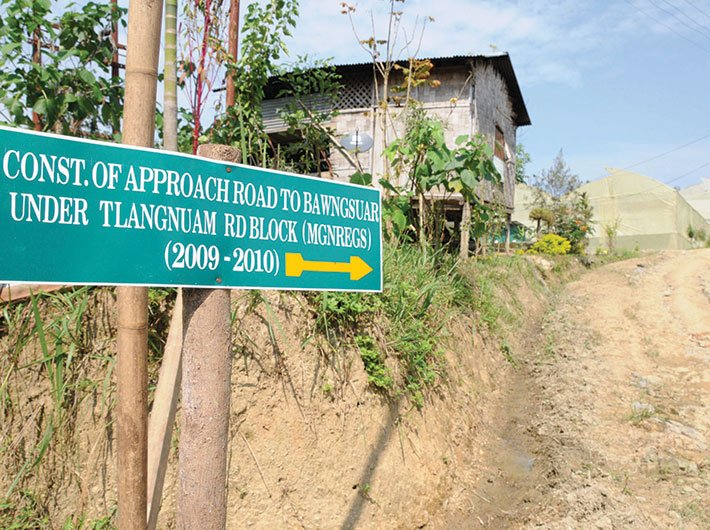
Though budget has reaffirmed govt’s faith in it, the scheme is riddled with multiple challenges
A law which is supposed to make work on demand a basic right for citizens has been faltering ever since it came into effect a decade ago. And as it enters its 11th year, it faces more than ever the possibility of being turned into a cash transfer scheme.
In the budget this year, the allocation for the National Rural Employment Guarantee Act (NREGA) matches the revised allocation of 2016-17, and thus appears to reaffirm the government’s faith in the scheme. However, the budget and the Economic Survey also talk about the possible introduction of a universal basic income (UBI), and of doing away with inefficient subsidies and welfare schemes. That can spell trouble for schemes like MGNREGS.
Indeed, too many things are wrong with the scheme, making it vulnerable to possible reforms that may change its very essence.
The Act guarantees 100 days of work per year for any able person who demands it. But it has never achieved an average number of workdays per household beyond 55. And at present it is struggling to achieve an average of a mere 40 days per household even in a year when demonetisation has sent thousands of surplus labour back to the villages looking for paid labour.
There are different views on what is wrong with this law-cum-programme. They range from lack of funds to absence of relevant work and asset creation. It has even been criticised as a deterrent to farming, as it draws people away to ‘paid laziness’.
Activist Aruna Roy feels that the scheme is being starved of funds and being prevented from delivering the goods. The evidence cited is: the latest budget allocation of Rs 47,000 crore is a mere 1 percent (Rs 500 crore) increase over last year’s.
Second, even last year the scheme was struggling for funds and had a huge hole of liabilities which the new budget does nothing to fill. As of today, 22 out of 34 states/UTs have negative balances amounting to liabilities of Rs 3,469 crore.
Again, the states have approved budgets for February and March which would require Rs 10,013 crore (at the average cost per person day of Rs 228). The new budget does not provide funds for any of these.
Funds are important if this scheme is to work, says Roy. In a post-budget statement she said: “Regardless of the budget allocation, what needs to be understood is that for the MGNREGS to work as per the legislation, it needs to have adequate resources to be made available for work to be provided on demand.”
The reason is that if people are provided work then payments cannot be delayed. For unpaid labour would be a bigger injustice than unemployment. At present 54 percent of the wage payments continue to be delayed, and as a result Rs 231 crore of compensation to workers also remains due.
Economist and former planning commission advisor Santosh Mehrotra says that the present allocation is certainly an improvement on the earlier year’s budgetary allocation of Rs 34,699 crore. It was revised later by over Rs 12,000 crore. But it is a good thing that this year the budget estimate (BE) matches last year’s revised estimate (RE). Now, if there are any deficits, these might be taken care of in the RE this year, he says striking an optimistic tone.
But fund crunch is not the only thing that is worrying about MGNREGS.
Says KS Gopal, activist and founding member of Deccan Development Society: “In recent years my focus on MGNREGS is more on the type and value of assets created rather than budget. This is because over Rs 2,50,000 crore have been spent over the past decade and one has only stories and not data on what it was used for and how it helped the farmer or the rural community. It is the only free money that is sought for all things sundry. It is also frustrating to see that employment provisioning is based on government whim rather than the period when workers want MGNREGS.
“I wouldn’t say it is corruption but it definitely is recklessness. Without assessment any investment is questionable,” says Gopal.
While condemning the way the scheme is being run, he and many other MGNREGS sympathisers are against exchanging it with cash transfer.
“Cash transfer is sought as it is easy to centrally implement, meet the Keynesian goal and do the partial implementation of what MGNREGS supposedly aims to,’’ he says.
The reason why he opposes it is that it would be like throwing the baby with the bathwater.
“Any intervention creates a societal dynamic and this is important to people. In my view, the single biggest contribution of MGNREGS was that it dramatically raised market wages of women. In fact, they earned more from it than from MGNREGS. It is because of this factor that kulaks [landowners] opposed MGNREGS. Of course, some assets were created but if this was done well and not ad hoc it would have a multiplier effect and be of value to poor people. Another scheme, the mid-day meal, helps children to eat together breaking caste barriers. In cash transfer none of these more crucial societal gains will accrue,’’ says Gopal.
On universal basic income he says: “The world seeks universal basic pay because of joblessness and due to growing economic inequity and democratic pulls. In a poor country like India dividing the tax money to be paid as cash transfer will have no societal gain and may even be negative. We need development and hence every revenue expenditure should lead to capital gains, productive natural resources, and this will have a cascading multiplier effect on society and help people to gain from both government and market opportunities as the latter is more real, large and sustainable.
“So when examining MGNREGS versus cash transfer we need to understand whose criteria we are meeting and which one has dividends beyond the scheme. Schemes should help people become self-dependent and not dependent,’’ says Gopal.
But can MGNREGS be retained in its present form – delayed wages, no data on assets, no long term impact of work – as a right to work law and preventedfrom becoming a right to income law?
In Kerala where there is not much scope for physical labour, MGNREGS funds were used innovatively to create a lasting income source. This was done initially by a block panchayat in Wadakkancherry in Thrissur district. The panchayat used the funds and some rural ministry funds to set up a labour bank that offered farming machines as well as workers besides farming services like sowing, harvesting to farmers round-the-year. This meant round-the-year income for the bank and round-the-year wages for the workers.
Anoop Kishore, deputy president of the Wadakkancherry municipality and the brain behind this project which has now been embraced across the state, says that his ultimate goal was to get monthly salaries for the workers. These are workers who demand work under NREGA and become members of the bank.
This kind of cooperative mode of functioning under MGNREGS is a model that could save a lot of workers from exploitation even as local-level planning ensured that assets that were created became sources of future income.
Giving cash is an easier option than ensuring creation of meaningful assets, creation of workers groups, labour banks and payment of wages on time. It is also a more convenient option than motivating local panchayats and NGOs to come up with plans that will meet long-term development goals of the area.
It takes a lot of courage to take the tough option. One has to wait and see which option the government will go for. n
Menon is a freelance journalist.
(The article appears in the March 16-31, 2017 issue of Governance Now)