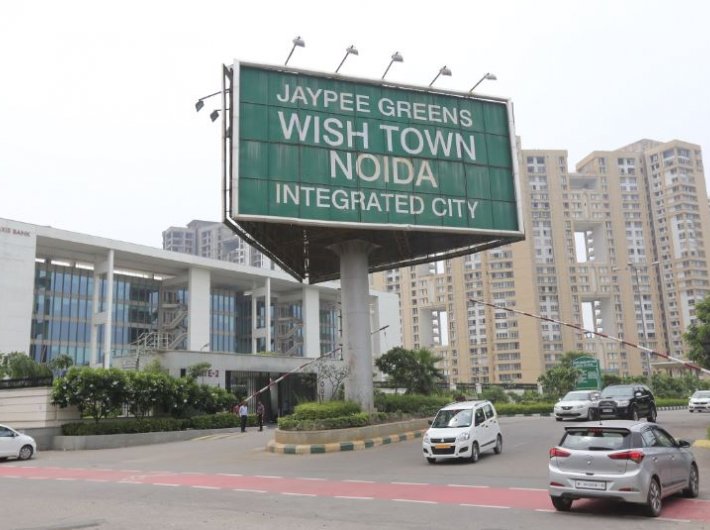
Some builders in Noida and Greater Noida go for insolvency, leaving thousands in lurch. The trouble is that the law does not give much say to the home buyers
Jaypee Group, considered a safe, stable and promising business group, forayed into real estate by offering luxury housing at Jaypee Greens Golf Course, and then ventured into large housing projects, catering to the needs of different segments in Noida and Greater Noida, which forms part of the National Capital Region.
Jaypee Group had entered into an agreement with the Uttar Pradesh government for the Yamuna Expressway project and in lieu of that a significant piece of land was allotted on lease by the Noida authority to Jaiprakash Industries Limited, now known as Jaiprakash Associates Limited (JAL), for residential and commercial development along the Noida-Greater Noida Expressway.
From the available documents, it is noticed that Jaypee Group formed Jaypee Infratech Limited (JIL) on April 5, 2007 by virtue of which certain rights of majority of its leasehold land conferred upon JAL were assigned in favour of JIL by executing several assignments deeds.
JAL offered booking of flats on this land and payments were collected by JIL on the instructions of JAL, as per allotment letters/demand letters. The letter of allotment was issued on JAL letter head and counter signed by JIL without disclosing or specifying any contractual relationship. In terms of the letter of allotment/demand letters, buyers made payments in good faith considering that a reputed business house was offering the flats and banks were financing the same. Initially, project development work was being carried out expeditiously. It, however, slowed down from 2014, when 70%-95% payment was made by the customers.
The reason for the delay in handing over the project was justified by JAL due to the ongoing recession in the real estate market. But, they assured that the flats would be delivered soon and buyers had no reason to doubt it as construction work was still being carried out.
However, August 9, 2017 was a dark day in the Indian real estate sector’s history, specifically for Jaypee Group investors, as the National Company Law Tribunal (NCLT) Allahabad’s insolvency order was obtained by IDBI Bank, with the consent of JIL management, for recovery of its defaulted loan amount of Rs 526,11,40,827.
Anuj Jain was appointed the interim resolution professional (IRP). The insolvency order resulted in suspension of the JIL board and all pending legal cases/suit and barred filing of any new suit against JIL during the moratorium period of nine months commencing from August 9.
The Insolvency and Bankruptcy Code (IBC) came into effect in 2016 and, in my opinion, the JIL insolvency order is the first order that has been obtained by consent, i.e., uncontested by JIL, affecting the rights of more than 25,000-30,000 homebuyers.
It is also learnt that the orders on three entities of Amrapali Group – Ultra-Home Constructions, Amrapali Infrastructures, and Amrapali Silicon City – were reserved by NCLT, New Delhi on August 10, 2017 on petitions filed by Bank of Baroda.
The order on the three companies of the Amrapali group would decide the fate of another about 40,000-50,000 buyers, forcing the government to think and make necessary amendments in the IBC with regard to the real estate sector.
Though the 2016 Code is a landmark step towards providing an umbrella legislation for the laws relating to bankruptcy and insolvency resolution concerning both individuals/firms and corporate entities, nonetheless this complex legislation has various practical, logistical and legal hurdles.
It appears that while drafting IBC, 2016, the legislature contemplated the interest and safety of financial creditors and operational creditors, but inadvertently failed to contemplate and consider the peculiar nature of the real estate industry and the home buyers who pay in advance for purchase of their residential flats and commercial properties under bonafide belief and trust that the builder shall deliver the same within the specified time. To put it simply, the home buyer is excluded from the resolution process as the IBC does not recognise him as a creditor.
The developer raised loan for development of flats when the entire project was funded by the home buyers themselves. The golden rule of this industry is that the inventory is sold in advance and funded by the customer either on down-payment plan (DPP) where 90%-95% is paid on allotment or construction-linked payment plan (CLPP) where 30% to 40% is paid on allotment and the rest is paid as per CLPP. Thus, home buyers are funding the entire project development and this is the reason that they pay ‘service tax’ on the amount paid to the builder as it amounts to service availed by them.
Thus, the developer is receiving funds from the customers as well as from the banks on the same asset. Does it not amount to ‘double financing of a single asset’, i.e., against the same piece of land?
There is no disclosure by JAL or JIL to its buyers about the mortgage of the land whereupon flats have already been allotted to the buyers and perhaps to home loan granting agencies.
It is startling why the Noida authority granted no objection certificate (NOC) to builders for mortgaging the asset to bankers, which already belongs to the buyers.
JAL sold flats/plots from 2008-09 to 2014-15 and from the master data drawn from the ministry of corporate affairs website, it is observed that loans taken by JIL from banks in 2008 and 2009 stand repaid.
The loans outstanding as on date relates to the period from November 24, 2011 till March 7, 2017. This clearly shows that JIL created mortgage of the same land on which flats are being sold to home buyers who purchased under development stage.
As per the audited financial statement (AFS), as on March 31, 2016, the total asset base was Rs 18,301.15 crore, out of which JIL has invested Rs 10,062.17 crore at the Yamuna Expressway. JIL has also invested in shareholding of Jaypee Healthcare Limited by investing Rs 427.50 crore.
The AFS shows that the paid-up share capital of JIL is Rs 1,388.93 crore, and bank loans are Rs 8,212.90 crore, together amounting to Rs 9,601.83 crore, to fund intangible asset, i.e., Yamuna Expressway having its book value at Rs 10,062.17 crore.
These figures prove that the original loan was taken for construction of the Yamuna Expressway by JIL and additional loans taken for this purpose were secured by mortgaging the land that belonged to the flat buyers who had paid money for purchase of their flats with proportionate right in that land, without the knowledge and consent of the flat buyers.
The money received by JIL from flat buyers was deposited in the bank account of JIL and, therefore, it is in the knowledge of lending banks that the land so mortgaged to them belongs to the flat buyers, as the money from such flat buyers was deposited in the bank account of the lending banks of JIL itself.
The Yamuna Expressway project was not a profit-making proposition. However, profits were made from the sale of land on which flats were booked by the flat buyers. If it is presumed that JIL paid interest to its bankers for funding Yamuna Expressway project at the rate of 12% per annum in 2009-10, the bankers have earned interest at least equal to their loan amount.
IDBI Bank, having known all these facts, filed its petition for insolvency of JIL in NCLT for recovery of their dues from the mortgaged land that belongs to the flat buyers and it is also surprising how JIL consented for its insolvency order. It comes to my mind that since assets belonging to the flat buyers were at stake, JIL consented for the insolvency order. However, is it not true that the action of IDBI Bank itself has put thousands of customers in a difficult position?
The flat buyers are not recognised as creditors under IBC, 2016 and, therefore, they cannot be a part of the committee of creditors to consent or dissent for resolution process under IBC, 2016 to be carried out in a period of six to nine months under the management of IRP.
Is it not correct that the fate of home buyers is left in the hands of parties who obtained consented insolvency order to decide the payment of bank dues from assets belonging to home buyers? The answer in my opinion would be ‘Yes’. Perhaps this insolvency order is the first uncontested order under IBC.
The need of the hour is that the home buyer should be incorporated as preferential creditor under IBC, and should be part of the creditors committee by making the desired amendment in the IBC, so that the home buyers can decide some stringent action against the builder, if required, or are part of the future course of action to decide the fate of their own money.
Unfortunately, if something goes wrong during resolution process and JIL is pushed into liquidation, then the recovery of the amount paid by the flat buyers may remain a dream.
Therefore, to bring IBC in consonance with its object of being “adequate, effective and speedy resolution of disputes”, it is essential that the most effected party, the flat buyer, is not left at the whims and fancies of others and be given priority in the hierarchy of payment, by making immediate necessary amendments.
Gupta of RKG Law Associates is a New Delhi-based corporate lawyer.
(The article appears in the September 1-15, 2017 issue of Governance Now)