
Post-Fani, people continue to live in distress

Many areas in Odisha are still crawling back to normalcy as daily essentials remain scarce after cyclone Fani.

Pradeep Baisakh | May 24, 2019

#aftermath   #Naveen Patnaik   #Odisha   #cyclone   #government   #Fani  
Photos: Pradeep Baisakh

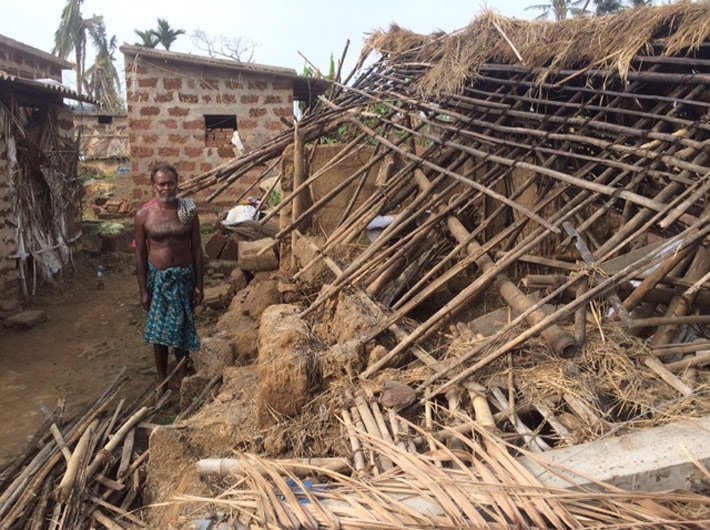
The families of Narahari Nayak and Prafulla Nayak from Durgadaspur village in Pipili area of Puri district of Odisha are sleeping on the road in the open as their houses were blown off during cyclone Fani that hit the Odisha coast on May 3. Several other families of the village who had thatched houses met with similar fate. Most of them in the village belong to the scheduled caste communities and are also economically poor. 

 
Dijabara Das of the village says, “We are sleeping on the road with families. Our daughters are going to school building to sleep. The other day a cobra was wandering near us and we had to kill it. There is every chance of a snake bite in present condition.” 
 
Each family in the village has got 50 kilogram of rice and rupees two thousand as immediate relief from the government, which helped to feed themselves and their children. “But this is not enough as rice will be finished in one or two days. We need more relief material for survival. We do not have enough money to buy them, as daily labour is also not available now. No such community kitchen is running here to feed us,” narrates Narahari Nayak.
 
Puspita Priyadarshini, a local resident and social activist says: “The biggest worry in the area now is the upcoming monsoon which will hit the state in less than a month. If government does not take urgent steps to repair people’s house, where will they live in the rainy days?” From government side, some people have got polythene sheet to build a makeshift living arrangement. 
 
In Satapada area of Puri district, where the cyclone landfall occurred, the scale of destruction is huge. Lives of people have become miserable and thatched houses are all gone. Most of the people who are affected are from the fisher communities. Their houses are damaged, boats are either completely or partially damaged along with the fishing-nets. Boats and fishing-net are assents for their livelihood.  
 
Sameet Panda, a social activist who visited Satapada area says: “Some religious institutions have started community kitchen in the area to provide food to the people living in the shelter homes. But people are in need of clothes urgently as most of them went with very limited clothes assuming that not much will happen to them in this cyclone as on earlier cyclones!” Panda narrates a very disturbing attempt by the micro-finance companies. “Though several micro finance companies have declared that they are withholding the process of recovering their regular installments from the people in the cyclone affected areas, their agents are indirectly pressuring the women of the self help groups in the area to pay their loans and installments. Agents of SKS finance, Bandhan to name a few. 
 
As the election results are over and Naveen Patnaik is going to be sworn in as the Chief Minister of the state for the fifth time, he has now to tighten up his relief and rehabilitation work to reciprocate the trust of people in him. 

Comments


Other News

When police data becomes the algorithm

For decades, policing has followed a familiar sequence: a crime occurs, the police respond, an investigation produces records and those records become part of the institutional memory of the criminal justice system. Artificial intelligence is beginning to alter that sequence. Instead of merely recording

Before India voted, the framers worried about the referee

“We are making a Constitution forever and not only for today.” Shibban Lal Saksena said this in the Constituent Assembly on June 15, 1949. He was warning that a ruling party might one day choose a loyalist to run India’s elections. Seventy-seven years later, the Supreme Court is wrestli

Delhi moves to real-time traffic management

The Cabinet Committee on Economic Affairs (CCEA), chaired by prime minister Narendra Modi, has approved implementation of the ITMS Project by Delhi Police at an estimated cost of Rs.1,789.52 crore, inclusive of taxes. The project will cover 42 identified traffic corridors and will be implemented in three

MDR on UPI: Can sustainability come without weakening the network?

The extraordinary transaction volumes and value (₹29.82 Lakh crore in August 2026 alone) of the Unified Payments Interface (UPI) have made it not only an Indian success story, but a global one. In 2024, UPI accounted for nearly 49% of the world’s real-time payment transaction volume, with more th

The Xi-Trump summit: The unending rivalry

Diplomacy is akin to an art, wherein the summitry, conflict resolution and negotiations form apt constituents of the entire context of deal making and “playing for keeps” in the international arena. The Xi-Trump summit in Washington last week, in which the American president broke all conside

“Indians, yet treated like outsiders”

Moving to Delhi-NCR for education can be an exciting experience for students from Northeast India. It gives us a chance to meet new people, experience a different culture and become more independent. But living away from home also comes with challenges that people who have not experienced them may not al

Upcoming Conferences


-->

Archives

Current Issue

Opinion

Facebook Twitter Google Plus Linkedin Subscribe Newsletter

Twitter






