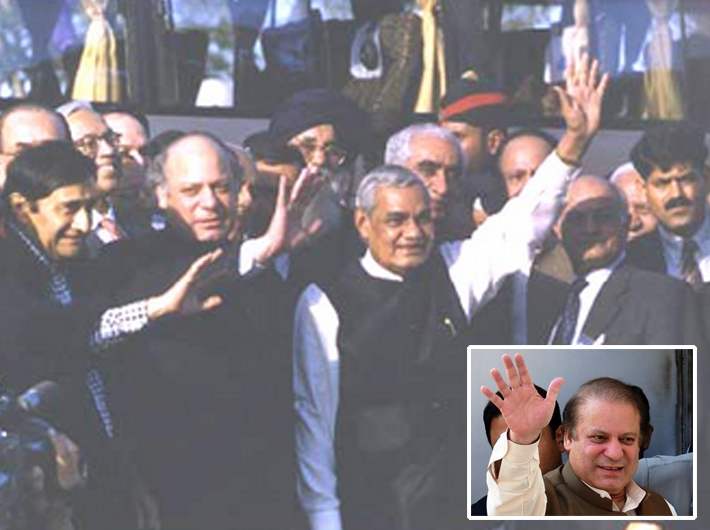
His last attempt to herald spring was cut short by Musharraf’s frost in Kargil. Having the mandate now, will Nawaz Sharif’s assertive claims bring the smile back on Indo-Pak relations?
In 1999, it was a phone call from Pakistan’s then army chief Pervez Musharraf, returning from Colombo to Islamabad on a Pakistan International Airlines flight, that sealed then prime minister Nawaz Sharif’s fate. Troopers of the infamous 111 brigade, involved in all coups in the country since its independence, climbed the gate of the television station and shut signals.
In a matter of minutes Sharif was put under house arrest.
Fourteen year on, the tiger has roared in Pakistan’s national elections as the complete results emerged on Sunday. The tiger —the symbol of Sharif’s Pakistan Muslim League (Nawaz) — or PML (N) — has got a big thumbs-up from the electorate, though itfalling short of simple majority in Pakistan’s 272-member national assembly. But credible it still is for Sharif, having defeated not only the late reverse swing of Imran Khan's Pakistan Tehreek-e-Insaf (PTI) but also its formidable opposition, the incumbent Pakistan People’s Party (PPP).
Connecting the dots with India
Back on the Raisina Hills, occupants of different offices in the South Block have been watching the scene unfold in Pakistan very closely. New Delhi has already welcomed the change of guard in Islamabad. Quick off the blocks, external affairs minister Salman Khurshid said: “India welcomes whatever result that comes out of a democratic election. Our government has had relations with Nawaz Sharif (in the past)…. I hope we can continue to have good relations if he comes to power.”
The ‘Lion of Punjab’, as Sharif is called, often said during the campaign that he wanted to “connect the dots” with India taking up from where the Lahore declaration left it in 1999.
The year 1997 was a landmark in Pakistan’s date with democracy, for that year the electorate gave Sharif a huge mandate on the plank of improving relations with India. And he seemed to have been trying to build the bridges post-victory when Musharraf’s coup cut it short.
Much water has flown down the Indus since the famous Lahore declaration between Sharif and then prime minister Atal Bihari Vajpayee, when the latter took the historic bus ride to Pakistan — the first by any Indian prime minister. But like in all high points, and brinkmanship, of relations between the neighbours, good steps have always been scuttled. While Sharif struck a chord with New Delhi, and there were indications of a welcome spring, Pervez Musharraf, the then army chief, brought back the frost with his military adventurism in Kargil — within two months of Lahore declaration, Bofors tanks were lobbing shell on Pakistani troops in answer.
Sharif has always maintained that he was never aware of the Pakistan army’s Kargil plans, while Musharraf said Sharif was briefed about it.
Officially eager, but will he deliver?
In its pre-election manifesto this time around, PML(N) promised to improve relations with India. In his public rallies, Sharif not only spoke about the Lahore declaration but also promised to investigate the role of Pakistan’s inter-services intelligence (ISI) in the 26/11 attacks on Mumbai.
Post-victory, and once he assumes charge, taming the hardliner ISI will perhaps be the key to Sharif’s efforts to improve ties with New Delhi.
Winning the first back-to-back elections — the first in Pakistan’s 65-year tryst with democracy in which the incumbent government completed its full five-year term —is also a historic moment for Sharif, who was pushed out of office midway through both his earlier stints. In his first term, then president Ghualm Ishaq Khan removed him in the early nineties, while Musharraf’s coup deposed him in 1999.
During the campaign for these elections, Sharif consistently maintained that he would, if elected, lead the country on 'good governance', not play a second fiddle to the army and try and improve ties with India.
In the rough and tumble world of Pakistani politics, where striking a fine balance, if not paying deference, to the army and the fundamentalist section is extremely important, Sharif was one politician who made his strategy clear vis-à-vis the army before and during the election campaign. In one interview, he said the prime minister, and not the military chief, is the country’s ‘boss’ — a contention that isn’t likely to go down well with the army.
The challenges
But can Sharif achieve what he has been promising in his pre-election rallies? More importantly, does he even want to engage in such groundbreaking work?
For one, 1997 and 2013 are poles apart. In ’97, the Pakistani government did not face much threat from terrorism; the lone threat for a democratically elected government in Islamabad was the military. That is one factor he has to take into account now.
In terms of improving relations with India, Sharif will not only have to contain the army and the ISI but also the ugly heads of terror like the Tehrik-i-Taliban and people like JuD chief Hafiz Saeed, the key conspirator of 26/11.
In a day or two, Sharif will formally stake his claim, and with it spawn quite a few posers that New Delhi would be eager to hear answered by Islamabad:
Will Nawaz Sharif call the shots in Pakistan, like he promised during campaigning, and stamp his authority in a country infested with a litany of woes, terrorism being perhaps the biggest in size and scope?
Will the Pakistani army and ISI take a backseat?
Will he be able to decimate terrorism, which is not only the biggest hurdle in India-Pakistan tie but has engulfed that country itself?
And, finally, will Sharif be third-time lucky and complete his five-year tenure and be able to deliver peace so far as New Delhi is concerned?