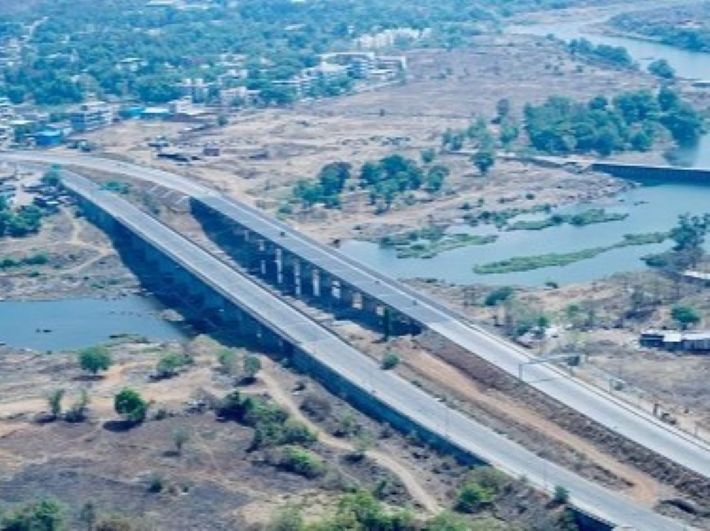
Toll in lives mounts as Konkan waits, incomplete NH-66 stretches continue to cause congestion
Seventeen years after the centre first approved the widening of National Highway 66 between Mumbai and Goa into a four-lane highway, a fresh RTI reply has revealed a sharp escalation in the project's sanctioned cost.
According to the RTI reply obtained by activist Jeetendra Ghadge of The Young Whistleblowers Foundation from the Ministry of Road Transport and Highways, the sanctioned cost of 10 four-laning packages covering 355 km of NH-66 in Maharashtra has risen from Rs 11,409.14 crore to Rs 16,909.22 crore -- an increase of nearly Rs 5,500 crore or approximately 48%.
The escalation comes even as several stretches of the highway remain incomplete, causing prolonged congestion and travel disruption for motorists travelling between Mumbai and the Konkan region.
The steepest increase has been recorded on the Parshuram Ghat–Arawali stretch in Chiplun-Ratnagiri, where the project cost has risen from Rs 983 crore to Rs 2,226 crore -- an increase of approximately 126%.
Across the 10 packages, cumulative expenditure has reached Rs 11,577 crore, according to the RTI information. This amount is already higher than the project's original sanctioned cost of Rs 11,409.14 crore, despite significant portions of the highway still awaiting completion.
The RTI disclosure has also renewed questions over the agencies responsible for executing and administering different portions of the project.
Ghadge said, “The government has treated Konkan's lifeline as an ATM for endless cost revisions with no accountability. What is deeply disturbing is that the Mumbai-Goa highway has been treated differently from several other major national highway projects."
While NHAI is executing the Panvel-Indapur stretch, the remaining Maharashtra portion has been entrusted to the state PWD for execution, with the projects being implemented under the national highway programme.
“When a project of this scale has remained incomplete for nearly 15 years despite thousands of crores being sanctioned and spent, the government must answer a basic question: who is ultimately accountable for the delay?”
The fact that the executing responsibility and financial administration are spread across different agencies cannot become an excuse for the people of Konkan to continue paying the price in the form of accidents where thousands of lives have been lost, along with congestion and endless travel hardship, said Ghadge.
The difficulties are particularly visible during Ganeshotsav, when large numbers of people from Mumbai and other parts of Maharashtra travel to their ancestral homes in the Konkan region.
The journey, which can ordinarily take around seven hours, can stretch beyond 12 hours during peak travel periods, with motorists encountering traffic bottlenecks, unfinished structures, pothole-affected sections and stretches operating with restricted carriageway capacity.
For thousands of families making the annual journey, the condition and incompleteness of the highway translate into longer travel times and prolonged periods of congestion.
The prolonged timeline of the Mumbai-Goa highway widening also stands in contrast with the construction of Maharashtra's 701-km Samruddhi Mahamarg.
The Samruddhi Mahamarg was constructed as an entirely new expressway over roughly seven years, while the widening of the existing Mumbai-Goa highway has taken nearly 15 years and remains incomplete across parts of the corridor.
The comparison raises questions about the reasons behind the prolonged execution timeline of the NH-66 widening project, particularly given the substantial public expenditure already incurred.
Key RTI Figures
Parameter: Figure
NH-66 packages covered: 10
Length covered: 355 km
Original sanctioned cost: Rs 11,409.14 crore
Revised sanctioned cost: Rs 16,909.22 crore
Cost escalation: Rs 5,500.08 crore
Percentage increase: ~48%
Cumulative expenditure: Rs 11,577 crore
Highest package-level increase: 126%
Parshuram Ghat–Arawali original cost: Rs 983 crore
Parshuram Ghat–Arawali revised cost: Rs 2,226 crore