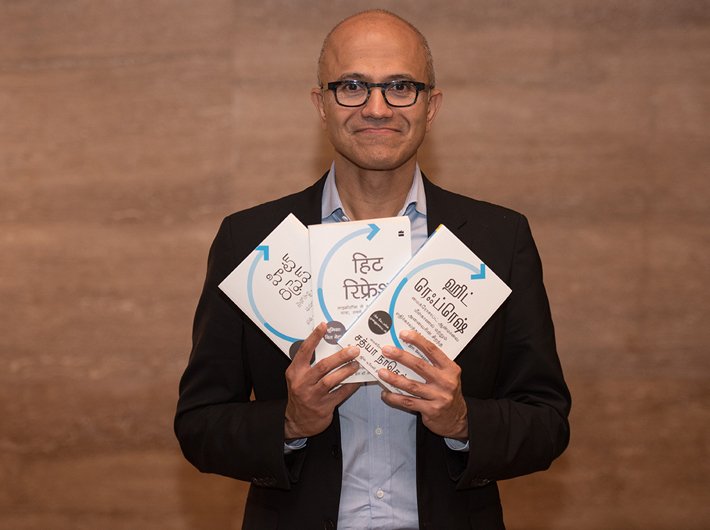
Nadella talks about his autobiography 'Hit Refresh' -- his journey to Microsoft from Hyderabad; how he is transforming Microsoft and the future of technology
Satya Nadella, CEO, Microsoft, was in town to launch the Hindi, Telugu and Tamil versions of his autobiography 'Hit Refresh' released on September 26. At an event hosted by Microsoft and HarperCollins India, he spoke about his book with Indian cricket legend Anil Kumble.
Satya discussed with Anil Kumble the leadership lessons he learnt on the cricket pitch that he uses even today as CEO—to compete vigorously and with passion in the face of uncertainty, putting the team first, and bringing out the best in everybody. They also discussed the positive impact of intelligent technologies on cricket, and how technology will redefine cricket for players as well as for the viewers.
In Hit Refresh, Satya delves into three key technologies that will lead to massive shifts in our economy and society— mixed reality, artificial intelligence, and quantum computing. These three currently independent threads will ultimately converge in the future where quantum computing will make artificial intelligence more intelligent and mixed reality an even more immersive experience. He also explores the values, ethics, policies, and economics that need to be considered in preparation for this next wave.
Excerpts from his conversation with Kumble:
On ‘hit refresh’ moment in life
In my life the birth of my son was one of those moments which had a deep impact. I was 29. So Zain (son) was about to be born. I was thinking of (planning) what will I do this weekend, when will I get back to work. When Zain was born everything changed. He was born with serious Cerebral Palsy.
In the first few months and years, I must say, I struggled with it. I would always think about why did this happen to me. All these plans we had no longer seemed valid.
And it was only through watching Anu (wife Anupama) and what came naturally to her… taking Zain around Seattle, taking him to therapies, giving him the best shot. It was then I realised nothing had happened to me. It was something which had happened to Zain and I need to step up as a parent, as a father. And that was a defining moment.
On his idea of empathy and how he brought change with it at Microsoft
If I look at what is Microsoft’s core business, it is about being able to unmet unarticulated needs of our customers. In no way we are going to succeed like that we don't have that deep sense of empathy.
What is that our customers really need from us and fully realise our sense of purpose and identity.
I think of empathy as not something as nice to have but as a core innovation agenda.
Now the challenge is you can’t simply go to work and turn on the empty button.
It’s sort of not possible to do so.
That’s why this integration of life, your life pursuits, what you have learnt as a parent, as a spouse, and to be able to take that to work…to me that’s perhaps something which needs to be unlocked.
And I am not even claiming that empathy is something which is innate, it is something that needs to be developed and it is life that teaches you. It is not a destination which is ever reached. Every day you better push yourself to have increasing levels of empathy for people around you. That’s best way to amplify your work.
On future of technology
Entire computing history has been about transforming the man machine interface… touch screen, speech, how we have made it more natural and intuitive to get more people to use computing. But the ultimate computing experience to my mind is the mixed reality.
You can now just in front of your eyes have both worlds — the real and the virtual world— you can blend the two. To me that is a complete realisation of the digital mirror being there, always. So am very excited about what we are doing with HoloLens, in education, in how people in factories work, in fact virtual reality. People are able to transcend space and time to collaborate. We have always build tools to collaborate and communicate.
The other thing that you mentioned is data and artificial intelligence (AI).
The current scene of our reality will be your ability to collect data, but more than that your ability to create intelligence or artificial intelligence.
Thats what defines whether it is health, educational outcomes or nay other value creation. It will fundamentally depend on how good are you in creating this data feedback loops.
Third is some of the computation challenges that we have not yet solved.
For example, the enzyme that’s involved in food production can’t be modelled. In fact it will take all the time from big bang to now for a classical computer to do so. Whereas with quantum computer, you can solve it.