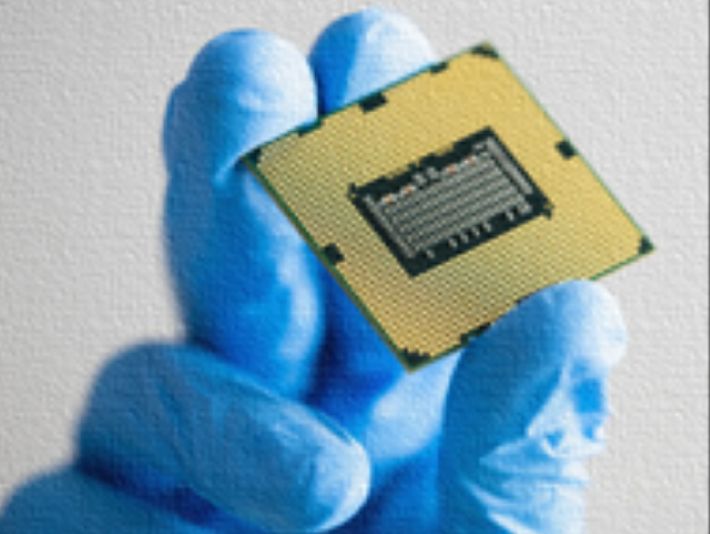
On Thursday, prime minister Narendra Modi will inaugurate SEMICON India 2026 at Yashobhoomi in Dwarka, New Delhi. Global chipmakers, policymakers and investors will fill the halls, all watching an industry India has built from the ground up. For three days, the country's semi-con (semiconductor) manufacturing story will be on full display. For an industry that barely had a heartbeat in India a decade ago, this is not just a conference. It is the moment India’s semiconductor ambitions step into the spotlight.
The theme this year is "Silicon to Systems: Building the Ecosystem." That phrase carries more weight than it first appears to. India is no longer asking whether it can make chips. It is now asking how fast it can build everything around them.
The Object That Runs the World
Hold up your phone. Somewhere inside it sits a piece of silicon smaller than a postage stamp, carrying billions of transistors switching on and off, billions of times a second. Apple's A19 Bionic chip, built at 3 nanometres, packs roughly 30 billion transistors onto that tiny surface. It is, without exaggeration, one of the most complex objects human beings have ever built.
Chips are not a niche product anymore. They sit inside cars, drones, aeroplanes, MRI machines and satellites. At the moment, the global electronics industry is valued at around $4.3 trillion and growing fast. Semiconductors sit right at the base of this growing structure, forming it’s foundation. Every other industry, from automobiles to healthcare to defence, depends on what comes out of a chip fabrication plant. That is what makes semiconductors a foundational industry. Miss this layer, and every layer above it becomes fragile.
The world learned this the hard way. For example, during the COVID pandemic, car factories faced shutdowns. Not because of a lack of steel or labour, but because they could not get chips. Countries that had spent decades treating semiconductors as someone else's problem suddenly scrambled to build their own capacity. The pandemic did not create the race for chips. It simply forced everyone to run faster.
A Long Road to This Moment
India's interest in semiconductors goes back further than most people realise, decades of quiet attempts, small starts, and lessons learned the hard way. For a long time, the ambition was there, but the ecosystem around it never quite came together. That changed with a different approach. Reforms in foreign investment, taxation and customs opened the door wide. Global electronics companies slowly began setting up manufacturing lines in India, and the results are hard to argue with.
In 2014-15, India produced about ₹1.9 lakh crore worth of electronics goods. By 2025-26, that number touched ₹13.11 lakh crore, a sevenfold jump. Electronics exports rose from around ₹38,000 crore to ₹4.24 lakh crore, an elevenfold increase.
Mobile phones tell an even sharper story. Production rose 33 times, from ₹18,000 crore to ₹6.27 lakh crore. Exports rose 165 times, from about ₹1,500 crore to ₹2.59 lakh crore. Smartphones did not even feature among India's top 100 exported goods in 2014. In FY 2025-26, smartphones became India's single largest exported commodity. Ahead of petroleum products and ahead of gems and jewellery. India now makes 99.2 percent of the phones it uses, and has flipped from a net importer of mobiles to a net exporter. This entire manufacturing engine now supports 2.5 million jobs.
This is the moment where the picture shifts. A country once known for false starts in electronics is now the second largest mobile phone manufacturer in the world by volume. Electronics manufacturing was the proof of concept. Semiconductors were always the next step.
Building the Mission
That next step arrived in 2021 with the Semicon India programme. The strategy was deliberate. Build a real ecosystem, not a showpiece. Semicon 1.0 came with a ₹76,000 crore outlay. Covering the entire value chain from chip design and fabrication to packaging, testing, equipment, materials and skilled talent. In July 2026, the government approved Semicon 2.0, scaling that foundation with a ₹1,27,500 crore outlay. This is built around six pillars: chip design, semiconductor equipment and materials, fabrication facilities, advanced packaging, research and development, and talent development.
The numbers on the ground back the intent. 12 semiconductor projects have been approved across six states, with investment commitments exceeding ₹1.64 lakh crore. The projects span across silicon and compound semiconductor fabs, display fabrication and advanced packaging. Three facilities have already started commercial production. That single fact marks India's shift from semiconductor policy on paper to semiconductor manufacturing on the ground.
Growing the Talent Behind the Chips
A fab is only as good as the engineers designing what goes inside it. The target set for this is clear. A pool of 85,000 skilled semiconductor engineers within this decade. Through the Chips to Startup programme, Electronic Design Automation tools have already been deployed across 320 academic institutions, with more than 68,000 students trained so far. Separately, 24 semiconductor design projects have been approved for financial support, along with 105 startups and MSMEs receiving EDA tool support under the DLI Scheme.
By April 2026, 211 chips had been taped out by 75 institutions, a clear sign that design capability is spreading well beyond a handful of elite labs. Seven of those chips have been fabricated at various nodes, including advanced nodes down to 12 nanometers.
To democratize chip design across the country, the ChipIN Centre has been set up at C-DAC under the Chips to Start-up (C2S) Programme and the Design Linked Incentive (DLI) Scheme. It serves as a centralized national facility providing access to advanced chip-design tools, fabrication services and specialized training.
The ChipIN Centre has extended these facilities to more than 1 lakh engineers from over 500 organizations, including 400 academic institutions and 100 start-ups. These organizations have collectively developed more than 300 chip designs for fabrication at SCL, Mohali, and advanced foundries abroad, while recording over 4 crore hours of chip-design tool usage. By enabling shared access to otherwise capital-intensive tools and services, this initiative has lowered entry barriers, reduced development costs and accelerated chip innovation, creating the world’s largest user base for a centralized chip-design facility.
An Alliance for the Chip Age
India's semiconductor push is no longer just a domestic story. On the fifth day of the India AI Impact Summit 2026, India formally joined the Pax Silica coalition. The coalition brings together the United States and other partner nations, focused on securing the global silicon supply chain. Its goal is to secure the full "silicon stack", from critical minerals and fabrication to advanced AI systems and deployment infrastructure. The mission is simple. Keep supply chains out of too few hands. Resist economic coercion. Keep the technologies that will define this century in the hands of open, democratic nations. For India, this is proof its semiconductor ambitions now reach well beyond its own borders.
Where It All Meets
This is what makes SEMICON India 2026 more than an exhibition. Over three days at Yashobhoomi, more than 600 exhibitors, 300 international companies will fill 15,000 square metres of space and 150+ renowned speakers sharing knowledge and wisdom . Six country pavilions and 12 state pavilions will sit alongside a startup showcase, a student hackathon, a workforce development pavilion and Women forum , each one a small window into a piece of the ecosystem India has spent five years building.
A chip takes years to design and months to fabricate, but its footprint lasts far longer, inside every phone, every car, every hospital equipment it powers. Every one of those devices in your life today depends on someone, somewhere, having built that chip first. SEMICON India 2026 is India's declaration that it intends to be that someone. Not tomorrow. Starting now.