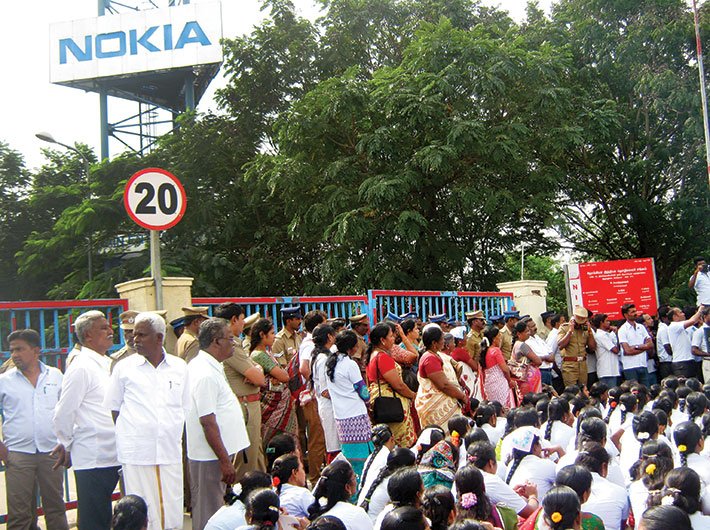
Closure affects families and staff cries betrayal even as some blame centre’s retrospective tax law for tech companies leaving Tamil Nadu
Twenty-five-year-old Marciline was surprised when her manager asked her to go home. She looked at the clock and it was not even noon. She immediately sensed that December 20 was to be her last day as an employee of Foxconn, the world’s largest contract electronics goods maker. Even in the morning when she came to report for work she had felt something was not right. “That day when I went to the factory, I hardly saw any production work. In the past couple of months I had seen many of my colleagues being asked to go on leave. And that Saturday I was asked to return home. I was told by the HR manager that I should come back to work only when the company calls me,” says Marciline, not knowing what steps she should take now.
The Foxconn plant at Sriperumbudur in Tamil Nadu has been shut and the staff sent home on leave. But the factory seems to have closed permanently.
Marciline feels that declaring a holiday with pay is an indirect way of closing the plant. She is the sole breadwinner and supports her siblings’ education.
She is not alone. Nearly 1,700 Foxconn employees are facing gloomy 2015.
Foxconn has announced the suspension of production at its Sriperumbudur plant located inside Nokia SEZ. The company had two units in Sriperumbudur, one at HiTech SEZ and another inside Nokia SEZ. At the peak of its operations, the company employed more than 6,800 persons at the Nokia SEZ factory alone.
Why bad news is worse
Majority of the employees of Foxconn are in the age group of 25-30 years and are not even graduates. They are just higher secondary pass (plus-2), and getting another job is very difficult.
Most of them had sensed trouble months back when some employees were told not to come to work. But they stayed on as they were helpless. Being unskilled workers, they know that it would be not easy to get the next job.
“I joined this company at the age of 24 and now I am 31. Here I am earning Rs10,000 per month. No other company would give me job at this salary since I have studied only till Class 12. My husband is a farm worker and I am supporting the family. I have two children; one is seven-year-old and the other five-year-old. How am I going to run the family?” asks Kavitha, who commutes daily from her home in Vellore district to the Sriperumbudur plant, covering a distance of almost 100 km.
For Gayatri it was a matter of pride working in an MNC. But today she stands at the closed gate of the factory protesting against suspension of production. The 25-year-old is getting married next year. “At the time of joining the company I thought since I am a permanent employee now, I would continue my job even after marriage. I don’t want to sit inside the four walls of the house just cooking,” says Gayatri. The company, she adds, is willing to make settlement offers but “we want jobs and not settlement”.
“When Foxconn started the factory in 2006 they had specifically called for 18- and 19-year-old applicants who had studied till Class 12. I also applied and got selected. I ended up discontinuing education. And now my future seems to be bleak. How am I even going to feed my family, parents, wife and a child?” wonders Masthal Bava.
Many of them even say that this is the company’s strategy to bring in a fresh lot at lesser salary. “They will make us go and hire new people at much lesser salary than what we are being paid,” says Bava.
Was job loss avoidable?
Foxconn has a global presence and employs over 2,00,000 workers across 85 countries. The management should have explored alternative lines of work. Shutting down the unit is not an option, says A Soundararajan, president of Centre of Indian Trade Unions (CITU), Tamil Nadu unit.
“Nokia was not the only company from where Foxconn was getting orders. Companies like Sony and Motorola were also placing orders. We do not want any more job losses now. They are forcibly keeping the employees out,” said Sounderarajan. The management did not reply to queries from Governance Now.
Shutting down scare in TN
Tamil Nadu took pride in being called an industrial hub of India. So why are companies leaving the state? A senior official from the state labour department, who does not wish to be identified, says, “It is not a good thing for us (the government) also when a company walks out after functioning for seven or eight years. A company must have sustainable business and there is a need for strengthened business ecosystem.”
It was the retrospective tax Act introduced by the Centre that forced Nokia to leave Tamil Nadu, he says. And when Microsoft did not include this plant in its buyout, Nokia had no other option than to announce a shutdown. To a query the official says, “We are inviting multinational companies to the state and they are coming.”
However, Subash S, who teaches at the Indian Institute of Technology (IIT) Madras argues, “I do not think that the exit of these companies (Nokia and Foxconn) is due to the retrospective tax Act. We should not create uncertainty regarding tax regime which will considerably affect our image among foreign investors.” He does admit, though, that the retrospective tax has created confusion among global investors.
Is Tamil Nadu still an attractive destination for foreign domestic investment (FDI) in manufacturing, especially in the electronics and auto components sector? Subash says if the government can learn from this episode and rekindle the confidence of investors by easing the regulatory hurdles, capital inflow will continue.
The story appears in January 1-15, 2015, issue