
Supreme court verdict on Maharashtra on Tuesday

NCP-Sena write to governor, claiming numbers

GN Bureau | November 25, 2019

#electionsm supreme court   #assembly   #NCP   #Congress   #Shiv Sena   #BJP   #Maharashtra   #governor  
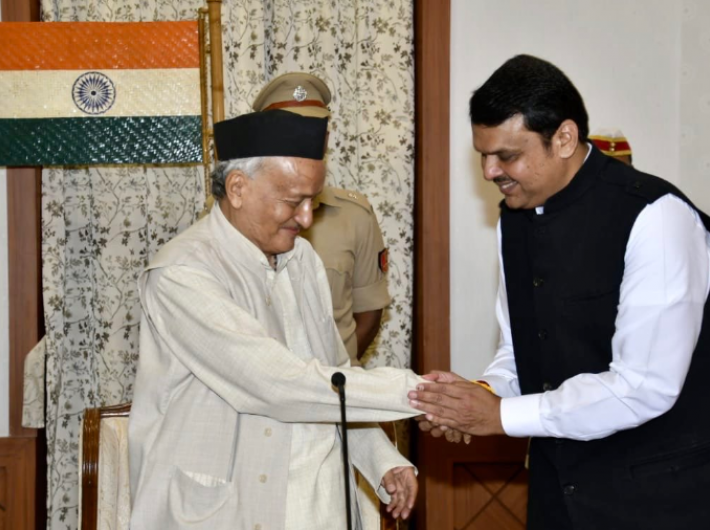
Devendra Fadnavis after being sworn as as chief minister by governor Bhagat Singh Koshyari on Saturday (Photo courtesy: @Dev_Fadnavis)

Amid the high drama in Maharashtra politics, the supreme court has reserved its judgment on Tuesday, even as the Shiv Sena and NCP wrote to the governor, claiming they had the number to prove majority.

On the Sena plea against governor Bhagat Singh Koshyari’s move to invite Devendra Fadnavis to form government early Saturday morning, the supreme court on Monday heard all sides and reserved its judgment for Tuesday morning.

A bench of justices NV Ramana, Ashok Bhushan and Sanjiv Khanna took note of the letter of the governor inviting Fadnavis to form government, and the letter of support of the necessary number of MLAs. Solicitor general Tushar Mehta represented the central government, while Mukul Rohtagi represented the Maharashtra government. The Sena and the NCP/Congress were represented by Kapil Sibal and Abhishek Singhvi. The crux of the arguments was the letter of support.

After the October 21 assembly elections gave not enough numbers to the BJP but clear majority for the pre-poll alliance of BJP-Sena, it was the Sena that upped the ante and sought a more share in power, which the BJP refused. When the governor invited it to form government, the BJP, the largest party, failed to do so. The governor then turned to the Sena, and also to the NCP, which too failed. The governor then recommended the president’s rule. The Sena and the NCP, ideologically bitter rivals, however, started talks, and the NCP chief, Sharad Pawar, persuaded the Congress to join in.

On Friday night, all stakeholders apparently went to sleep believing Sena chief Uddhav Thackeray would be sworn in as chief minister the next day with the NCP and Congress in support – a very surprising outcome. The more surprising development came early Saturday morning, when the prime minister recommended revocation of the president’s rule, the president gave his assent, the governor invited Fadnavis to form government – with Pawar’s nephew and NCP legislative party head Ajit Pawar as deputy chief minister.

The Sena and its new allies claimed foul play and petitioned before the apex court. Meanwhile, Sharad Pawar maintained that he was not party to his nephew’s moves, and neither were most NCP MLAs.
 

Comments


Other News

Not just politics, let`s discuss policies too

Why public policy matters Most days, India`s loudest debates stop at the ballot box. We can name every major leader and recall every campaign slogan. Still, far fewer of us can explain why a widow`s pension is delayed or how a government school`s budget is actually approved. That

When algorithms decide and children die

The images have not left me, of dead and wounded children being carried in the arms of the medics and relatives to the ambulances and hospitals. On February 28, at the start of Operation Epic Fury, cruise missiles struck the Shajareh Tayyebeh school – officially named a girls’ school, in Minab,

The economics of representation: Why women in power matter

India’s democracy has grown in scale, but not quite in balance. Women today are active participants in elections, influencing outcomes in ways that were not as visible earlier. Yet their presence in legislative institutions continues to lag behind. The Nari Shakti Vandan Adhiniyam was meant to addres

India will be powerful, not aggressive: Bhaiyyaji

India is poised to emerge as a global power but will remain rooted in its civilisational ethos of non-aggression and harmony, former RSS General Secretary Suresh `Bhaiyyaji` Joshi has said.   He was speaking at the launch of “Rashtrabhav,” a book by Ravindra Sathe

AI: Code, Control, Conquer

India today stands at a critical juncture in the area of artificial intelligence. While the country is among the fastest adopters of AI in the world, it remains heavily reliant on technologies developed elsewhere. This paradox, experts warn, cannot persist if India seeks technological sovereignty.

RBI pauses to assess inflation risks, policy transmission

The Reserve Bank of India (RBI) has begun the new fiscal year with a calibrated pause, keeping the repo rate unchanged at 5.25 per cent in its April Monetary Policy Committee (MPC) meeting. The decision, taken unanimously, reflects a shift from aggressive policy action to cautious observation after a signi


Archives

Current Issue

Opinion

Facebook Twitter Google Plus Linkedin Subscribe Newsletter

Twitter






