These three years have seen a shrill “us versus them” debate. Either you are with BJP’s variant of nationalism, or you are an anti-national
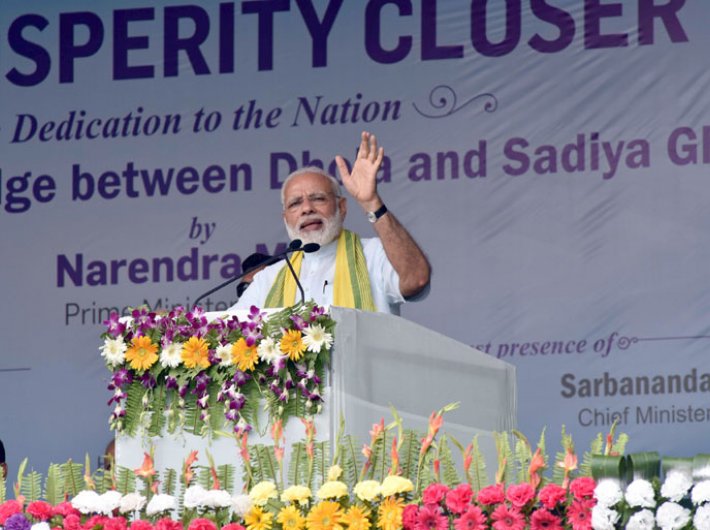
Narendra Modi is like Greek mythology’s King Midas: whatever he touches turns into gold. Most people in this country are left dazzled by his ability to make dramatic announcements with a statuesque flourish.
The past three years of the Modi government have left the liberals quite worried. But most others are satisfied with what the union government has done till now. That perhaps explains why the scrapping of Rs 500 and Rs 1,000 currency notes did not have any impact in the assembly elections. In fact, the BJP performed better than most expectations, winning a brute majority in the politically crucial state of Uttar Pradesh. Ditto for Goa and Manipur, where the BJP managed to form the government.
These three years have also seen a shrill “us versus them” debate: either you are with BJP’s variant of nationalism or you are an anti-national.
Much to the discomfort of minorities, the Hindu right-wing has asserted itself, triggering bloodshed. The killing of Akhlaq in a village in Dadri in 2015 over beef consumption rumours, followed by dalits being ruthlessly beaten up in Gujarat and several other cases of people being lynched in different parts of the country even though they were carrying official documents, highlights the issue.
The raksha of cows is no longer the issue here, the Gau rakshaks are. They don’t hesitate to take law into their own hands. Though the prime minister has spoken out against violence perpetrated by the gau rakshaks, it has failed to slow them down. That is a matter of deep concern.
The “us versus them” debate is in fact quite vicious.
Pankaj Mishra writes in his book “Age of Anger”: “While Modi’s neo-Hindu devotees on Facebook and Twitter render the air mephitic with hate and malice against various ‘anti-nationals’, his government moves decisively against ostensibly liberal and Westernized Indians, who belong to what the chief of the RSS in 1999 identified as that ‘class of bastards which tries to implant an alien culture in their land’. Denounced by the numerous Hindu supremacists on social media as ‘sickular libtards’ and ‘sepoys’ (the name for Indian soldiers in European armies), these apparent Trojan horses of the West are now being purged from Indian institutions.”
The protest in the premier Jawaharlal Nehru University in February 2016 and the subsequent arrest of JNU students union chief Kanhaiya Kumar on the charge of sedition shook the country. It was an attempt to silence dissent. The students and teachers of the university simply refused to be cowed down. It was later found that controversial slogans had been raised by outsiders.
Centre for Policy Research chief Pratap Bhanu Mehta, who will take over as vice chancellor of Ashoka University in July, wrote in the Indian Express after Yogi Adityanath was chosen as the chief minister of Uttar Pradesh: “It signals that the BJP will now be dominated by extremes, its politics shaped largely by resentment rather than hope, collective narcissism rather than an acknowledgement of plurality, hate rather than reconciliation, and violence rather than decency. Hubris has set in. The party believes it can get away with anything. It now intends to.”
The years that Narendra Modi has been in power, there certainly has been some improvement. Many poor now have gas connections. Also, many unbanked now have bank accounts. The Swach Bharat Abhiyan is showing some result. Affordable medicine is now available through Jan Aushadhi Kendras. There are many other government schemes that are yielding results, if not fully then at least partly. However, cleaning up the Ganga is an effort that seems to be a miserable failure.
The economy, the government says, is in a better shape. The bad news, however, is coming from the IT sector, which was once the apple of the eye. Layoffs in thousands are taking place in the IT sector, taking away the sheen from the government’s efforts.
Another key reform is the Goods and Services Tax (GST), which would lead to a uniform tax structure across the nation. Though it did not come about in the first three years of this government, it is going to be in place as the fourth year starts.
But the citizenry like this government, not just for governance and reforms, but for the chest-thumping opportunity that it provides.
The surgical strike carried out in 2016 by Indian commandos within Pakistan, killing nearly three dozen militants, showed that this government means business. People loved the machoism. The 56-inch chest swelled with pride.
When Modi travels the world, people adore the speeches that he makes. His word play tugs at heart strings, giving a feeling that India is finally being taken seriously in the international fora.
There is now talk that Modi may prepone the general elections. That may or may not happen. He has kept his promise – to make a significant difference. That cannot be denied.
A caveat: Modi must not forget that King Midas starved as his food turned into gold. Too much of dazzle can do more harm than good in the long run.