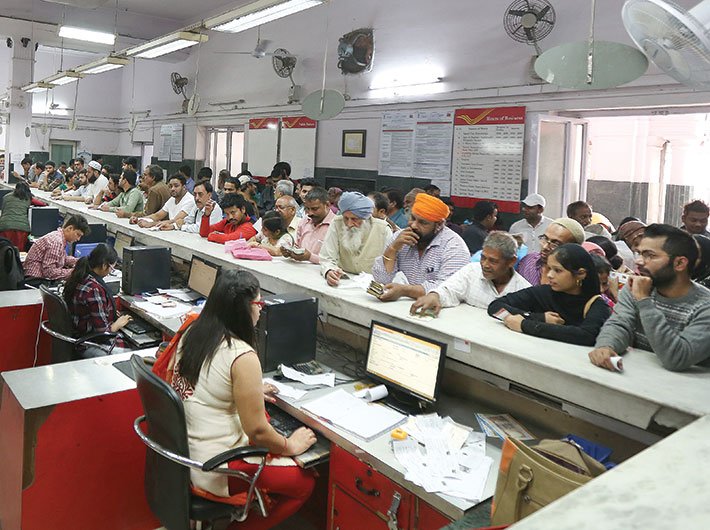
It’s not just people who are bearing the brunt of demonetisation, bankers too are feeling the heat
Since November 8, never-ending queues, rising tempers, despair and frustration have become a routine. It’s a nightmare for people who are struggling to deposit or exchange money at banks. And what about those who are working in banks?
Bankers are going through an equally harrowing experience. Long working hours, frayed tempers and shortage of staff – they are braving it all. “I haven’t slept or eaten properly in the past week. There is panic among people, which is putting pressure on us,” says Raj Kamal, a bank branch officer.
The bank branch where Raj works is in a small village in Haryana. He and the head cashier are the only staff at the branch. “There is a rush of about 500-600 people every day. It is maddening. It is difficult for me to take a break – even for five minutes. I don’t have lunch anymore; forget about going to the washroom,” he says.
On November 9, when banks were closed for the general public, it was a usual working day for bankers. They were supposed to get instructions regarding money exchange and other rules and regulations following demonetisation. On that day, most bank officials reached office before time to get themselves updated with the new strategy. But Raj, despite coming to the bank early and staying up late, did not get any briefing.
“I was sitting idle as customer dealing was closed. New currency notes were delivered to the chest branch [select branches of scheduled banks authorised by RBI for distribution of notes and coins] at 1 in the night. As a result, we didn’t get any money on that day. On November 10, I was panicking as we had no money and it was time to open the bank,” he says.
Terrified, Raj did not open the bank till afternoon. He hurriedly went to the chest branch to request new currency notes. This process, however, should have been the other way round. “I had to write a letter requesting them to give me Rs 10 lakh. I took the money and rushed back. But by then, a large number of people had gathered outside and were trying to break open the doors. There was panic and chaos all around,” recollects Raj.
Every bank branch is mandated to have at least two security guards. But none were deployed at his branch, claims Raj. “With no security guards, people broke into a fight every now and then. I had to request the SHO office, which is linked to our branch, to provide a guard. The one they sent was already on duty the previous night. So he came here for just half a day and left,” he says.
Raj’s woes didn’t end there. There is just one note-sorting machine at his bank. The machine is a big help for bankers as it separates the issuable, non-issuable and ATM-fit currency. It also helps in detecting forged notes. “The machine here is full of mud. People deposit old notes that are full of dirt and moisture. Therefore, the machine doesn’t work properly,” he says.
It is becoming very difficult for bankers like Raj to deal with such physical and mental stress every day. “We are trying to cooperate with the government but this is becoming really tough. If I make a mistake in such a scenario I’m supposed to cover it up from my own pocket. So far I have lost about Rs 16,000 from my salary,” says Raj.
The scenario is the same in chest branches. “The work of a chest branch is double than any normal bank. We have to distribute money not only to the public but also to banks. But this task has become tedious as we have only a few people to handle the crowd,” says Mahendra Pratap, who works at a government chest branch in Delhi.
The branch has only three senior officers and six clerks. Pratap says that around 700 people line up outside the bank for depositing or exchanging the money, which is way beyond their capacity. “Why do you think people have to wait? It’s because we don’t have enough people in banks, especially in government. We have only one machine to count notes,” he says.
Lack of supply of new currency notes is worsening the situation. “How can we distribute money to banks? The chest branches have not yet received cash. There is far more demand than supply. People are definitely going to face problems, and let’s not even talk about a banker’s plight,” he says.
The banks are instructed to make a report at the end of the day mentioning the amount deposited and exchanged, along with forged notes received. The report is then sent to the controlling office and goes to the head office from there. The head office passes it to the government. Because of this lengthy process, other banking functions like loan processing have taken a back seat, confesses Pratap. “Our priority is the people waiting outside. We can’t keep doing everything together,” he says.
The names of banks and branches are withheld to protect employees’ identities.
(The article appears in December 1-15, 2016 edition of Governance Now)