Beyond LPG: Is PNG ready for India’s next cooking fuel transition?

Govt should consider a PNG-focused inclusion programme on the lines of PMUY to expand access in urban, semi-urban, and high-density peri-urban areas

Himanshu Jaiswal and Badri Narayanan | May 4, 2026

#Conflict   #Energy  
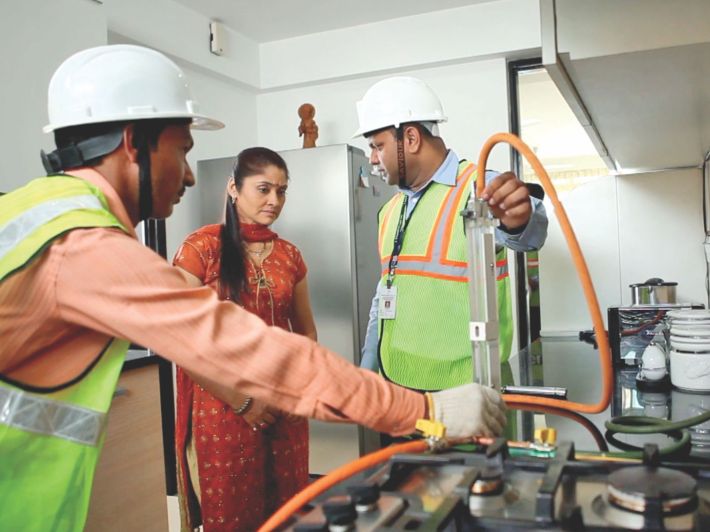
(Photo: Courtesy Gail India)

India, the second-largest importer and consumer of LPG after China, faces growing pressure due to supply constraints. Most of India's LPG imports transit through the Strait of Hormuz, a focal point of global turmoil. Given that LPG forms the backbone of household kitchens and the restaurant industry, any supply disruption triggers far-reaching repercussions. To address the current LPG crisis, the government has pursued multiple approaches: maximising domestic output, prioritising household over commercial users, acting against hoarding and black marketing, and suspending new LPG connections. In parallel, authorities have encouraged faster piped natural gas (PNG) connections to ease pressure on LPG demand, with more than 5 lakh PNG connections activated since March 2026.
 
Apart from being a clean cooking fuel, PNG is lighter than air, making it easier to dissipate in case of leakage. It is generally more economical than LPG, metered for exact usage, and available 24x7 through pipelines, eliminating the need to book or store cylinders. Despite these advantages, PNG has not achieved nationwide mass adoption comparable to LPG. This piece examines the demand-supply dynamics to understand why.


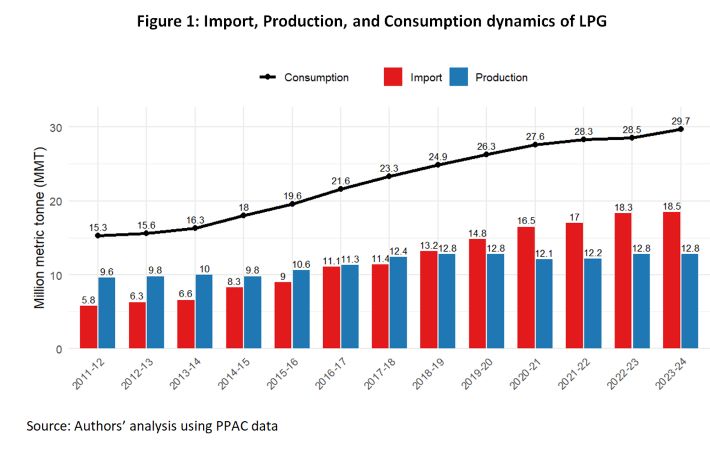
Although India imports around 60% of its LPG requirements, domestic production, a by-product of crude oil refining and natural gas processing, remains limited relative to rapidly growing demand. As Figure 1 illustrates, LPG consumption has nearly doubled from 15.3 MMT in 2011-12 to 29.7 MMT in 2023-24, driven largely by the Pradhan Mantri Ujjawala Yojana (PMUY), which expanded household adoption particularly in rural India. Domestic production, however, rose only modestly from 9.6 MMT to 12.8 MMT over the same period, with the widening gap bridged almost entirely through imports, which rose steeply from 5.8 MMT to 18.5 MMT.


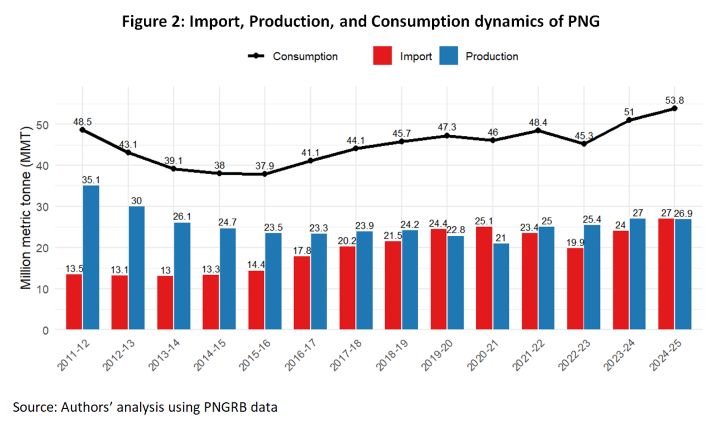
India's natural gas dynamics, as shown in Figure 2, present a more uneven trajectory. Total consumption moved from 48.5 MMT in 2011-12 to 53.8 MMT in 2024-25, modest overall growth marked by periods of stagnation. Unlike LPG, PNG consumption has lacked a consistent upward trend. Domestic production, which stood well above imports at 35.1 MMT against 13.5 MMT in 2011-12, has since declined to 26.9 MMT, while imports have nearly doubled to 27 MMT, now equaling production. This reflects structural constraints: limited pipeline and city gas distribution infrastructure, uneven regional coverage, and slower expansion of household connections.


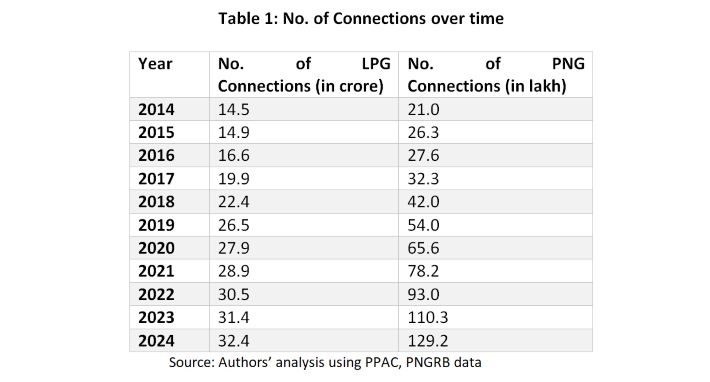
Table 1 highlights the sharp divergence in scale of expansion between LPG and PNG. LPG connections grew from 14.5 crore in 2014 to 32.4 crore in 2024, an addition of nearly 18 crore connections, reflecting massive nationwide adoption. PNG connections, by contrast, added just over 1 crore new connections, growing from 21 lakh to 129.2 lakh over the same period, underscoring its untapped potential, especially in semi-urban and rural areas.


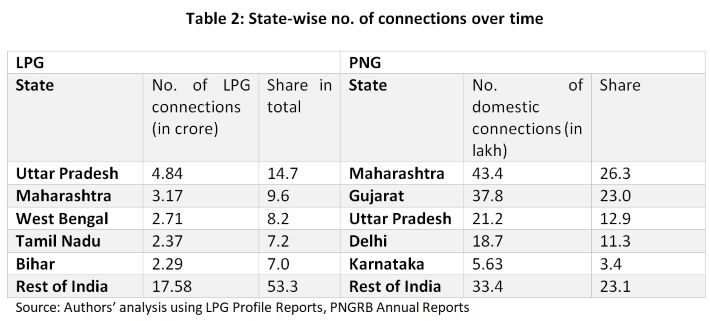
Regional disparity further constrains PNG's expansion. As Table 2 shows, LPG connections are relatively evenly spread, with the top five states accounting for around 47% of total connections. PNG connections, however, are heavily concentrated, with the top five regions alone accounting for nearly 77% of domestic connections. Maharashtra and Gujarat, two of the most urbanized states, dominate in PNG connections, reflecting the concentration of city gas networks in a few urban-industrial centres.
 
This stark disparity underscores that PNG expansion remains geographically uneven and infrastructure-dependent. Going forward, India must target a mix of cooking fuels to reduce the vulnerability. As a policy recommendation, the government may consider a PNG-focused inclusion programme on the lines of PMUY with subsidised connection charges and easier financing to expand access in urban, semi-urban, and high-density peri-urban areas, while LPG remains the primary clean cooking fuel in remote regions where pipelines are unviable. 
 
The commercial food and hospitality sector should be encouraged to shift from LPG to PNG through concessional connection fees, faster approvals, and targeted incentives. PNG expansion should also be integrated into a broader urban infrastructure agenda encompassing faster rollout of city gas networks, streamlined clearances, and better coordination with municipal corporations. Domestic gas production, LNG planning, and renewable cooking solutions should also be on the development agenda.

Himanshu Jaiswal is Research Fellow, Infisum Modeling Inc. Badri Narayanan is Founder and Director, Infisum Modeling Inc.

Comments


Other News

Legends, vignettes and tales from the freedom movement

Robin Hood of Kathiawar and Other Extraordinary Stories from India’s Freedom Movement By The Paperclip  HarperCollins, 348 pages, Rs 499  

Solicitor General Tushar Mehta tells quirky tales from the world of law

The Lawful and the Awful: Quirky Tales from the World of Law By Tushar Mehta Rupa Publications, 336 pages, Rs 995  

Cabinet meet discussed `Ease of Living`, `Ease of Doing Business`

The Council of Ministers has deliberated upon valuable perspectives and best practices relating to boosting ‘Ease of Living’ and ‘Ease of Doing Business’, prime minister Narendra Modi said on Friday.   As he shared details of the Council meeting held the d

India should deepen energy partnerships with Africa

The vulnerability of Strait of Hormuz continues to influence energy politics globally. India is highly dependent on imported crude oil as a significant portion of its oil imports still come from the Gulf ultimately making such disruptions particularly consequential and has immediate economic ramifications

The rupee stumbles: Can India Inc. chip in?

Every time the Indian rupee weakens to a new record low, the conversation follows a familiar script. The RBI intervenes. Economists debate the current account deficit. The government appeals to citizens to cut consumption. And within a few news cycles, attention moves on, until the next record low arrives.

Provisional answer key for civil (prelim) to be released soon after exams

For the first time, the Union Public Service Commission will release the Provisional Answer Key for the Civil Services (Preliminary) Examination 2026, soon after the exam, to enhance transparency and uphold the highest standards of conduct of examination.   Terming it as “a


Archives

Current Issue

Opinion

Facebook Twitter Google Plus Linkedin Subscribe Newsletter

Twitter