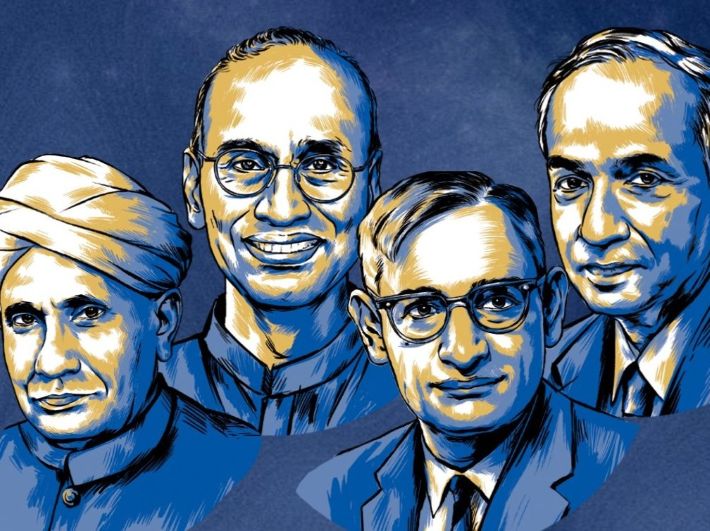
Commitment to humanism, according to Rudrangshu Mukherjee, whose new work ‘A Touch Of Genius’ brings together the Wisdom of India’s Nobel laureates
A Touch Of Genius: The Wisdom of India’s Nobel Laureates
Edited by Rudrangshu Mukherjee
Aleph Books, Rs 1499, 848 pages
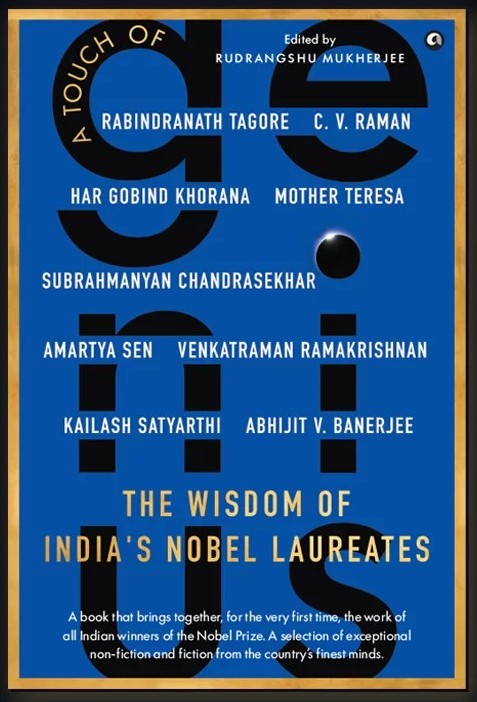
Since 1901, when the Nobel Awards were instituted, there have been nine Indians – Indian citizens, naturalized Indians, and erstwhile citizens of independent India – who have won this most coveted honour. Rudrangshu Mukherjee, Chancellor and Professor of History at Ashoka University, has compiled representative works of these nine exceptional minds in one volume. ‘A Touch Of Genius: The Wisdom of India’s Nobel Laureates’ brings together, for the first time, the work of Rabindranath Tagore, C. V. Raman, Har Gobind Khorana, Mother Teresa, Subrahmanyan Chandrasekhar, Amartya Sen, Venkatraman Ramakrishnan, Kailash Satyarthi and Abhijit V. Banerjee.
The book, which contains over seventy essays, stories, poems, songs, and prayers, is divided into ten sections—Memoir, Literature, Science, Economics, Religion and Philosophy, Aesthetics, Inequality and Injustice, Politics, India, and Nobel Lectures. Each of the sections contains illuminating chapters that provide the reader with extraordinary insights into the human condition, literature, art, science, religion, philosophy, politics, human rights, economics, and the world we live in.
In this excerpt from his introduction, Mukherjee shows what is common to these nine individuals:
It is time for this introduction to turn to a theme that it raised earlier but did not discuss. This refers to the laureates’ overriding commitment to humanism. Tagore writes about this in ‘The Religion of Man’ and in ‘The Crisis of Civilization’ but he flags it also in his Nobel Prize acceptance speech which he delivered in Stockholm in May 1921, eight years after he was awarded the Nobel. One of the many ways he did so was by invoking a verse from the Isa Upanishad. In Tagore’s words, ‘He who sees all beings as himself, who realizes all beings as himself, knows Truth.’ Human beings are part of a whole and constitute the whole. Embedded in the line is also the message of self-realization and equality. Mother Teresa embraced this spirit in her commitment of service to the wretched of the streets of Calcutta. In her acceptance speech, she invoked the prayer of Saint Francis of Assisi to bring to all human beings the ‘gift of peace’. [Mother Teresa had planned to begin her Nobel lecture on 11 December 1979 with the prayer of Saint Francis of Assisi. However, she included the prayer in her acceptance speech delivered on 10 December 1979.] The writings of Kailash Satyarthi also appeal in the same register to end the oppression of children across the globe. Albeit from a different philosophical standpoint, Sen’s concern with welfare, gender inequality, and famines, and Banerjee’s quest to minimize and eradicate poverty through policies that are better targeted, grow from their empathy with the suffering of millions of human beings.
C. V. Raman drew out the scientists’ commitment to human beings in a telling passage, ‘Ultimately, the aim of scientific knowledge is to benefit human life.... The most important, the most fundamental investigations, though at first might seem an abstraction of nature, are precisely those, which in due course, affect human life and human activities most profoundly.... Scientific work is valuable because it will ultimately prove its value for the whole of human life and human activity.... And precisely those scientists who have laboured not with the aim of producing this or that, but who have worked with the sole desire to advance knowledge, ultimately prove to be the greatest benefactors of humanity.’ It is the lives of human beings that is at the heart of Ramakrishnan’s query ‘Why we die?’ At a stretch—but not a long one—Chandrasekhar captures the perennial human quest when he concludes his Nobel lecture with the words, ‘The simple is the seal of the true and Beauty is the splendour of Truth.’ The search for truth, self-realization, the removal of suffering, discrimination, poverty, the betterment of life, and harmony among human beings—these noble virtues and aspirations were embraced by these Nobel laureates.
There are two other related themes that emerge from the writings of most of the writers. One is freedom. Tagore wrote that one of the motivations behind setting up his school in Santiniketan was ‘to give freedom and joy to children’. Sen, who went to this school, cherishes the spirit and the importance of freedom that he imbibed during his school days. As Sen’s ideas evolved, he linked the ideal of freedom to the idea of democracy. The latter he considers to be a universal value since it best safeguards, though not perfectly, the freedom of human beings. It does so, according to Sen, in at least three ways. First, democracy provides for political freedom ‘which is a part of human freedom in general, and exercising civil and political rights is a crucial part of good lives of individuals as social beings. Political and social participation has intrinsic value for human life and well-being’. Prevention of that participation is a deprivation. Second, democracy enables human beings to be heard and to claim political attention. And third, democracy facilitates public reasoning and debate—it ‘gives citizens an opportunity to learn from one another, and helps societies to form its values and priorities’.
Tagore linked his idea of freedom with childlikeness. He wrote, ‘…I felt that as I had a deep love for nature, I had naturally love for children also. My object in starting this institution [in Santiniketan] was to give the children full freedom of joy, of life and of communion with nature.... I had a few boys around me, and I taught them, and I tried to make them happy. I was their playmate. I was their companion. I shared their life, and I felt I was the biggest child of the party. And we all grew up together in this atmosphere of freedom.’ Mother Teresa—rooted as she was in her Catholic faith—loved children. ‘Let us bring the child back,’ she prayed, ‘…let us make every single child born, and unborn, wanted.’ For Satyarthi, love for children becomes the drive for reform. He said most movingly at the Nobel Prize ceremony, ‘I am representing here—the sound of silence. The cry of innocence.... I represent millions of those children who are left behind.... I have come here only to share the voices and dreams of our children—because they are all our children…. My only aim in life is that every child is free to be a child: free to grow and develop, free to eat, sleep and see daylight, free to laugh and cry, free to play and learn, free to go to school, and above all, free to dream.’ The child for these laureates is the future of humanity. Satyarthi ended his speech by quoting the famous passage from the Brihadaranyaka Upanishad: ‘From the unreal lead me to the real/from the darkness lead me to the light/from death lead me to immortality.’
The nine jewels in this volume, through different routes, have undertaken this journey to feel the touch of genius and immortality.
[The excerpt reproduced with the permission of the publishers.]