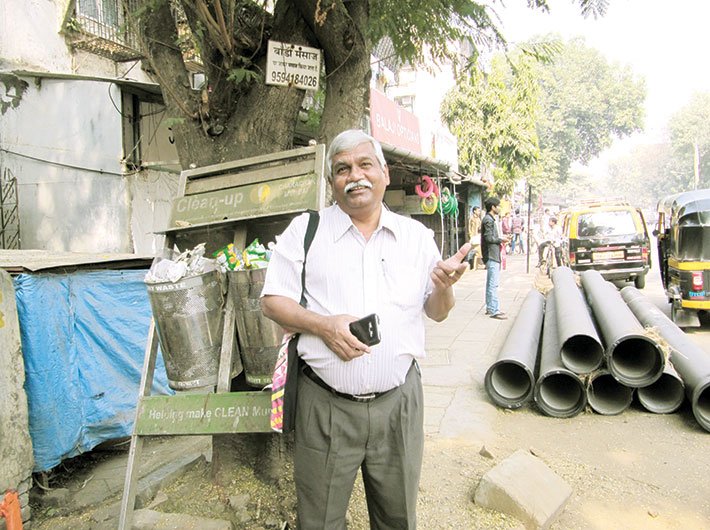
After his retirement, Subhash Rane has taken up the cause of cleanliness with a missionary zeal. Mumbai’s people and civic authorities have responded well
As I walk across the thickly crowded lanes of Malad East in P North ward with Subhash Rane, I notice that unlike the rest of Mumbai, streets here are devoid of any dumping sites, garbage heaps or scattered waste. Walking further through the interiors reinforces the impression.
Subhash Rane, a well-known resident of the area, along with the locals and the municipality ensures the area is kept clean round the year.
Making a collective effort in these congested areas, shopkeepers, merchants and vendors keep their waste in the bins outside which are then collected by BMC (Brihanmumbai municipal corporation) vans every evening. Working full time, with the help of BMC employees, Rane had ensured that waste management of his area – be it schools, slums, roads or markets – was done properly. Later, in place of the bins, plant and flower pots were placed. Rane, 64, has been working on cleanliness and upkeep of P North and parts of P South wards for four years now.
It all started after his retirement from Siemens, a multinational conglomerate. With time on hand, this senior citizen wanted to do something constructive. He enrolled himself for a course in city farming at Marathi Vignyan Parishad, Sion. Over there, he received a handout on dry and wet waste management which he found to be highly important. Rane wondered why the same could not be replicated in his own locality. Wanting to do something better for the community, he got in touch with the municipality and read a brochure on advance locality management (ALM) to understand the practice better. He later approached the local corporator and expressed his willingness to work with him. Starting with his own housing society, Rane began visiting each house to create awareness about dry and wet waste management and difference between the two, and ensured that the civic body collected garbage from the doorstep of every house and slum regularly. Slowly, many dumping spots in the area turned green. A year later, along with BMC employees, Rane was felicitated for his work by the local corporator.
Rane also took training sessions at Paryavaran Dakshata Manch, an NGO, where he learnt about dry and wet waste management. He later became its member and conducted awareness programmes on waste recycling and rainwater harvesting. He now has many youngsters under his wing.
At Upper Govind Nagar, six housing societies are segregating their dry and wet waste. While the wet waste is collected by BMC trucks from the bins placed outside society compounds, dry waste is sold as scrap by residents. “Everyone in our building has started segregating waste and keeping two bins outside their homes. Sweepers have been given instructions to collect waste separately which benefits them too as they can sell off the dry waste to scrap dealers without putting their hands in the garbage. It is not that difficult,” says Janardhan Jamsandekar, a resident of Maduban society where Rane also lives.
Rane now wants to spread this practice in other housing societies as well. “Very few societies follow the BMC rule. The struggle is to segregate waste at the source completely so that BMC refuses to take mixed waste at all. Without segregation, I will not be able to continue this work,” he says. “Initially there was a lot of resistance. Those with small children at home throw diapers out in the open as there are no toilets inside. I try to make them understand the consequences; the difficulties their children can face in future. To a great extent they have been sorted out,” adds Rane.
In the Swachh Mumbai Prabodhan Abhiyan, 750 organisations under the BMC collect garbage in the city. As we walk past the Vadarpada slum, Rane tells me that waste is collected by organisations twice every day, from each house and slum, in addition to the cleaning of community toilets, drains and the area in general, at a cost of '20 per month per house. BMC too chips in with funds to support the cause. Rane however is not that happy with the way the system is being implemented though it is on since 2000. A few yards ahead as we pass by a soiled pole-mounted bin, Rane points out that though the municipality has installed garbage bins on roads, plastic bags are not placed inside and as a result they become dirty.
In his journey towards cleanliness, things have not been all rosy for Rane. He has been accused of being a nuisance and trouble-maker by politicians who consider him a hindrance in their work. Refusing to be cowed down to a threat from a corporator’s representative, Rane prefers to take obstacles in his stride for betterment of the society at large. “This gives me a sense of satisfaction and purpose,” he says.
“It is not that only an MLA, MP or corporator has to work. Anyone who has interest and knowledge can do it,” he says taking out his BMC diary from his cloth bag. “This is my Bible. Be it RTO, police or fire brigade, it has all the contact numbers.” Not just this, Rane also keeps all circulars of the BMC with him to remain updated with information.
Passing through an open heap of sludge, next to a garbage dump in cattle shed, Rane says though the daily cleaning was carried out in the morning, some miscreants with proximity to a local corporator dumped the waste in open. Pointing to a community toilet, he says that at one point it was so dirty that the contractor was not willing to carry out its repair work unless it was cleaned.
In another case, when the roof of a community toilet was missing, the corporator instead got the walls painted. “What was the use if the roof was missing while people complained of the unbearable stink?” Rane, however, saw to it that the roof was made over the toilet.
The popularity of Rane in the area becomes evident as he is greeted by locals in almost every lane we pass by. Some want to discuss their grievances. While others want him to represent them in the upcoming municipal elections, though Rane does not have any of those intentions.
A resident praises him saying, “He is genuine. He will do what even leaders won’t do.” Further ahead, a group of senior citizens ask him to join them. Kantibhai Lalan, a real-estate agent, offers him a chair and a glass of water. Lalan also hands him a written complaint which he wrote to the BMC over the dirty and unhygienic condition of a community toilet. “In a corrupt atmosphere, we need more people like him. We are proud of him. Our ward is very clean,” Lalan tells me.
A few metres down the road, MNS ward president Dinesh Gaikward seeks Rane’s blessings and says that if politicians don’t follow on promises made in their own election manifestos, we will rather have a sincere senior citizen who has been spending gruelling hours for our betterment. “A corporator merely starts a scheme, but Rane has been instrumental in getting the work done. Any person who takes active interest in management of their locality is harassed by local politics. This must end,” says Gaikwad.
For his consistent efforts for treatment of waste at the community level, Rane was once again felicitated, this time by BMC, in December last year. Soon, compost drums will be installed at the six housing societies of Upper Govind Nagar and residents will be taught how to recycle their waste and produce fresh manure for gardens. Along with DIRT, a organic waste recycling company, Rane will educate residents about benefits of composting, recycling, and selling manure.
Such awareness drives have streamlined the system even during festive seasons with roads remaining free from any litter. The green activist says that '11 crore have been allocated for awareness generation by the BMC. “It is not just the responsibility of the municipality but also of the public. Whenever I come across any issue concerning BMC, I call 1916, which is the disaster control number. Citizens can lodge complaints and contact BMC staff directly on this number.” Rane also actively uses Facebook to post suggestions on civic issues.
For the past two years, Rane has been involved in cleaning of the city’s only surviving ‘green lungs’ and a popular picnic spot, Aarey milk colony. He has planted 5,000 saplings there, largely with his own money and some through contributions. Besides, he is committed with many organisations working on environment preservation. “Elected representatives come to power with only 30 percent votes as the remaining 70 percent do not vote. We are representatives of these 70 percent. If people take active part in their community affairs, things will move,” he says.
Prakash Patil, deputy municipal commissioner, waste management, BMC, says, “Rane is doing very good work and must continue, since a dedicated person like him can help BMC greatly. Community bins have been removed and garbage collection takes place right from the source, twice daily. We need to replicate this model in the rest of the city.”
Rishi Aggarwal, a research fellow at Observer Research Foundation, a public policy think tank, says that BMC must encourage Rane’s activities and needs to ensure that segregation of waste at the source is a widespread practice. Echoing Rane’s thoughts, Aggarwal adds that with its new draft circular, BMC is willing to give property tax rebate to zero garbage housing societies. A group of citizens, in a feedback to BMC, have said that the corporation must ensure that societies adhere to this practice before property tax rebate is made applicable.
Rane says there is nothing new or different in what has been done to make the ward cleaner. “Neither me nor the corporator designed anything. Everything in this area has been implemented within the given system of BMC and can be replicated in all the 227 wards of Mumbai.”
[email protected]
(The story appears in the February 16-29, 2016 issue)