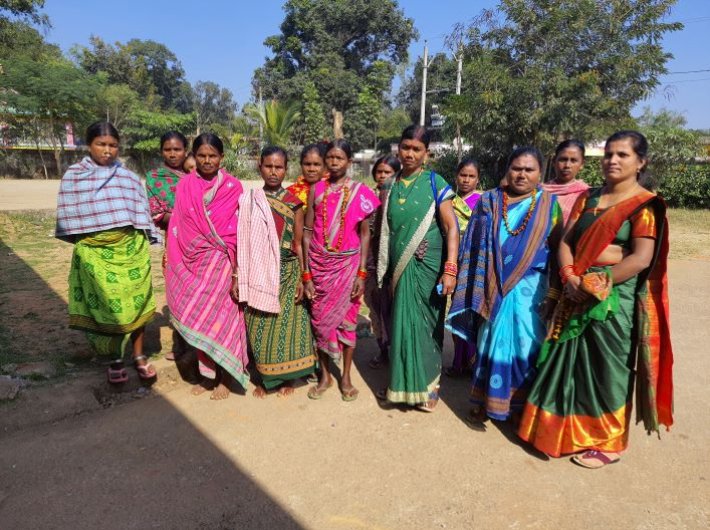
Odisha has several success stories of farmer producer organinsations doing decent business
Meet Promila Krishna, 39, Lalita Nayak, 40, Parbati Gadba, 42, Sanadei Dhuruwa, 39, and Nabita Barika, 41, of Kundra block in Odisha’s Koraput district. Except for Promila who is a matriculate, others haven’t attended school beyond the elementary level. However, while introducing themselves to a newcomer, they wouldn’t hesitate to announce their designation: director, promoter, etc, of course with a wide grin.
Together, for the last five years, they have been successfully leading Mauli Ma Producer Company Limited (MMPCL) in Kundra. Promila is the chairperson of this enterprise of 522, all-women, shareholders drawn from 36 non-descript villages under eight gram panchayats. “We all can sign our names,” claims Lalita, a director.
MMPCL is not alone. Four other such ventures, registered under the Companies Act 2013, operate in Boipariguda, Dasmantpur, Laxmipur, and Bandhugaon blocks of Koraput. A few more are in the process of registration.
Approximately, eighty-five percent shareholders (members) of these women-led companies are from Bhumia, Paraja, Banjara, Kondh, Gadaba and Durua tribes. All of them are small or marginal farmers.
“There’s enormous interest among the tribal women to start their own venture,” sayd Ramesh Chandra Swain, senior program manager, Centre for Youth and Social Development (CYSD), a leading NGO working in Koraput district for over three decades.
Narrating the story of these farmer producer organinsations (FPOs), he recalls that earlier, the barter system was in vogue in these areas. Women farmers encountered difficulties in selling their surplus produce and were victims of distress sell. “In 2015, we discussed the idea with them. It took some time, but once convinced, they haven’t looked back.”
The entrepreneurs also acknowledge the CYSD’s constant back-end support.
As is the norm, each company goes through the annual audit process and files IT return. Their structure and operational pattern is similar. However, the only male member in each company is the CEO.
An educated youth, preferably from a shareholder family, is appointed as CEO at a token monthly salary. He maintains records, prepares the balance-sheet and does the running around on his bike. Mansai Santa, 27, a Kondh graduate is the CEO at MMPCL.
The board of directors (BoD) meets on a fixed date, every month. Its responsibilities include, developing business plans, decision-making, investment, input-linkage, convergence (government departments), trader negotiation, audit as well as statutory requirement compliance.
Last year, the turnover of MMPCL, Jagarana Farmers Producer Company (Laxmipur) and Boipariguda based Sabujima Producer Company Ltd stood at Rs 23 lakh, Rs 17.50 lakh and Rs 27 lakh, respectively.
However, Dangarrani Farmer’s Producer Company Ltd (Dasmantpur) and Banaprabha Farmer Producer Company (Bandhugaon), both in early days and learning the trade, reported a turnover of less than Rs 3 lakh.
It’s not bad going, though.
Forget, luxuries, they lack access to even proper healthcare or education. Till a few years ago, most of these pockets were in the news for Naxal activities.
Each company consists of producer groups at the village level. These groups collect from the shareholders, millet, maize, scented rice, seasonal vegetables and locally available forest goods, tamarind etc.
Though, one is free to sell individually, they prefer the bulk trading route which assures better price and rules out chances of exploitation. The companies collect a small amount from the farmers as service charge for product handling (collection, transportation), quality control (measuring moisture parameter) and marketing (finalizing traders and price negotiation). Each company boasts of assets – a desktop computer, weighing machine and moisture meters.
The other source of income is in the form of interest on loans availed to shareholders, mostly for seasonal crops. The amount, a few thousand rupees, is decided on the basis of land size. The borrower can avail loan, either, or both, in cash and kind (seeds, fertilizers). At the time of sale, the capital with interest is deducted and the borrower collects the rest. It’s a win-win equation for both the parties.
In 2020, MMPCL, which according to Ramesh has “well adapted and streamlined lending procedure”, fetched a loan of Rs 6 lakh.
Kamala Bhumia, a promoter, had invested the borrowed amount (Rs 23,000) on maize farming. Her return: Rs 70,000. By Kamala’s own admission, she reaped a neat profit of Rs 35,000, that too in six months.
Kamala’s fellow friends, Sukmani and Surya Bhumia tell similar stories. While the former took Rs 10,000 and earned Rs 58,000, Surya Bhumia spent the amount (Rs 12,000) on maize cultivation. She sold 15 quintals, at Rs 2,300 a quintal.
“A smile on the farmer’s face gives us immense satisfaction,” states Promila. “Our aim is to involve more and more women and grow together,” she adds.
Though, MMPCL had begun with 200 shareholders with an initial one time capital of Rs 200 each, its membership fee has remained unchanged. Promila says they are planning to enhance the shareholder strength to 1,000 by 2022 end.
Their other target is to own an office building. Though, they claim to have been assured of support by the local MLA, a suitable site is not yet finalized. Every month, they pay a rent of Rs 2,500 for their three-room office at Kundra.
However, the immediate task before them is to hold the annual general body meeting, already cancelled for two years due to Covid-19.
Given the number of shareholders, a large field with enough shade is chosen as the venue for the annual meeting. Depending on the duration of deliberations, arrangements are made for tea, snacks or lunch.
However, after the brainstorming event, they unwind, at least, for an hour. “We enjoy our dance, Dhemsa,” Lalita and others say in unison, excitedly.
Dhemsa, a traditional folk dance of tribal people of central India-southern Odisha and adjacent areas of Chhattisgarh and Andhra Pradesh, is an integral part of tribal life. Forming a chain by clutching each other by shoulders and arms, they dance to the beats of traditional instruments.
With economic empowerment, a perceptible change is visible in the outlook of these women. They are serious about the education of their children. Promila intends to send her teenaged son and daughter for engineering and nursing courses respectively in Bhubaneswar. “Both education and exposure are essential in life,” she thinks. Others echo her sentiment.
What surprises more is the awareness level of these illiterate women. Besides, protection of local forests, they are trying to make the villages liquor free. In some villages, they maintain, liquor consumption has reduced, drastically.
A resident of Raniguda recalls that during the Covid-19 period the FPOs played a massive role. From creating awareness, making provision of cooked food for the economically vulnerable groups to distribution of government’s pandemic assistance (rice and money), the women did everything.
That apart, they also assisted in identification of households for support for agricultural intervention and distribution of dry ration kit, seed kit and inputs meant for families depending on non-timber forest produce like tamarind.
With markets closed due to lockdowns, the FPOs collected farm produce from villagers and sold at Jeypore and other large towns in the district.
“We are happy that we could do our bit in those tough times,” maintains Subhadra Bhumia, Raniguda’s former sarpanch and also a promoter.
According to former information commissioner and CYSD’s co-founder, Jagadananda, in remote tribal pockets, illiteracy among the tribal girls and women is still a major challenge; there are other constraints too. For them, to try, set up and run an enterprise is not at all an easy job. As he puts, “When such enterprises thrive against extreme adverse situations, the joy is limitless.”