Ashok Datar suggests simple, localised solutions; rewards to abiding municipalities and use of revenue for improved infra
With increase in the number of cars, burgeoning traffic and parking on both sides of Mumbai’s congested roads, city-based transport expert Ashok Datar has urged Maharashtra deputy chief minister Devendra Fadnavis to bring in all-party consensus for bringing in parking policy.
In a letter to Fadnavis, Datar says when prime minister Narendra Modi’s enunciation of ‘Sabka Saath, Sabka Vikas’ should be the guiding factor, it is simply ignored when it comes to parking. He calls for thoughtful parking regulations and equitable justice to people who consume very little space for travel through buses, trains, metros or walk. This, he says, will reduce the capex on wider highways emissions. “Through space management and use of fees, throughput of all vehicles and people can be improved.”
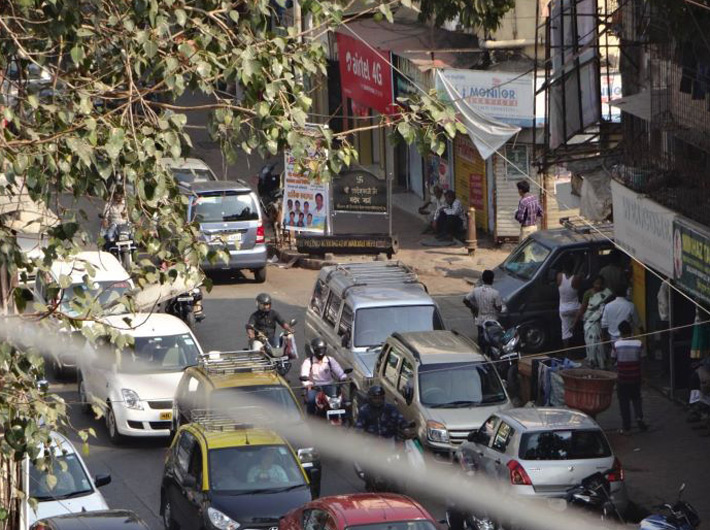
“Our streets have become visual eyesores with car parking on both sides that too for free 24X7/ 365 days of the year. More space is occupied by parked cars on road compared to new roads built by government. Fleet of buses have reduced further increasing traffic congestion on a spiral,” he adds.
Despite spending over Rs 1 lakh crore on highways, metros and sea links since the last 30 years, traffic jams are increasing, becoming longer and frequent at more locations due to increase in the number of cars that continue to outstrip road space that can be build, says Datar.
Private vehicles are increasing at a rate of 10% a year and the number of cars per km of road have increased to more than 1,000. Out of 22 lakh cars in Mumbai, more than 7 lakh are parked on roads, in many cases on both sides of narrow roads, all year round. Barely 2,000 cars are parked under pay ‘n park and about 2,000 cars in multi-storied lots that have proved to be inconvenient for users and idle as there are no takers.
“Most of our roads were not designed for mass car ownership. Predominance of cars on roads in driving and parking modes is slowing down traffic which can be controlled by sensible and thoughtful parking regulation. In Mumbai, we are now embarking on a large metro plan, but unless we have regulated parking, road traffic in the city will be bigger and bigger pain point” he writes.
Datar says that in Delhi, despite building an excellent metro system catering to 60 lakh people daily with comfort, speed and reach, the number of cars have grown at the same speed as in Mumbai. This, he says, has provided proof that merely having metros does not reduce the number of cars or contain congestion. He adds that cities like London, Tokyo, Shanghai, Singapore or Bogota have managed congestion and jams primarily through a combination of public transport and parking regulation.
Datar says in 2018, BMC established a municipal parking authority and expedited establishment of around 30 vertical parking lots with 50 to 4000 parking spaces in a high rise in lieu of extra FSI to builders if they build public parking for use of general public beyond the residents of high rises.
“However large numbers and higher floors were found to be unpopular for parking. The municipal parking authority didn’t get any political support by corporators or government and now after about five years, the municipal parking authority is at its wits end. There is a feeling that the state government is not interested in parking as a subject in any serious manner for possible negative political fallout,” says Datar.
He further says a false advocacy has been built for tolerating a large number of cars on road in the name of support to the car industry as it involves large investment, employment and economic growth. “Common belief is that motorists and automobile industry do not want parking regulation as it restricts car sales. The car industry cannot be sanctimonious about sales if the cities in India are going to be grossly inefficient due to anarchic parking. There has to be primacy for citizen in all classes.”
The transport economist says that parking regulation is a simple and local solution and fees can be "mild" or "strong" depending upon the intensity of traffic on different roads balanced between the space used and people carried.
“You are kindly requested to instruct the state government to bring in parking regulation and fee, applicable to all cities with a population of million and above with suitable consideration to local conditions. The revenue from parking fee and fines should be used to provide road infrastructure like good footpaths and signals, lighting of roads, and policing. It may be a good idea for state government to provide matching revenue to municipalities that abide by the parking code of approved practices and collect revenue which should be used to benefit poor commuters and women,” he says.