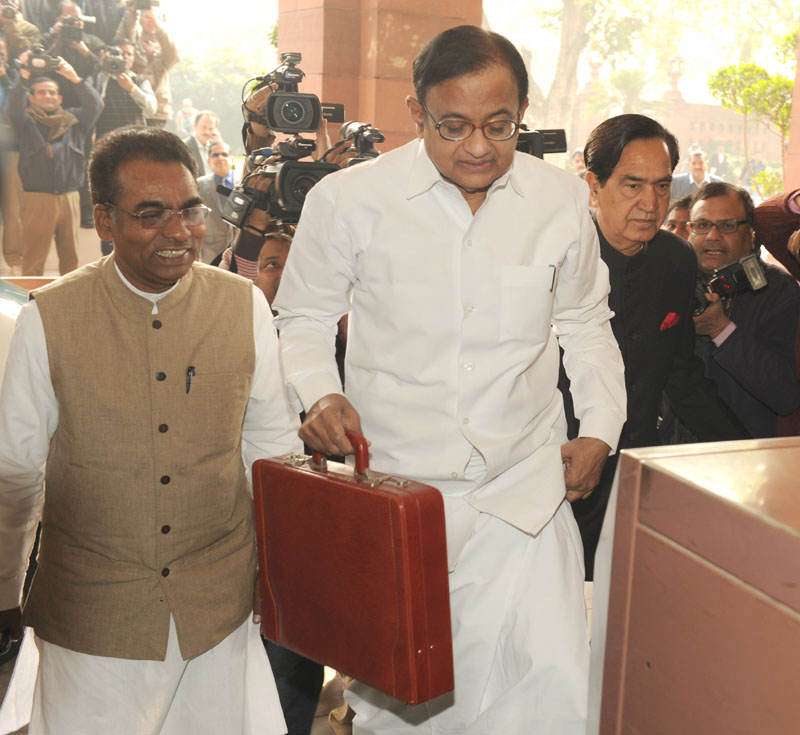
Union finance minister P Chidambaram presented the Interim Budget for 2014-15 on February 17, 2014. Here are some of the highlights:
The planned expenditure will remain unchanged at Rs. 5,55,322 crore.
Fiscal and Revenue deficits are estimated at 3 and 4.1 percent respectively.
The agriculture GDP growth rate in the current year is estimated at 4.6 percent (from 4 percent during UPA-II).
Rs. 1,15,000 crore has been earmarked for the food subsidy for the implementation of the National Food Security Act.
Excise duty has been changed in order to give a boost to the automobile industry (rates can be reviewed during the regular budget): for small cars it has been reduced from 12 to 8 percent; for the SUVs, it has been reduced from 30 to 24 percent.
(Read the whole speech here)
Budgetary support to the ministries
- Ministry of defence: Rs. 2,24,000 crore
- Ministry of human resource and development: Rs. 67,398 crore
- Ministry of health and family welfare gets Rs. 33,725 crore
- Ministry of railways: Rs. 29,000 crore
- Ministry of drinking water and sanitation: Rs. 15,260 crore
- Ministry of social justice and empowerment: Rs. 6,730 crore
- Ministry of housing and poverty alleviation: Rs. 6,000 crore
- Ministry of women and child development: Rs. 21,000 crore
PC's 'vision for future'
"The UPA Government has a clear line of sight to the goals that we have set for ourselves. I have broken down the steps toward those goals into tasks that must be undertaken by the Government of the day. I crave your leave to identify ten such tasks:
Fiscal Consolidation: We must achieve the target of fiscal deficit of 3 percent of GDP by 2016-17, and remain below that level always.
Current Account Deficit: Since we will run a Current Account Deficit every year for some more years, it can be financed only by foreign investment, whether it is FDI or FII or ECB or any other kind of foreign inflow. Hence, there is no room for any aversion to foreign investment.
Price Stability and Growth: In a developing economy we must accept that when our aim is high growth there will be a moderate level of inflation. RBI must strike a balance between price stability and growth while formulating monetary policy.
Financial Sector Reforms: The recommendations of the Financial Sector Legislative Reforms Commission that require no change in legislation must be implemented immediately and, for the other recommendations, we must draw a timetable for passing legislation.
Infrastructure: We must rebuild our infrastructure and add a huge quantity of new infrastructure. Every proven mode l must be adopted and the PPP model must be more widely used. New financing structures must be created for long term funds and pooling of investments.
Manufacturing: We must focus on manufacturing and especially on manufacturing for export. I propose that all taxes, Central and State, that go into an exported product should be waived or rebated. I also propose that there should be a minimum tariff protection so that there is an incentive to manufacture goods in India rather than import them into India.
Subsidies: Given the limited resources, and the many claims on the resources, we must choose the subsidies that are absolutely necessary and give them only to the absolutely deserving.
Urbanisation: Our cities will become ungovernable, and perhaps unliveable, if we do not address the decay in our cities. Cities have wealth, cities also create wealth. That wealth should be tapped for resources to rebuild the cities with a new model of governance.
Skill Development: Skill development must rank alongside secondary education, university education, total sanitation and universal health care in the priorities of the Government.
Sharing responsibility between States and Centre: States have the fiscal space to bear a reasonable proportion of the financial costs of implementing flagship programmes and must willingly do so, so that the Central Government can allocate more resources for subjects such as defence, railways, national highways and telecommunications that are its exclusive responsibility."