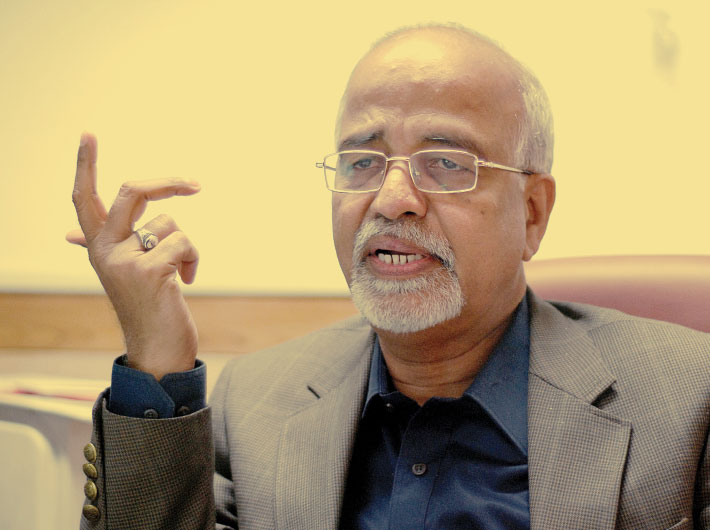
Satyanand Mishra retires on September 4 as the central information commissioner; there will be six vacant information commissioner’s posts at CIC
Wajahat Habibullah, the first chief information commissioner of India, gave the central information commission (CIC) a strong foundation and Satyananda Mishra, an IAS officer of 1972 batch from Madhya Pradesh cadre, managed its evolution. Mishra retires on September 4 as the central information commissioner and with him leaving; there will be six vacant information commissioner’s posts at CIC. According to a newspaper report, Mishra would be replaced by Deepak Sandhu, a 1971-batch Indian Information Services officer. We bring you an interview where Mishra speaks about various challenges before the commission.
This interview was published in March 1-15, 2012 issue of Governance Now.
There are 26,000 cases pending with the CIC. It is feared that delays in information release will render the RTI Act ineffective. Why does the commission have only six information commissioners against the sanctioned strength of ten? (Three more have since been appointed.)
It is not the duty of commission to fill up these vacancies; this is the responsibility of the central government. We have written to the government from time to time to fill up these posts. We need all the ten positions to be filled soon.
As the RTI Act completed five years in 2011, there was a debate: on one hand, the political leadership wanted to review it leading to fears of dilution and on the other hand the activists wanted more powers to it. What are your thoughts on ‘RTI 2.0’?
I have not heard of any serious discussion within the government about the amendment and don’t even see there is any need. The reason probably for not amending the act is the pressure from civil society. It is insisting that the law should not be tampered with and it should be allowed to roll out the way it is. As of now, I don’t think it is being amended anytime soon.
Adding to that question, there have been instances of RTI activists getting attacked or even killed. Is there some way to offer them protection?
People who are seeking the information under the act need to be protected. But the law and order or the protection of an individual is the responsibility of the state. If such incidents have taken place in some state then the state government or state police must act to bring the culprits to book. If immediate action is taken against such people then people will be afraid of taking such an extreme step. Even if we make a rule, there will be no way we can protect such people because the number of people asking for information runs into millions.
You completed a year as head of CIC in December. How do you see it evolving?
It has evolved extremely well. I think we have very sound principles which were laid down by my predecessor. The only worry is that appeals and complaints are mounting. If they keep mounting like this and there is no corresponding mechanism to dispose of these cases quickly then the delay in filing of appeal and its disposal will only increase, which is not good sign. We do not want the CIC to turn into any other law court where cases keep pending for years.
But then all of us, the activists and people in the commission, will have to think about the way out because the number of RTI requests is only going up. And even if we fill up all the ten posts, cases cannot be handled.
These are the things about which one must give a serious thought. We have not come with any suggestions of what can be the other ways, because some of the ways could be extremely radical which may not have acceptability. For example, if we decide to give short orders, it may not be easily accepted. But then we can decide 100 cases a day. You cannot give any suggestions to dismantle cases in law courts but this is not a law court. This is a people’s court and there is no distance between this commission and people, they are part of it.
We are seriously thinking of giving very short orders and some day we will try that in the commission to see how it is accepted. Within the present format there is a scope to increase the number of disposals. Some of the commissioners are handling a huge number of cases a month.
Are officials getting more used to this increased transparency or is there some resistance, the tendency to hold back information?
The tendency to hold back information will always be there. We have not reached the stage where people are happy to disclose information on their own. Therefore we have to have the law and we have to enforce it as well. There has been reluctance because it is not easy to access information at present. But I feel that with more use of information technology in government offices, less work will be done on paper and more work will be done on computer. It would be much easier for them to access that information.
Do you think more awareness is needed about the law?
Awareness about the law among the citizens and among the government officials is still not much. People know that there is something called RTI... a majority of citizens may not even know that. And those who know, do not know what it can achieve. We sometimes receive applications which show that people think it is some substitute of a grievance redressal mechanism. It can be a grievance redressal mechanism but not always. People have developed a lot of expectations from the RTI. But even now its awareness is limited to urban or semi-urban areas. It has not spread much.
But through campaigns we can spread the word. Jaago Grahak Jaago, a campaign of the consumer affairs ministry, has really made an impact on citizens. And there are private companies which are coming up with advertisements for their products along with this campaign. So we should do something similar with the RTI, in which the social message can be embedded with other messages.
As for the ambit of the law, there have been demands—and even one court judgment—to bring public-private partnerships (PPPs) within the RTI Act. There have been demands to bring bodies like the BCCI under the RTI. Is there any mechanism to review the ambit and extend when necessary?
This has to be decided on the case-to-case basis. Within the parameters of a public authority, when a case comes, the commission decides whether it is covered by RTI or not. Otherwise it will need amendment to the law to say that a PPP will be covered under RTI. But right now there is no upfront definition of this kind.
Last month, at an RTI workshop, you spoke frankly about the need for a strong Lokpal and you also reportedly said people had lost faith and trust in the government.
It would be very unfortunate if people lost trust in the government. But I do not think that people have lost faith in the government. This can be proved by the huge turnout of people voting in UP or Punjab elections. So it is not correct to say that people have lost trust in the government. People have lost faith in many government servants.
There is certainly a need for a strong agency, whatever its name may be, to take up cases of corruption and follow it relentlessly till the guilty is punished. But the fear is that if we bring too many such interventions without any structural change, it will not be of use.
The change in the system to stop corruption cannot happen by policing. That can happen when we recruit good people to the government at all levels. And also they need to undergo regular training. There should be change in the system of hierarchy as well.