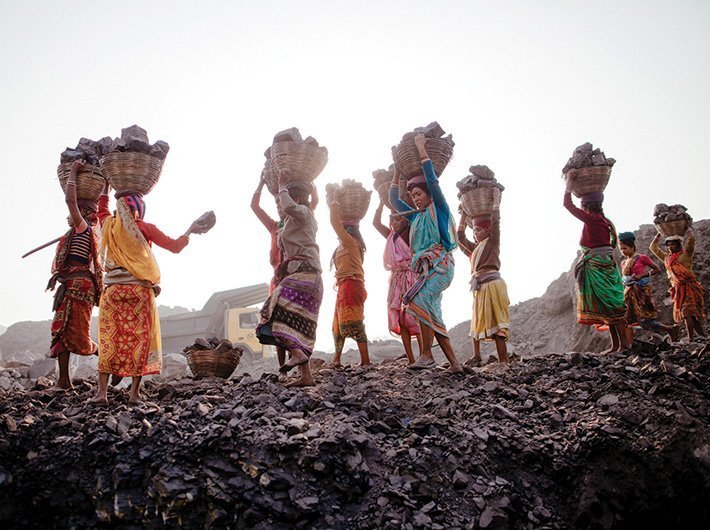
Not only do significantly more women compared to men engage in unpaid work, they spend two to ten times more time on unpaid work
Women spend two to 10 times more time doing unpaid work than men, showed research carried out by ActionAid India.
“Invisible Work, Invisible Workers - The Sub-Economies of Unpaid Work and Paid Work” is about women’s unpaid labour in four districts of three states of India – Maharashtra, Telangana and Uttarakhand. It comprises of a survey of 1,560 women and the desk review of schemes and policies aimed at reducing and redistributing women’s unpaid work in those states.
Releasing the report on Wednesday, union minister Ramdas Athawale shared his memory of his mother who worked as an agricultural worker and put him through school. “Women take on a number of responsibilities and they should get justice and security in the sphere of work,” he said. He promised to take up the issues raised with the authorities concerned.
Sponsored by UN Women and conducted with women from the community, partner organisations and a team of researchers led by Prof. Ritu Dewan of Centre for Development Research and Action, the research generates evidence on the continuum of women’s paid-unpaid work in the specific context of both urban and rural constituencies.
“During the research women told us “Our children grow up on the street”. The burden of work leaves women with little time for childcare,” said Dewan.
“The continuum of paid work and unpaid work calls for the need to add a fourth “R” of re-define to the existing three “R”s of recognize, redistribute and reduce connected with women’s unpaid work,” she said.
According to the research, not only do significantly more women compared to men engage in unpaid work, they spend two to ten times more time on unpaid work. In addition to their paid activities, this creates a double burden for them with implications for numerous facets of their life cycle – on their health, on their ability to acquire education, skills, a paid job and an independent income as well as a voice and social status.
“This is not to say that men do much less work, but in general the number of men involved as well as their share of the work burden is significantly less in terms of both hours and ranges as compared to women.”
“At ActionAid our research seeks to strengthen our interventions in the field and collective struggles for justice,” said Sandeep Chachra, executive director, ActionAid India.
“In terms of the amount of stress that women have to bear, the study revealed that nearly 80% of women in all areas categorically expressed their desire for sleep. For rural men too sleep was a priority though at 20% less as they also share the burden of paid and unpaid work albeit to a lesser degree than women. We need to see how these issues can be tackled on the ground,” he said.
The burden of unpaid work is also intensified by the lack of adequate public provisioning in critical sectors such as energy, health, water and sanitation, food security and livelihoods. Intensifying women’s burden and increasing it manifold is the huge vacuum created by macroeconomic policies and strategies that do not take cognizance of its existence. This is aggravated even more by the continuous and consistent withdrawal of whatever little state support exists in the hunt for capital accumulation.
The discourse on women’s unpaid work is especially relevant in the Indian context because women’s labour force participation has seen a declining trend over the last decade, with 21 million women exiting the workforce and a large majority moving into what is termed as the realm of ‘domestic responsibilities'.
Highlights
• In India, women are employed primarily in the informal sector, which accounts for 93 percent of the national workforce (NSS, 2009-10). With merely 22 percent of them recorded as workers, four-fifth of the women are associated with the farm economy, which has little or no economic or social recognition and limited access to social protection.
• By and large women’s work is characterized by informality, invisibility, vulnerability and drudgery. Even when they are remunerated, the work conditions and their wages remain grossly exploitative and in contravention of international and national labour standards.
• The marginalisation of women is further exacerbated due to their socio-economic position in society. Moreover, entering the labour market does not mean that women abandon their unpaid and care work. Instead, the expectation is that they will continue with multiple activities.
• Not only do more women do unpaid work than men, they also spend between two and ten times more time on it than men do. In places like Uttarakhand, the agricultural economy is becoming feminised, while men often migrate to urban areas for work. Property and landholdings are on average very low.
• Women often have little (if any) property ownership and huge dependence on common property resources and informal infrastructure. Women’s work is often veiled by a failure to recognise sense of community and communal ownership.
• 80% of women surveyed for the report expressed the simple desire for sleep.
• Due to the lack of recognition and support for women doing unpaid work, children are left with the elderly or unemployed or simply on the streets with other youth. These children are the future of the country and of the workforce.
• Work is a continuum. Unpaid work is not separate from other work and must not be treated as such. This report suggests new estimators and methodological approaches towards this continuum.