
A president all the way, fighting child labour and, keeping critical info safe

Here is a list of five stories from our latest edition that you must read this weekend

GN Bureau | July 8, 2017

#women   #child labour   #Pranab Mukherjee   #weekend stories   #cyber security  


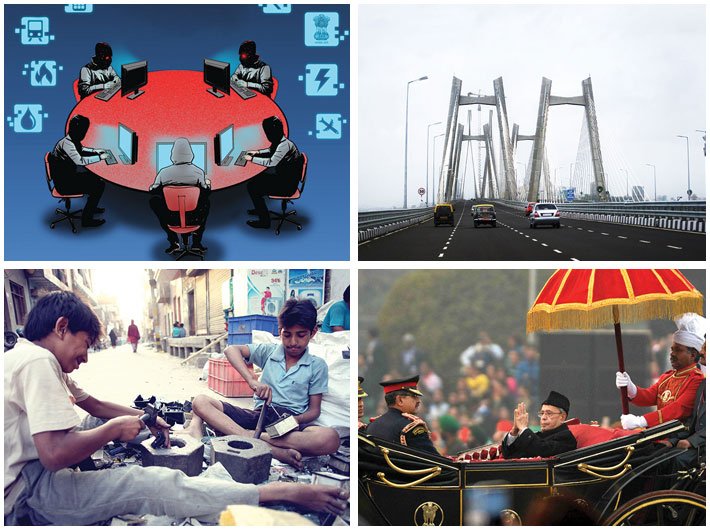
President Pranab Mukherjee, who demits office soon, has been known as a man “of the constitution”, a believer in it, and was called to be its custodian during the last five years. His familiarity with the country’s constitution, as also the constitution of the Congress, was legendary and ‘Pranab da’ was the man to go to if any clarity was required on a provision or a grey area. He has left his mark on Rashtrapati Bhavan by opening it to the public and equally by speaking up about tolerance. Governance now assesses his term as president.
 
 
In a historic move, the government, after nearly two decades, ratified two of International Labour Organisation’s (ILO) core conventions on child labour – convention number 138 (minimum age of labour) and convention number 182, which bans all the worst forms of child labour. The ratification has deservedly received praise from ILO and child rights activists. The government termed it as a “milestone initiative” with the “aim of realising a ‘child labour free India’ and restoring to the children what is rightfully theirs – their childhood and their dreams”. But the question is: Will the ratification alone ensure welfare and safety of the children in India?
 
 
The world’s largest mass migration is currently underway in India. Indians are city bound. They are abandoning villages for a variety of reasons that range from drought to dreams. It’s a massive movement every day... This is also the right time for India to foray into unexplored new ground to decisively rewrite and reconfigure existing knowledge about urban life, cities and its future. It’s the right time, because we Indians know that we need cities.
 
 
India has, relatively speaking, moved up significantly in automation. The protection of the automated and unautomated systems, which run most of the critical infrastructure, however, is still in its early days. India doesn’t have a strong defence mechanism to deal with threats from the state actors. It has come a long way though. Here is a brief on the major works undertaken by the government in last ten years in cyber security.
 
 
Though there is no way to arrive at exact numbers, psychiatrists and others in healthcare are in no doubt that the number of women abusing substances (from alcohol to all kinds of drugs) is increasing. For a country of more than 585 million females, India has only three de-addiction centres dedicated to women – one in Delhi, one in Manipur, and one in Mizoram. The condition of government-run de-addiction centres (where men and women are usually treated together) is pathetic; addicts who can afford it prefer private de-addiction centres, which are expensive, and those who cannot register and wait for their turn at centres run by NGOs. 


Comments


Other News

Not just politics, let`s discuss policies too

Why public policy matters Most days, India`s loudest debates stop at the ballot box. We can name every major leader and recall every campaign slogan. Still, far fewer of us can explain why a widow`s pension is delayed or how a government school`s budget is actually approved. That

When algorithms decide and children die

The images have not left me, of dead and wounded children being carried in the arms of the medics and relatives to the ambulances and hospitals. On February 28, at the start of Operation Epic Fury, cruise missiles struck the Shajareh Tayyebeh school – officially named a girls’ school, in Minab,

The economics of representation: Why women in power matter

India’s democracy has grown in scale, but not quite in balance. Women today are active participants in elections, influencing outcomes in ways that were not as visible earlier. Yet their presence in legislative institutions continues to lag behind. The Nari Shakti Vandan Adhiniyam was meant to addres

India will be powerful, not aggressive: Bhaiyyaji

India is poised to emerge as a global power but will remain rooted in its civilisational ethos of non-aggression and harmony, former RSS General Secretary Suresh `Bhaiyyaji` Joshi has said.   He was speaking at the launch of “Rashtrabhav,” a book by Ravindra Sathe

AI: Code, Control, Conquer

India today stands at a critical juncture in the area of artificial intelligence. While the country is among the fastest adopters of AI in the world, it remains heavily reliant on technologies developed elsewhere. This paradox, experts warn, cannot persist if India seeks technological sovereignty.

RBI pauses to assess inflation risks, policy transmission

The Reserve Bank of India (RBI) has begun the new fiscal year with a calibrated pause, keeping the repo rate unchanged at 5.25 per cent in its April Monetary Policy Committee (MPC) meeting. The decision, taken unanimously, reflects a shift from aggressive policy action to cautious observation after a signi


Archives

Current Issue

Opinion

Facebook Twitter Google Plus Linkedin Subscribe Newsletter

Twitter







