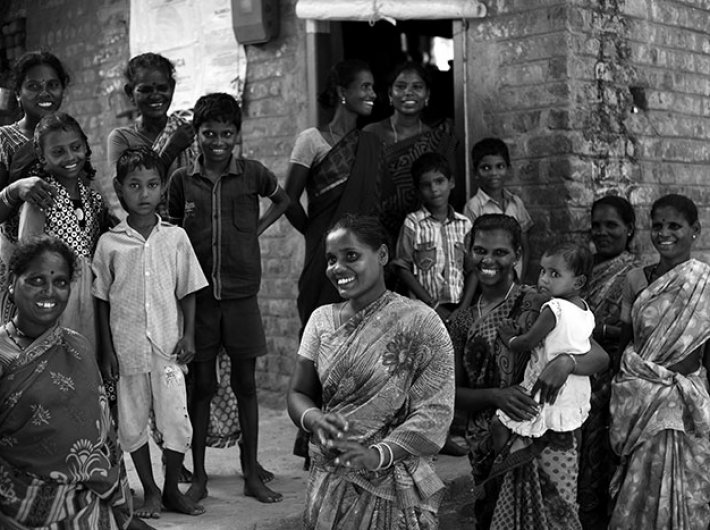
They live as whole families in small straw huts they made with their bare hands, on a patch of land miles away from the nearest town. It looks desolate. But it is, they tell me, “paradise”. Because before they came here, they had been forcibly held as bonded labourers by a plantation master. It is 2016, India is a global power, and I am talking to people who have escaped what is effectively slavery.
They are members of the Yanadi tribal community in Andhra Pradesh, one of the most marginalised communities in India, regularly exploited by the rich and powerful. They tell their story: “The plantation owner was a vicious man. When he got angry because we had not cut enough of the crop, he would tie us to a tree and beat us. It was hell we were living in. If an adult ran away, he would hold their children captive until they returned. He took one of the children, aged 8, to work every day at his house in town. When she was 12, he began to rape her. She ran away but was brought back to the house.
Then one day, when she was able to visit a nearby temple, she was spotted crying by a member of our community. She told them what was happening and they connected her with a local organisation that together with the police raided the plantation and freed us all. They got us allocated this land and we will build our own houses and farm buildings. We feel so happy now that we are free. We will stay here forever.”
Another group of freed bonded labourers has recently joined them. They had been held by another modern-day slaver at an illegal fish farm working in dangerously toxic conditions, handling with their bare hands the rotting birds used to feed the fish. When they describe their conditions, the group who lived on the plantation say that they had thought no one could live in conditions worse than theirs until they met the escapees from the illegal fish farm. “At least our situation was better than theirs.”
I can’t quite believe that I am hearing people who have endured slavery talk of how others had it worse. I ask them how they escaped their captor. “One of the members of the Yanadi community, now a professional NGO worker, heard of our plight from one of our relatives. He exchanged his shirt and trousers for a lungi like the ones we wear and came to the farm pretending he was visiting a relative and was willing to work for free while there. He spent two days undercover there, whispering to us that he could come back with the NGO and the police, if we wanted to be free. We all said yes that we would. He slipped away and came back with the raid. The owner escaped. But we are free.”
I am overawed by the bravery of the NGO worker who went undercover, and of the little girl who reported her abuser.
I remember the line from the African-American former slave and anti-slavery activist, Harriet Tubman, who said, “I freed a thousand slaves. I could have freed a thousand more if only they knew they were slaves.” I ask the group: “Did you know that what was being done to you, how you were being kept, was illegal?” “Yes”, comes a reply, and then more: “Yes”, “yes”, “we knew”. I ask further: “Did you tell anyone in authority?” The reply sets out plainly the brutal inequality of power they faced: “Who would we tell?”
It is the day before the 125th anniversary of the great dalit leader BR Ambedkar, and huge “marches for equality” are set to take place. The two groups of former bonded labourers will join tomorrow’s events. Ambedkar’s work is still unfinished. As I leave, they ask for nothing. Well, they ask for one thing. They ask that I return. “Please come back and see us sir, see us when we have built our houses here.”
As we travel back, I ask the activists accompanying me what has happened to the moral framework of the landowners who exploit them. “Oh, they think it is perfectly normal. It is partly the caste system, partly greed, partly what they saw their parents and grandparents do to people at the bottom of society. The landlords club together as a network. We’ve been working on getting Yanadi people access to land that is in their own name, which the landlords hid from them and made them work on as if it was the landlords’. We’ve had to protect our staff after the landlords held fundraisers to pay for activists to be killed.”
Hasn’t the modern world, the internet, the new economy and globalisation changed any of this? All that is built on top of the old system. And the gap is widening, with the higher castes holding the top. It will only be broken down from below. I am reminded of how the English radical politician Tony Benn, himself an aristocrat, described the establishment: “I don’t think people realise how the establishment became established. They simply stole land and property from the poor, surrounded themselves with weak-minded sycophants for protection, gave themselves titles and have been wielding power ever since.” This is what I have witnessed in its most naked form today.
But I have also witnessed the refusal of people in even the most desperate situations to succumb to the lie that their mistreatment is acceptable, that their worth is less than others. Talking with one of the families I asked them the name of their daughter, born on the plantation. “She is called Bangaram, sir.” “It means …” “I know, it’s one of the few Telugu words I know, it means gold. She is gold.”
Phillips is the international director of policy, research, advocacy and campaigns for ActionAid, an NGO working to tackle inequality and injustice.
Twitter at @benphillips76
(The column appears in th June 1-15, 2016 issue of Governance Now)