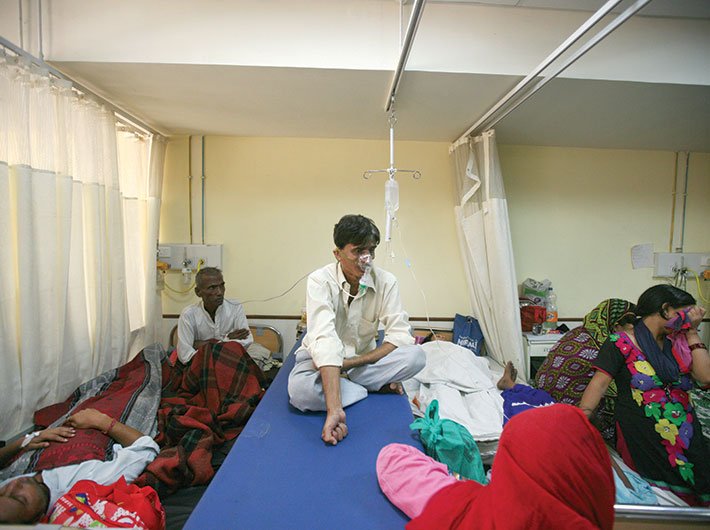
Cardiovascular disease requires long-term treatment and medicines are simply not within the reach of the poor in India, shows a study
Should health insurance include the cost of medicine? That is the question raised by a recent study on India which seeks to measure the financial burden of cardiovascular diseases on people.
While it does not make any suggestions, it does point out that health insurance schemes in India do not cover medication costs. It further points out a known fact that 75 percent of health expenditure in India is out of pocket. And medications comprise 70 percent of these out-of-pocket expenses.
The study quantified these out-of -pocket expenses in purchasing cardiovascular medicines in India by measuring the resources available to individuals, subtracting daily medication costs to treat ischemic heart disease, and comparing the remaining available resources to established poverty thresholds set down by the C Rangarajan committee on poverty line.
The study led by Indian scientist Raj Kiran Pandey in the University of Chicago concluded that cardiovascular disease demands long-term treatment and the medicines are simply not within the reach of people in a low and middle income country like India.
It says that cardiovascular disease can lead to two outcomes in an Indian scenario: the patient decides not to take any medicine or the patient falls below the poverty line, incurring severe debt.
In order to assess the financial burden of heart disease, the researchers created five step-up treatment regimens for the most common cardiovascular medications in India. These were created by progressive addition of Aspirin, Hydrochlorothiazide, Losartan 25 mg, and Atorvastatin 10 mg or 40 mg. Daily cost from steps 1 to 5 increased from Rs 0.13, Rs 1.16, Rs 3.81 and Rs 10.07 to Rs 28.85.
The researchers deducted the expense at each stage from the resources available as per daily per capita expenditure data from the National Sample Survey. They compared the resultant income to the 2014 poverty threshold recommended by the expert group led by Rangarajan. This group had calculated Rs 32.4 as poverty threshold for rural India and Rs 46.9 as poverty threshold for urban India. This meant that 31 percent of rural population and 27 percent of the urban population is poor.
To the population below the poverty line, any health expenditure may be assumed to be unaffordable, the study says. For instance, buying a primary prevention regimen of an Aspirin and an anti-hypertensive (Hydrochlorothiazide 12·5 mg – step 2) would increase gross poverty ratios to 34 percent and 28 percent of rural and urban people respectively. This regimen could impoverish an additional three percent rural and one percent in urban population.
Hence, the treatment would mean swelling the numbers of the poor in India. Such being the case, the study offers no solutions but merely mentions that health insurance in India does not include medicine costs and generic drugs are not easily available to majority of people.
So for most people with disease, the only option is either to ignore it or take the pill and incur back-breaking debt. The study, “Financial Burden and Impoverishment Due to Cardiovascular Medications in Low and Middle Income Countries: An Illustration from India”, was published in PLOS in May this year.
Says lead author Kiran Raj Pandey: “17 million rural and 10 million urban people would be impoverished just because they took drugs they needed. Poverty figures would go up by 2 to 3 percent. That is a significant financial burden.”
Since medication is the reason for a huge amount of financial burden on the patients, including them in insurance may be an option, he told Governance Now. He also suggested subsidies for medication.
He says the study was for the whole of South Asia and India was just a case study and hence any one solution may not suit everyone.
The findings of the study have serious implications. They show that as much as 17 percent (93 mn) of the rural and 32 percent (76 mn) of the urban adult population may benefit from cardiovascular medicines. “If all of them were to buy cardiovascular medicines out of pocket, 4.05 percent of the urban adult population and 3.14 percent of the rural adult population could be impoverished due to the purchase. This could mean that 17 million people in rural areas and 10 million people in urban areas could be impoverished if all the people who would benefit from these medicines bought them out of pocket. Poverty gaps could increase by as much as 2.91 percent in rural areas and 2.88 percent in urban areas.”
Another problem area as far as chronic conditions like cardiovascular disease is concerned is the requirement for multi-drug regimen.
This poses a significant burden on people as chronic diseases like CVD are rarely treated with just one drug.
Although the Indian government has declared essential medicines free within the public health system, availability has often been reported to be anywhere between 0 to 30 percent. Health insurance schemes like the Rajeev Swasthya Bima Yojana and AarogyaShri are now available for some people, but they mostly cover hospital charges and do not provide long-term prescription coverage. As a result, 70 percent of out of pocket health expenditures in India are for purchasing drugs.
According to activist Vandana Prasad of the Jan Swasthya Abhiyan, this study has pointed to a serious lacunae in healthcare, as cardiovascular diseases and some other non-communicable diseases require chronic treatment for which there is no provision.
Menon is a freelance journalist.
(The story appears in the July 1-15, 2016 issue of Governance Now)