
Book review: The memoir of the bureaucrat, written in humorous vein but remains serious in its message
Himanshu Upadhyaya | December 8, 2016
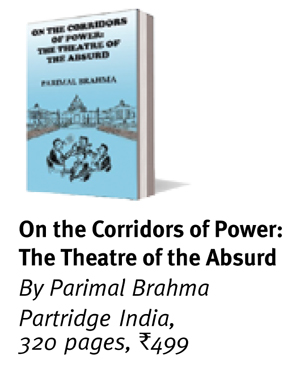
The year 2014 saw the publication of the memoirs of a former CAG of India, Vinod Rai, and this year another former member of this prestigious constitutional body has penned an account of his time as an auditor (and also administrator while on deputation). Parimal Brahma’s book talks about the experiences that honest and upright officers in public administration go through. He recalls the tragic story of his friend, Abhas Chatterjee, a topper in the 1966 civil service exam, who quit services in January 1992, feeling disgusted and disenchanted with the system.
Brahma recollects grave episodes of how the idea of public accountability gets compromised by actions of public administrators. This memoir has very little on the early years of his career as probationary civil services officer and the first posting. Towards the end of the first chapter, he looks at his days of working as deputy accountant general (works) at Bhopal, where he was transferred from Calcutta in 1971.
There is an account here of how he moved from public auditing to the central secretariat. He recounts that initially he was short-listed for the position of under-secretary, department of economic affairs. This shift could not take place since the cadre-controlling authority, the CAG of India, felt that not taking his prior consent was akin to taking him for granted. Many months later there came an order from the CAG office posting him as an under-secretary at the ministry of defence. One can see the aspirations of a bright young Indian audit and accounts service (IAAS) officer and a slight bitterness tinged with a tone of humour.
There are three chapters where he recollects his days in the ministries of defence, civil aviation and tourism, and environment and forests. He recollects personalities of various secretaries and ministers through episodes that are both humorous and deadly serious such as the proceedings of the public account committee (PAC) on audit paragraphs. Several episodes that he narrates give the reader an impression of what systemic deficits are encountered in ensuring public accountability and probity. Occasionally, Brahma would cite correspondence – a letter from an anguished father of a Major voicing the grievances and a letter that he wrote to the PMO pointing out flaws in the system of selecting secretaries. He is unsparing in his criticism of how we continued many years to maintain an overseas tourism promotion office in a country from where only 18 tourists a year on average would come to India. Similarly, he also talks about how he had to disapprove a tourism director general’s Malaysia trip for an event whose agenda was more tilted towards poaching Indian tourists to east Asian countries, rather than attracting tourists to India.
Third chapter has details on how the environment ministry failed to deliver on the idea of environmental protection, be it protection of tigers or conserving our holy rivers against pollution.
The fourth and fifth chapters raise several important issues concerning ethics in governance and the need to preserve the institutions and parliamentary processes that have a promise to ensure public accountability and probity. He talks about the cash-for-question phenomenon that makes elected representatives ask ‘motivated questions’, the loopholes in the premier investigation agency CBI, the promise that the institution of Lokpal (ombudsman) offers and a few episodes of his work in what he calls ‘graveyard postings’.
The fifth chapter starts with his narration of his efforts yet again to break away from a ‘prison’ called the central secretariat and at last finding a reprieve that he got a chance to return to roots – the CAG office. This chapter also raises some pertinent issues about how the top boss as the CAG is appointed and a need to ensure accountability in selection. It is known for quite some years now that this coveted constitutional post has been bagged by persons belonging to IAS cadre and questions have been raised whether there shouldn’t be a rethinking about giving it to IAAS cadre when the next CAG gets appointed.
I had picked up this memoir with a hope that Brahma would tell his readers about the much awaited amendments to the CAG (Duties, Powers and Conditions of Services) Act, 1971. Sadly there is nothing on this and other ongoing debates around the role of CAG in the PPP arrangements.
Upadhyaya is an assistant professor at Azim Premji University, Bengaluru
(The book view appears in the December 1-15, 2016 issue)
The extraordinary transaction volumes and value (₹29.82 Lakh crore in August 2026 alone) of the Unified Payments Interface (UPI) have made it not only an Indian success story, but a global one. In 2024, UPI accounted for nearly 49% of the world’s real-time payment transaction volume, with more th
Diplomacy is akin to an art, wherein the summitry, conflict resolution and negotiations form apt constituents of the entire context of deal making and “playing for keeps” in the international arena. The Xi-Trump summit in Washington last week, in which the American president broke all conside
Moving to Delhi-NCR for education can be an exciting experience for students from Northeast India. It gives us a chance to meet new people, experience a different culture and become more independent. But living away from home also comes with challenges that people who have not experienced them may not al
The government has reduced the Basic Customs Duty (BCD) on major imported crude edible oils with a view to moderating domestic edible oil prices, providing relief to consumers and mitigating inflationary pressures arising from the sharp increase in international edible oil prices.
In his opening address at the 18th BRICS Summit in New Delhi on September 12, prime minister Narendra Modi did something India`s diplomacy has been building towards for three years: he moved the ‘Voice of the Global South’ from a slogan to a work plan. Addressing the leaders, he argued that t
The Pradhan Mantri Jan Arogya Yojana (PM-JAY), a welfare scheme which covers approximately 45 crore beneficiaries across India, provides cashless health cover of Rs. 5 lakh per family per year. It is the largest health insurance scheme which helped crores of poor families by reducing out-of-pocket expend











