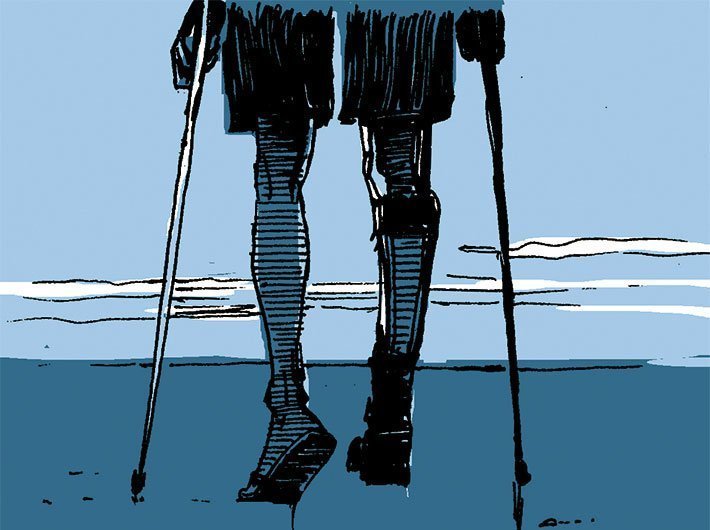
Special initiatives can bring Persons with Disabilities back in race for social inclusion
The pandemic affected various ethnic and social groups quite disproportionately. This becomes particularly important for a country like India, where many social groups are yet to be integrated with the mainstream population. Development disparities and crimes against weaker sections of society are indicators of the prevalent gaps in the dream of social inclusion. Perhaps the pandemic undid significant progress made through policies to bridge these gaps.
In this context, Persons with Disabilities (PwDs) occupy a special place. Being quite vulnerable and suffering from certain ailments, they lag behind the general population in terms of education, nutrition, employment, economic and social participation, etc. Such individuals would have been affected immensely due to the pandemic, which thereby pushed them further away in the race for social inclusion. In order to improve the status of the PwD community, the government came up with many policies and Covid-support measures. This article aims to analyse the existing measures of empowerment of such individuals and the new measures deployed by the government during the pandemic. Based on the same, a strategy to stimulate the process of empowerment of such individuals has been developed.
Initiatives of the government – pre- and post-pandemic
In terms of support during the pre-Covid times, the government has indeed come up with many novel and innovative schemes to help PwDs with their special needs. However, in order to avail them, proper documentation is a prerequisite. With the onset of the ongoing pandemic, the process of issuance of disability certificates turned online.
In order to ensure proper monitoring of PwDs, the Department of Social Justice and Empowerment, Government of India, introduced another instrument in 2016. This instrument is called ‘Unique Disability ID or UDID Card’. Recently, during the massive vaccination drive, the government has even recognised the same as a valid proof of identity for PwDs. In Rajasthan, UDID cards have been issued to almost 358,000 persons whereas 390,000 persons hold disability certificates.
As regards economic empowerment, the National Handicapped Finance and Development Corporation (NHFDC) sanctions loans to PwDs with the help of its state channelising agencies and through partnering with various NGOs. Indeed, the corporation has done well so far and upon partnering with local NGOs in smaller towns, it will be able to perhaps reach the last differently-abled person.
For Covid support, apart from the special guidelines issued by the Ministry of Health for PwDs, many other statutory public bodies issued advisories to provide additional support. For instance, the National Human Rights Commission had issued an advisory which entailed special relief measures for PwDs. In terms of economic support, it involved providing direct financial support to those PwDs which have lost employment due to the pandemic and timely issuance of disability pensions.
Perhaps the most important measure was providing food and ration support to PwDs irrespective of possession of disability certificates by them. An advisory was also issued by the Department of Empowerment of Persons with Disabilities (DEPWD). It included ensuring supply of essential support services, personal assistance, and physical and communication accessibility to PwDs during quarantine. The advisory also laid emphasis on special care to be taken for children and women with disabilities.
Even the National Disaster Management Authority (NDMA) issued its guidelines which mention inclusive approaches and strategies to “Build Back Better” (BBB). BBB is a holistic concept which leverages techniques in post disaster reconstruction for building a more resilient community in a more efficient and effective way.
The Way Forward
• The process of issuing disability certificates and UDID cards indeed needs to be ramped-up as well as simplified. Delay and pendency in the process should be minimised. As regards application process, the e-Mitra operators should be upskilled to handle diverse clients more specifically and efficiently – thereby enabling more PwDs to receive the benefits of government schemes. In unison, it would also help keep track of PwDs and their upliftment.
• Lack of disability-friendly infrastructure continues to remain a gridlock in integrating PwDs with other social groups. As many as 19 states are yet to build a disability-friendly community toilet. These include many wealthy states like Punjab, Maharashtra and Tamil Nadu. Construction of toilets accessible to PwDs forms the core objectives of the Swachh Bharat Abhiyan (launched in 2014) and The Rights of Persons with Disabilities Act 2016.
• In recent years, the use of AI and ICT in building sustainable communities has gained traction. Such futuristic technologies are being viewed as a solution for elimination of any form of bias towards treatment of individuals, thereby leading to social groups fully receiving their rights. The same idea can also be leveraged for the holistic development of PwDs in India.
• At the secondary education level, AI can step in to provide access to high quality educational resources in multiple languages and formats accessible by PwDs. Since differently-abled persons have historically been alienated to the benefits of technology, AI and ICT can act as the ice-breaker.
• NGOs also play a vital role in the upliftment of PwDs. NHFDC can increase its outreach to NGOs in small towns as well, so that loan schemes are effectively availed by PwDs and they do not have to resort to informal ways of borrowing with lesser accountability attached to the lender.
• Involvement of private players is equally much desirable. Companies like Flipkart and Amazon have come up with innovative solutions for employment of PwDs. In their Mumbai and Bengaluru facilities, they have already started hiring teams with speech or hearing disabilities. These companies collaborate with NGOs committed to the cause of generating employment for PwDs. These individuals undergo training in order to manage last-mile delivery and order fulfilment.
• In PPP mode, the government and private enterprises can collaborate on such innovative solutions, bringing it out on a bigger scale – on the lines of MGNREGA. This would not just empower a differently-abled person but also lead to a sustainable income source and a dignified self-reliant life. This is in line with what the CEO of the government think-tank NITI Aayog has said, that employment engagement and empowerment of PwDs would lead the nation forward.
The pandemic has indeed exacerbated many hurdles for differently-abled individuals. Data from studies reviewed in this article allowed formulation of a diverse array of approaches towards alleviation of plight of Persons with Disabilities. If the above suggestions are followed wholeheartedly, PwDs would be able to catch-up quickly to other communities in the race for social inclusion.
Beohar Adwait Sinha is an intern with the department of social justice and empowerment at NITI Aayog.