Unmanned aerial vehicles have the potential to transform urban governance, and new rules are definitely a step in the right direction
In 2015, India started its Smart Cities Mission (SCM) with the purpose of harnessing technology to initiate infrastructural makeovers and transform the country into a more liveable, economically dynamic and environmentally sustainable nation within five years [see: https://pqars.nic.in/annex/253/A30.pdf]. Since then, cities across India have made progress toward these goals while having new technologies and systems tested by the Covid-19 pandemic.
For instance, Pune, Bengaluru and Vadodara have set up Integrated Command and Control Centres (ICCC) to gather information on food and shelter provision with location and contact details of food distribution, shelter homes and kitchens. All this data is accessible via dashboards, maps, simulation models, and visualise crisis scenarios to monitor mobility patterns, track the Covid-19 outbreak in real-time, dispatch frontline workers, and boost emergency services.
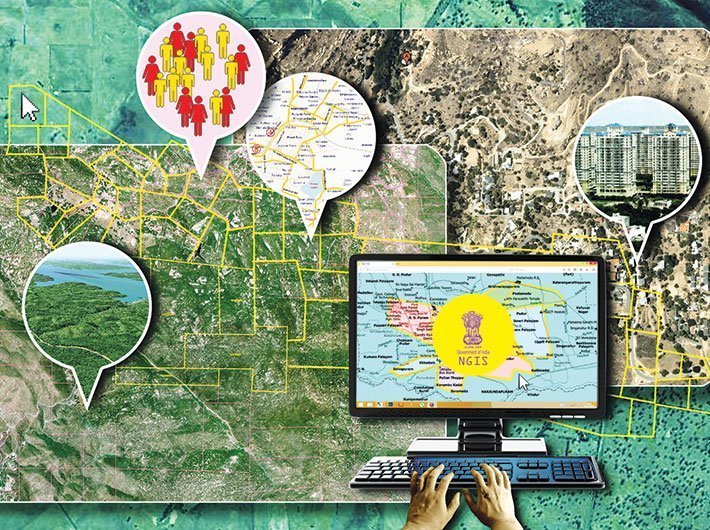
The underlying system that enables all of the above to work is Geographic Information Systems (GIS) – a spatial system that creates, manages, analyses and maps data. The use of GIS in India during the pandemic has demonstrated the power of location technology, scalability, speed and ability to identify trends that have proven useful in our fight against Covid-19.
However, as India’s progress towards building smarter cities remains slow , more can be done with technology to advance the country towards its smart city goals. [See: https://www.business-standard.com/article/current-affairs/nearly-49-of-smart-cities-incomplete-targets-distant-as-deadlines-loom-121062500133_1.html]
Drone mapping supercharges GIS management
One emerging technology that is fuelling the growth of the geospatial industry is unmanned aerial vehicles (UAV), commonly known as drones. From delivering medical supplies to sanitising public spaces, drones have aided the implementation of public lockdowns and pandemic awareness measures.
Like GIS, drone technology enables mapping of large areas in a cost- and time-efficient manner, offering a viable alternative to satellite imagery. When combined with location intelligence, drones can offer better performance and accuracy in the areas of logistics, mapping, and data collection – all crucial areas for a smart city to thrive.
By incorporating spatial variables, the use of drones can help simplify complex data mapping required in the construction and maintenance of smart cities.
With India’s new and liberalised drone policy that aims to make the country a drone hub by 2030, there is now a need to manage air traffic in low-altitude airspace. Without official regulation, drones could collide en route in addition to the possibility of overcrowding air space and invading people's privacy.
One of the ways to prevent air collisions and gain better control is through location-based solutions like geofencing. Drone operators can partition a section of airspace in a decentralised way using blockchain technology, in addition to defining other areas by a centralised organisation.
For example, certain geofenced air spaces would be designated for emergencies only or ‘no-fly zones’ like airports. In residential areas, geofencing can limit the times of day drones are permitted to fly due to noise or safety concerns.
Flying high with location-enabled drones
As cities today continue to grow above and below ground, a third dimension – height – becomes inevitable to managing cities. This means that a 3D map with accurate data sources – made possible through the conversion of vast amounts of data collected by drones – is essential for smart city planning.
3D maps are detailed representations of city centres that contain rich data layers and attributes aligned to physical geometry and terrain. From land allocation, emergency response, sustainability evaluations and infrastructure planning, 3D maps provide smart cities with a foundation on which data can be integrated. They gather high-definition location information and real-time map data across country, so city developers, policymakers and public agencies can make informed, data-driven decisions.
For instance, drones are being used to create precise maps of Africa’s fast expanding urban areas. As satellite imagery may not be clear enough due to cloud cover and its tendency to be low-resolution, Zanzibar, an African coastal island, leverages small-scale drone deployments to acquire a series of aerial photographs that are eventually stitched together to generate a high-resolution map of the island [See: https://www.bbc.com/news/business-46801668]. These photos are used for better planning, land tenure and environmental monitoring.
Taking off as a nature preservation tool
When it comes to care, drones can help us protect all kinds of living beings including the natural landscape, and manage threats from natural causes such as global warming.
Drones armed with predictive analytics software has the ability to generate contextual spatial data to improve environmental conservation programmes, and serve as a safer and more efficient way to conduct wildlife surveys, map natural resources and animal populations. Doubling as ‘disaster managers,’ drones could aid humanitarian agencies in relation to crisis mapping, search and rescue operations, cargo transport and relief drops during natural disasters such as floods, famines, or hurricanes.
Weather instrumentation like wind gauges, thermometers, humidity and pressure sensors mounted on drones are also able to detect changing weather patterns and living conditions in cities. Such data form the basis of various ecological surveys, policy decisions, and environmental sustainability.
In India, publicly available data suggests a widening gap between waste generation, waste collection, and treatment [See: https://www.downtoearth.org.in/blog/waste/why-india-s-solid-waste-management-system-needs-a-digital-overhaul-75671]. Drones could thus prove to be a useful tool for government agencies, as they can produce 3D mapping of landfills to identify how landfills are changing. Access to this data can help address complex issues like toxic dumping, garbage disposal, treatment, employee safety, and environmental hazards. With artificial intelligence and location intelligence, waste managers can leverage data on trash and littering behaviour to inculcate good citizen habits through public awareness campaigns.
Building smarter cities; one drone at a time
As things stand, drone technology isn’t going away anytime soon. Whether it’s using spatial intelligence to manage road works, planning a 5G network, or developing a mapping application, drones can help cities make the most of their location data.
The latest drone rules in India show that the country is taking the right step in the right direction by incentivising research and development and fostering public-private partnerships, while leveraging its strengths in engineering to accelerate the uptake of drone technology; unlocking long-term economic viability towards becoming a smart city.
Abhijit Sengupta is Director and Head of Business, India, and Southeast Asia, HERE Technologies.