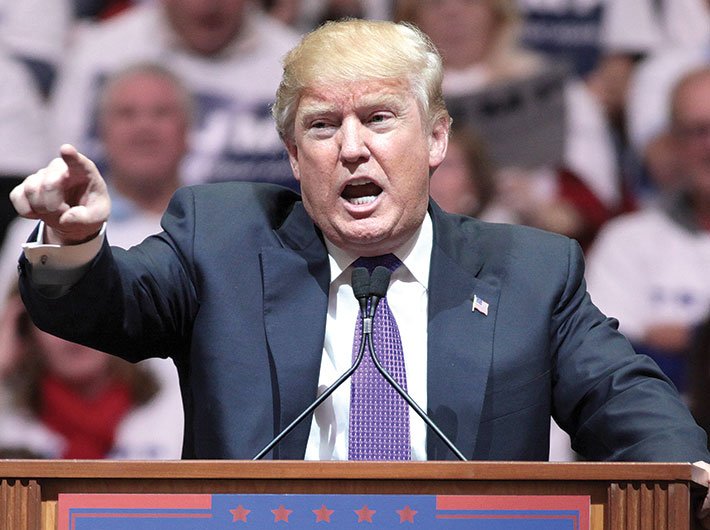
As the dust settles on the US presidential elections and analysts discuss Donald Trump’s victory threadbare, the larger question on what this upset victory portends for the US and for the world at large will continue to be a part of the intellectual discourse and common man’s discussions. For sure, the world we live in today is very different from what we had imagined. Eminent commentator Pratap Bhanu Mehta pointed out in his recent article in the Indian Express: “The world is in revolt. And we have no clue about the depth of distemper that has occasioned this revolt.” But what caused it and where is it leading to?
There were tell-tale signs of the coming of this revolt; distress, anger and disappointment, signs we failed to see or comprehend. From Austria to Germany and from Britain to India, the right wing, conservative forces seem to have become stronger. In the month preceding the US elections and Brexit, the changing ideological currents were apparent. Donald Trump himself claimed in his election campaign that American elections would be Brexit Plus. Following the victory of the Republicans in America, many European leaders are promising Brexit like results.
In retrospect, we may claim that the rise of the right wing in politics is associated with the miseries that the process of globalisation unleashed, especially in the aftermath of the global meltdown. It has led to a decrease in the manufacturing base in the developed countries and diminishing employment in the manufacturing sector in these countries. According to the Economic Policy Institute (EPI), “The US lost 5 million manufacturing jobs between January 2000 and December 2014.” Growth has been negative in Europe and it is slowly inching up in America. Rapid globalisation and decreasing manufacturing and employment have put increased pressure on the middle class and lower income group in the developed countries and it is believed to have had played a major role in Trump’s electoral victory. But are the reasons merely economic or is there more to it?
While the economic fallout of globalisation was widely covered by the mainstream media and debated extensively, its cultural impact has not received due attention. Globalisation has opened borders and not just markets, and in this it has been led by the technological revolution. Free trade of images and information has had a powerful effect and moulded the minds of men, tastes and values; not just in the developing, poverty-stricken nations inundated with multinationals, but also in the affluent west. It was on the road to creating what Francis Fukuyama said in his acclaimed book, The End of History and the Last Man, a ‘universal culture’. As global lifestyles and values became more prominent, the local began to retreat in public spaces. However, it was by no means forgotten. The working class, poor, marginally educated and marginalised sections were affected, by not just loss of jobs, but also by loss of a sense of identity and a sense of belongingness. A familiar world was unrecognisably changed. The elite and the entrenched welcomed the changed world, but the larger population having little knowledge and access to global ways of living detested the changes. Free movement and changing demographics only increased their discomfort. As diversity increased, the ideas of pluralism, free movement and unlimited opportunities sounded hollow, while it changed the familiar sights and sounds and the cultural level.
Interestingly, the global and the liberal were not universal; not inclusive. It was the dominant ideology and thinking that was paraded as global, displaying often vulgar disregard for the ethnic and local culture. It was not an exchange among equals in which cultures borrowed from each other. In the changing world, where the Americans dominated the cultural mind space and the Chinese threatened to dominate the economic space, the political space became the arena of conflict. America was also not truly inclusive. It did not provide space to the uncertainties of the marginalised, but imposed what the elite portrayed as deeply liberal ideals. In fact, liberals became their own enemies by closing their doors. In large measure, Hillary Clinton represented this liberal philosophy.
The ideological moorings of liberal philosophy; free competition, market driven economy, transparency, democracy, pluralism and interconnectedness, which seemed so enticing as a value, were becoming increasingly difficult to practise. The pinch became harder in the time of economic recession. Political correctness was no longer a virtue. It was rather symptomatic of hypocrisy that liberals showed.
The challenge to liberals came from conservative ideologies, which look back at the past with fond memories, a la golden age kind of feeling with a desire to somehow move the clock back and attempt to recreate the past in the present. It is not altogether surprising that the political agenda of the right wing rests largely on xenophobia, anti-immigration and protectionism. Nowhere was this desire more evident than in the recent US elections, where Donald Trump made ‘Make America great again’ the slogan of his campaign.
Such has been the rise of the right, that even governments in Europe have conceded to their demands and interestingly these demands are by and large related to culture. So, the French government banned Muslim women from fully covering themselves with ‘burkinis’ while swimming or lounging at certain beaches. The Danish parliament approved a controversial ‘jewellery law’ that allows the government to confiscate valuables from immigrants that would help finance their accommodation, while Trump promised to build a wall with Mexico.
The rise of right wing forces is no longer an anomaly. The UK’s exit from the EU shocked the world. Brexit was driven by the anti-immigrant rhetoric of the Independence Party, which has long called for Britain to shut its borders. Across western Europe, right wing leaders have created what Jean-Claude Juncker, president of the European Commission, termed in the Time magazine as “galloping populism”. The movements like those of Sweden Democrats and the National Front in France are increasingly coming out in the open and gaining support.
As things stand now, the American election shows that the rise of the right wing is now not limited to the Islamic world or the developing countries, but has spread to Europe and America. This definitely signals tectonic changes in the world ideologies.
Madhava is an associate professor at SNDT Women’s University, Mumbai. Wankhede is an assistant professor at SNDT Women’s University.
(The article appears in Decmber 1-15, 2016 edition of Governance Now)