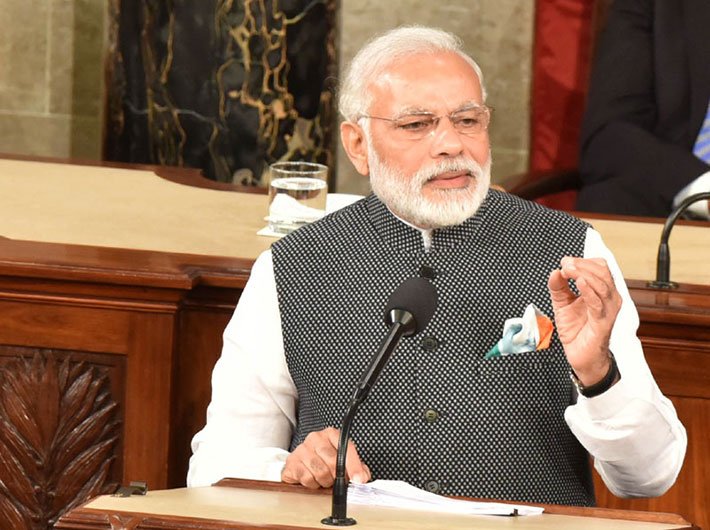
Prime minister Narendra Modi has strongly spoken out against cow protectors and on the targeting of dalits, two interlinked evocative issues that saw a worrying trend across India of groups taking law into their own hands.
"If you have a problem, if you feel like attacking someone, attack me, not my dalit brothers. If you want to shoot anyone, shoot me, not my dalit brothers," declared Modi in his stentorian voice as he attempted to douse the fire of anger that had quickly spread among the dalits after four young men were ruthlessly beaten up by cow vigilantes in Gujarat.
Now that Modi has broken his silence, it should have a salutary impact on the current crisis that saw dalits becoming increasingly polarized.
There are about 200 million scheduled caste people in the country and a sixth of the Indian populace was feeling that it was under attack, specially after the Una incident. Gujarat has witnessed a string of violent protests over this issue, with dalits demanding stringent action against the cow vigilantes.
In any case, Modi’s steely message should help to rein-in the overzealous self-styled cow protectors who have been running amok not just in Gujarat, but across the country. There have been just too many instances of trucks loaded with cows being stopped and the trucker being assaulted on the mere suspicion that the cows are going to be slaughtered.
Cows are no doubt an emotive issue in this country, but strangely there seems to be little concern about their well-being. People will go to extraordinary length to prevent the cow from being killed, however there will only be a few who will genuinely take care of the sick cows and nurse them back to health. Frail, ailing cows roaming around the city and eating garbage is a common sight.
What’s worse, over 500 cows died at Jaipur’s gaushala in Rajasthan in July and The Tribune quoted a veterinarian as saying that starvation was a likely cause of these deaths.
According to the 19th livestock census, the total livestock population consisting of cattle, buffalo, sheep, goat, pig, horses and ponies, mules, donkeys, camels, and yak in the country is 512.05 million in 2012. The total livestock population has decreased by about 3.33 percent over the previous census.
The population of cows has increased by 6.52 percent over the previous census (2007) and the total number of female cattle in 2012 is 122.9 million.
In the first townhall address on Saturday, Modi strongly condemned the actions of cow vigilantes, saying most of them were anti-social elements masquerading as gau rakshaks (cow protectors).
He asked the state governments to prepare a dossier on such “cow protectors” and observed that 80 percent of them would be found to be involved in illegal activities. “It makes me angry that people are running shops in the name of cow protection… Some people indulge in anti-social activities at night, and in the day masquerade as cow protector.”
A day later, during his visit to Telangana continued on the subject by calling for the protection of dalits and punishment for fake cow protectors. "If you have a problem, if you feel like attacking someone, attack me, not my dalit brothers. If you want to shoot anyone, shoot me, not my dalit brothers," he said.
"What is the reason we torture our dalit brothers? What right do you have? The section which has suffered for centuries, will you force them to suffer more?" he added in Hyderabad, which had seen an agitation following the suicide of dalit scholar Rohith Vemula on January 17.
And in Medak, Modi said: "Be wary of 'nakli' (fake) gau rakshaks, they have nothing to do with cow. Governments should crack down on them."
This is a powerful remark and in a way helps to assuage the feeling of hurt. But they came nearly a year too late for 52-year-old Mohammad Akhlaq Saifi who was lynched by a mob in Dadri, Uttar Pradesh over the accusation of killing a cow.
It is clear that Modi has showed not only his empathy and concern for the dalits, but also sent out a message against cow protectors who perhaps had never thought that their free run would ever end. It has hopefully now come to an abrupt halt.
Modi’s message comes at a crucial time when assembly elections are just round the corner in Punjab as well as Uttar Pradesh, two states where dalits have a considerable say in politics. Modi has spoken, but have the dalits heard. This will become clear when the votes get counted.