Studies critical of Gandhi’s early phase are not only welcome; they are necessary to appreciate what he went to achieve
Undeniably, Gandhi had a moral force unparalleled in recent times. For comparable examples of moral greatness, people often go back by centuries – to Jesus Christ and similar names. The crucial difference, however, is that nearly all great religious figures and spiritual teachers come with some supernatural element; grace from above and so on, which granted them enlightenment. They were not like you and me; they were the chosen ones. You and me, bereft of that grace and full of all human frailties, stand little chance to pull ourselves to a higher moral plane. But Gandhi, unlike the great religious figures, serves as an example of the human potential, of what an average human being can achieve; because he started out like a plain, average chap.
Gandhi was a man before he became a mahatma. That man, in his early 20s, had little ethical inclinations beyond the three vows his mother had forced on him before leaving for London (avoiding wine, women and meat). His social vision, too, was that of a small-town upper-caste middle-class boy – that too, of nineteenth century. (For the social vision of a small-town upper-caste middle-class boy from the same state in the twenty-first century, listen to Hardik Patel.) In South Africa, he unfortunately did not have an epiphany in an instant, he did not have a social-political equivalent of overnight enlightenment, and his understanding of race and empire was quite naïve and foolhardy.
That was where Gandhi’s moral evolution began. When we look at the great moral heights Gandhi was to achieve in later decades, we may as well acknowledge the low he had begun with, making it an even more dramatic moral arc. Instead, the broadly accepted popular discourse glosses over his early blunders and prejudices and refuses to allow the poor young man of the 1890s his narrow world view.
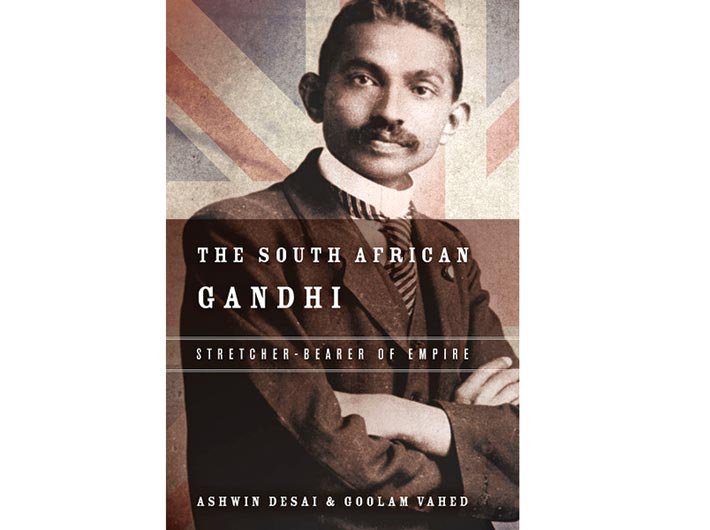
Hence, the recurring controversies over books that look at Gandhi in his pre-mahatma years. The latest among them is ‘The South African Gandhi: Stretcher-Bearer of Empire’ by South Africa-based scholars Ashwin Desai and Goolam Vahed, which has created some controversy, less because of its content and more because of its endorsers.
Desai and Vahed’s project here is to show “that Gandhi sought to ingratiate himself with Empire and its mission during his years in South Africa. In doing so, he not only rendered African exploitation and oppression invisible, but was, on occasion, a willing part of their subjugation and racist stereotyping. This is not the Gandhi spoken of in hagiographic speeches by politicians more than a century later.”
Unlike what Arundhati Roy says in her endorsement (“It uncovers a story, some might even call it a scandal, that has remained hidden in plain sight for far too long”), this story has not been hidden: many scholars, acknowledged by the two authors, have uncovered several unpalatable facts about Gandhi’s Africa experience. And there is nothing in it to be scandalised about – when these facts are seen as just another stage in Gandhi’s ethical and political evolution.
In uncritical adulation of Gandhi, we expect him to be ready with all ethical qualities as stepped out in the world in his teens, whereas we should be looking at the painful process by which he developed his moral resources. In his South Africa years, his attitudes towards the Empire, race, and discrimination were highly dubious, yes, but the more important fact is that those attitudes were to undergo a sea change soon. After returning to India in 1915, he was to arrive at a new understanding of the processes of inequality, of discrimination, and ways of standing up against them. In other words, he developed a critical attitude – one of those things we refuse to learn from him.
[email protected]
(The article appears in the September 16-30, 2015 issue)