
The movie inspired by Modi’s childhood has a remarkable social message

'Chalo Jeete Hain' raises issues of caste, poverty, inequality in a quietly radical way

ajay

Ajay Singh | July 28, 2018 | New Delhi

#Short Film   #Chalo Jeete Hain   #Caste   #Narendra Modi   #Inequality  
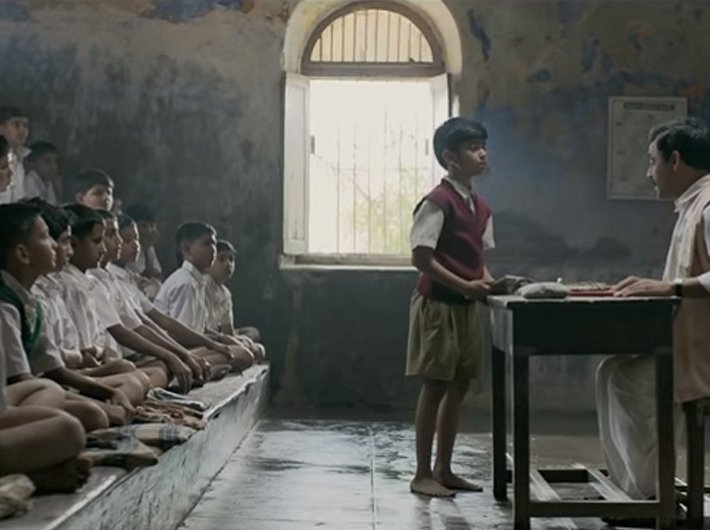
YouTube screengrab of Chalo Jeete Hain

A 32-minute short film titled ‘Chalo Jeete Hain’, premiered at a screening hosted by vice president M Venkaiah Naidu at the GMC Balayogi auditorium on Wednesday, is more remarkable for the social message it carries than the fact that it is inspired by Prime Minister Narendra Modi’s childhood days.

The film is essentially centered on deep-seated caste prejudices that glaringly exist among the Hindus much to the discomfiture of a young lad called “Naru” (the abbreviated name of Narendra). It revolts Naru’s sense of justice to see a boy of scheduled caste denied education on account of his penury. The scheduled caste’s unending travails and society’s apathy is boldly depicted in the movie.

But the beauty of the movie is that it is not seditious. The ‘peela phool’ (yellow flower) offered to the gods in Hindu temples is used as a metaphor of social reforms. In fact, “Peela Phool” is also the title of a play written by Modi during his school days and staged in Vadnagar town where he spent his childhood days. The play is essentially a commentary against orthodox brahminical order but avoids commenting against the caste system directly.

For instance, the movie is replete with instances of even upper caste people coming to the support of those considered untouchables by the higher echelons of society. The faith in the inner goodness of the society is emphasised quite forcefully when the protagonist of the movie manages to collect enough money through contribution to fund education of the scheduled caste friend. One can see the satisfaction on the face of Naru when he sees his friend walking into the classroom.

This short movie breaks the usual mould on various counts. It carries a very profound message without spreading any rancour against anyone. Though it is apparently inspired by Modi’s childhood life, it does not convey any political message and exclusively focuses on social reform. What is particularly outstanding in this short film is the deep empathy felt for one another by those living on the margins in the suburban milieu.

Naru’s family is also living in stark poverty and economically they are only a shade better than the scheduled caste family, though they are not so ostracized socially. Yet Naru could easily identify himself with the travails of a scheduled caste boy both economically and socially. He seemed quite conscious of humiliation one faces on account of not only economic marginalisation but also social inequality. In one scene, the hero accompanies his mother who does domestic chores on a rich neighbourhood to eke out her family’s living.

‘Chalo Jeete Hain’ is also a classical portrayal of society’s fault line while reposing an unremitting faith in its collective strength to overcome it. The movie may not be a work of revolutionary story-telling in the subversive sense – it is conformist to the core. This may expose the movie to the charge of being an exercise in public relation by the prime minister. It may also be seen as a prelude to image correction in the run-up to the election campaign for 2019 Lok Sabha elections. Without contesting these charges, there is no denying the fact that the short film is a socially audacious enterprise in a scenario where a biopic like ‘Sanju’ gets a big draw. In this case, the protagonist of the movie, Naru, would have to bank on the collective goodness of the society to make this movie a vehicle of social message and not just entertainment.

[This comment has appeared on FirstPost.com]

Comments


Other News

New pathways for tourism growth

Traditionally, India’s tourism policy has been based on three main components: the number of visitors, building tourist attractions and providing facilities for tourists. Due to the increase in climate-related issues and environmental destruction that occurred over previous years, policymakers have b

Is the US a superpower anymore?

On April 8, hours after warning that “a whole civilisation will die tonight,” US president Donald Trump, exhibiting his unique style of retreating from high-voltage brinkmanship, announced that he agreed to a two-week ceasefire with Iran. The weekend talks in Islamabad have failed and the futur

Machines communicate, humans connect

There is a moment every event professional knows—the kind that arrives without warning, usually an hour before the curtain rises. Months of meticulous planning are in place. And then comes the call: “We’ll also need a projector. For the slides.”   No email

Why India is entering a ‘stagflation lite’ phase

India’s macroeconomic narrative is quietly shifting—from a rare “Goldilocks” equilibrium of stable growth and contained inflation to a more fragile phase where external shocks are beginning to dominate domestic policy outcomes. The numbers still look reassuring at first glance: GDP

Labour law in India: A decade of transition

The story of labour law in India is not just about laws and codes, but also about how the nation has continued to negotiate the position of the workforce within its economic framework. The implementation of the Labour Codes across the country in November 2025 marks a definitive endpoint in the process. Yet

Time for India to build genuine resilience in energy security

There is a strip of water barely 33 kilometres wide between Iran and Oman that connects the Persian Gulf to the rest of the world`s oceans. For most of India`s history, it was a distant geographic fact. Since late February, it has been a kitchen problem.   The Strait of Hormuz. T


Archives

Current Issue

Opinion

Facebook Twitter Google Plus Linkedin Subscribe Newsletter

Twitter






