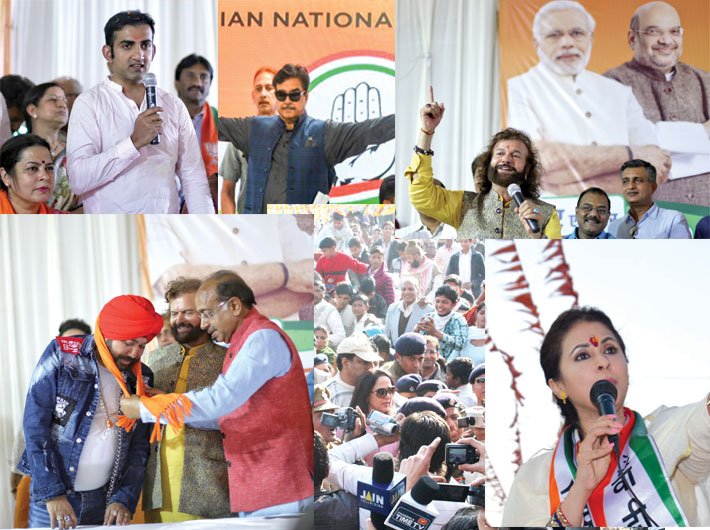
Their fame should be no disqualification but most of them end up triviliasing democracy
In a 1992 Lok Sabha by-poll, voters of New Delhi – the power hub of the capital – were faced with an enviable choice: Rajesh Khanna of the Congress versus rising-star Shatrughan Sinha of the BJP. The voters preferred the superstar over the non-superstar. It is not clear how Rajesh Khanna discharged his duties as an MP and served the constituency. At any rate, the choice was framed by the party bosses, and the voters chose wisely. Just a few months earlier, they had rejected the superstar and backed a seasoned politician, LK Advani. The BJP leader had then contested also from Gandhinagar, and chose to retain that seat, leading to this by-poll. Thus, people preferred an old-fashioned veteran politician over a superstar but when the choice was between two film personalities, the higher star power won the day. Rajesh Khanna went to increase his vote tally substantially when fighting Shatrughan Sinha.
The voters of Allahabad, however, chose differently in 1984, though the sympathy wave after the assassination of Indira Gandhi had also something to do with it. They backed another superstar, Amitabh Bachchan, instead of trusted and otherwise giant politician, HN Bahuguna.
As Paresh Rawal is taking the bow, it is clear that for most film stars, being a politician is just another role to play. Apart from Sunil Dutt (and the whole of the south), no exceptions come to mind. There have been more and more of celebrities in politics since the 1980s, as TV screens entered the middle-class homes. The best candidate to symbolize this phenomenon could be Nitish Bhardwaj, Lord Krishna of ‘Mahabharat’ tele-serial, who in 1996 defeated Inder Singh Namdhari in Jamshedpur. (Namdhari is still a serving politician, but Bhardwaj quit after losing in 1999.) The trend is only rising now with a battery of actors, stars, starlets, balladeers, sportsmen and a hair stylist coming forward to do their bit for the nation through the platform of politics. Gautam Gambhir and Vijender Singh should feel very much at home in their new careers, when politics is increasingly looking like a spectator sport thanks to prime-time TV and social media.
Fame and popularity are certainly no disqualification when anybody with no qualification can also contest elections. Many of them indeed come forward with a praiseworthy zeal to serve the people, and are already working for the political party of their choice before taking the plunge in the polls. It is better that they are seeking people’s mandate, because nomination to the Rajya Sabha is always an option. In Nehru’s time, it was Prithviraj Kapur, Indira Gandhi backed Nargis. By the time Hema Malini and Rekha were nominated to the upper house, they had precedents in Vyjayantimala Bali and Shabana Azmi. Hema Malini’s choice instead to contest Lok Sabha polls should then be welcome. Compared to the royal route Sachin Tendulkar chose to serve the nation, Gambhir is prepared to face the hustle and bustle of campaigning.
Those of us with different expectations from elections may wince at the star power trouncing the long years of politics on the ground, even if most non-celebrity candidates are not like Bahuguna either. Being an MP and representing lakhs of people is a fulltime job. Between one film shoot and the next, between one TV show appearance and the next or between two bouts, it is difficult to find time for helping voters in accessing benefits of government welfare schemes or voicing their concerns and participating in parliamentary debates. Bahuguna and Advani by the dint of their work among masses are better qualified at this job than Amitabh Bachchan and Rajesh Khanna.
Those of us with different expectations from elections may also scoff at the transformation of an MP into a number. In the presidential form towards which our politics is veering, the choice before the voter is not between individual candidates, but between parties they represent – or more precisely the prime ministerial candidates of those parties. As the top leadership gets stronger, the middle-rung of politics made up of MPs becomes inconsequential. This top-down, centralized model has improved governance in terms of delivery of services, truncating the role of the MP for people in the constituency. However, the flip side is that the MP is not able to voice the social and political issues – law and order, corruption, communalism, or crony capitalism, for instance.
(This article appears in the May 15, 2019 edition)