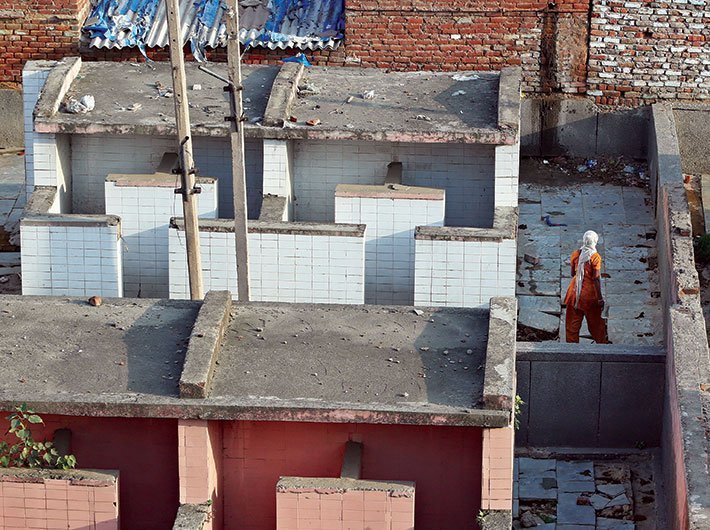
How many times a day do you flush the toilet? This number is probably between five and eight times for an average person. How many times a day do you spare a thought towards what happens to the human waste after you flush it away? The answer to this is likely to be close to zero for most people.
While citizens with access to piped sewer networks rarely have a reason to worry about what happens to their waste, about two-third of Indian households with toilets are, in fact, not connected to sewer systems and rely on on-site sanitation systems. It is critical that members of the society acknowledge the challenges arising due to unsafe sanitation practices, such as adverse living conditions, for the most vulnerable groups and the society at large.
Currently, in India, it is estimated that 60% of faecal sludge is dumped illegally without any treatment – contaminating open land and water bodies across the country. The pathogen content in faecal sludge is extremely high and without proper treatment leads to the transfer of major infectious vectors. Nearly 70% of India’s surface water is now polluted and contaminated by biological, toxic, organic and inorganic pollutants.
What does this mean for communities?
Many communities in India, especially those downstream from polluted rivers and without access to piped water, are afflicted by infectious diseases like diarrhoea, typhoid, intestinal worms, cholera, malaria, schistosomiasis. In 2019, approximately 33 people for every 100,000 of the Indian population died due to sanitation-related ailments, with a high incidence of disease among children under the age of five. Without safely managed sanitation, the disease burden devastates quality of life socially and economically.
Additionally, unsafe sanitation is increasingly being recognised as the cause for spreading anti-microbial resistance – infections that are resistant to antimicrobials and antibiotics. Anti-microbial resistant bacteria are known to have vast presence in wastewater and without treatment, go on to re-contaminate humans through drinking water or food. It is touted as one of the most enormous and historic public health challenges faced by India and countries around the world. Without building safe water and sanitation systems as protective frontiers, communities shall face more serious breakdowns of public health systems in the future.
The Covid-19 pandemic is not only a demonstration of the severe loss of human life due to infectious diseases, weak health and improper sanitation systems; it is also a paradigm of how safe water, sanitation and hygiene practices are key to provide resilience against adverse outcomes en masse. Many things from a rigorous hand-washing regime to adequate waste management were key levers that enabled the country to fight against the pandemic. Had these systems been in practice before the pandemic, there is a significant case to suggest that the pandemic would perhaps have been less destructive for the communities.
What can we do about it?
Think about it this way: a single truck of faecal sludge dumped into the open contains the equivalent of 5,000 people defecating in the open. This leads to public health and environmental challenges that are further magnified to large chunks of the population. However, there are ways to build preventive barriers to ensure that the waste finds its way to treatment plants. By developing an integrated and holistic sanitation value chain known as Faecal Sludge and Septage Management (FSSM), the waste can be safely treated and converted into a form safe for disposal into the natural environment. Moreover, the treated wastewater can also be utilised in agriculture and other use cases by extracting key nutrients and energy from the sludge – provided it meets the scientific standards set in policy.
Not only is safe sanitation one of the most integral Sustainable Development Goals (SDG 6.2), it is also a crucial component of the One Health approach to public health – a multi-level, multidisciplinary approach to achieve positive health outcomes through optimal human-environment interactions. While India has made significant progress on driving forward the safe sanitation agenda, there is much more that needs to be done even more rapidly, with support from the FSSM and safely managed sanitation construct. This is why sanitation should matter to you – for the healthier, safer and more sustainable communities of the future.
Khushi Desai is Analyst, Urban Sanitation, Dasra