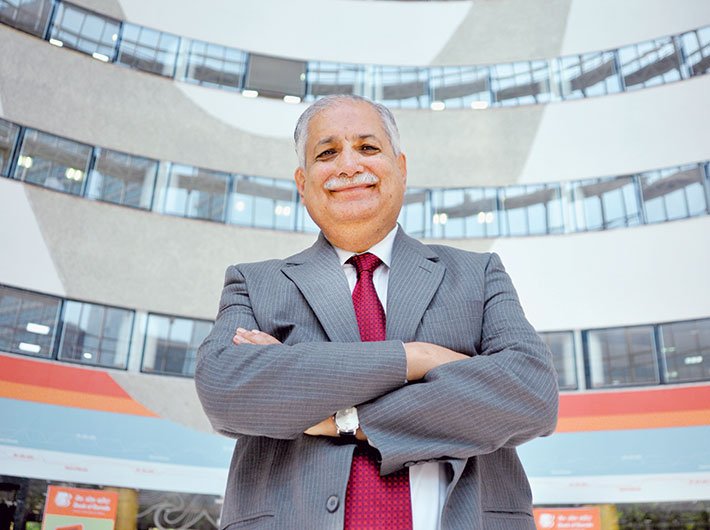
Ranjan Dhawan, executive director of Bank of Baroda, was entrusted with the additional charge of the managing director and CEO of the public sector banking giant on February 27. Before joining BoB as executive director in November 2012, he was the chief general manager of Punjab National Bank. With its vast network, BoB is a crucial player for financial inclusion. Excerpts from an interview with Sweta Ranjan:
Under the PMJDY, millions of accounts have been opened but transaction remains an issue. So, what next?
The intention of Jan-Dhan Yojana was that the government would have accounts readily available for various benefits it is contemplating, for example, fuel subsidies of various kinds. So, the accounts are now ready and now this [transaction] has to be [initiated] by a lot of activities. We assume and hope that in times to come these activities will take place. I was recently in Chandigarh and I was told that in one or two areas and in one or two schemes money has already started flowing and accounts are now being credited with the amount. In one scheme Rs 30 crore is being credited per month. We find from our practical experience that people don’t withdraw this money because they feel amounts are as for two or three months and then withdraw a good amount. I think activity has started.
Is this scheme a matter of compulsion, or do banks see a business interest in it?
We – at least public sector banks [PSBs] – have taken up this challenge in national interest. We do feel that every family in the country should have an account and we did it with will and enthusiasm. It is correct that these accounts are not remunerative as yet. Until and unless people have balance in their accounts, they will not be so. We have spent a lot of money in opening these accounts and we will spend a lot of money on the IT systems and other things for holding and maintaining these accounts. We hope that going forward these accounts will also become remunerative for the bank.
Do you see business viability in working with the poor?
I think it is an investment for the future. If we believe that this country will have 6.5 or 7 or 8 percent growth, it is going to pull millions and millions out of poverty and into the lower middle class. These people will require bank accounts which will have money in it. I do believe this has created a base for the PSBs to acquire good customers in the future. This future may occur two to three years later, or five to seven years later.
What about mobile banking for financial inclusion, the way it has been done in some African countries?
Mobile banking is mainly successful for funds transfer in Kenya. They had a system called M-Pesa. There is an ecosystem which has been set up. For example, if a poor person wants to transfer money to his village, there are various kinds of shops. He would give his money to one shop, there would be mobile transfer of his money to the shop near his village and somebody from his family can come and collect this money.
I believe that banking of the future is going to be mobile banking. Even today people prefer to do their internet shopping or internet travel [booking] through the mobile phone. Increasingly people do not access the internet on the PC. Funds transfer will occur – is also occurring – via internet through the mobile, also through a lot of apps. For example, Bank of Baroda has developed an app: Baroda m-connect. If I want to do banking, all I do is just use this app conveniently.
This is very convenient but will it suit the poor who are not tech-savvy?
It will suit them because it is very user-friendly. Secondly, the handset cost, even of smartphones, has come down drastically. The only handicap, to some extent, will be for illiterate people. I am sure that over a period of time, some solution will be worked out and we would have a process which will help the illiterate transfer their money. We can have self-explanatory icons. Secondly, not many people realise this but even the illiterate people are ‘numerate’, they can read numbers. This is the technology whose time has come.
How sustainable is the existing ATM infrastructure to handle the increased workload from new accounts?
Our ATM infrastructure is getting upgraded rapidly. About two years back Bank of Baroda had 2,200 ATMs, today we have more than 7,000. I am now seriously looking at the possibility of adding 3,000 ATMs under a different model. I will not disclose what this model is. But, yes, the ATM infrastructure in the country is rapidly expanding and now penetrating even the rural areas.
It is not the case that an ATM would be viable in every rural area and for that we also have the business correspondent (BC) model, which is working. Any new technology, any new process takes time to stabilise. We must remember that even the BC model was floated about five years back, and it has taken four to five years to stabilise.
There is no magic wand: it has its teething problems, technological problems. For example, in rural areas, typically connectivity is very weak. It has taken time to solve the connectivity problem. One of the ways we have done so is through satellites. Satellite (connectivity) is available anywhere and everywhere, wherever you may be. It is expensive. So, there are problems of expenses, there are problems of technology absorption also, because if you make a transaction through some other route then you have to change and upgrade your technology over here. Because technology is hitting the data sever in Mumbai. How do we recover the transaction if the data link breaks? There are a lot of technological problems we face. We are working on them. What gives hope is the fact that over the last five years we have solved most of such problems.
Your bank had opened 56 lakh accounts by mid-February. Did you face any staff shortage or infrastructure problems?
One problem that has occurred during opening accounts under the Jan-Dhan Yojana is that we have not carried out normal development work that we do. Our job is to serve customers. The normal banking development work, to some extent, took a back seat because the entire branch staff was concentrating on opening the Jan-Dhan accounts.
So, staff strength was an issue…
No. There have been no issues. The branch staff was almost exclusively deployed to open the Jan-Dhan Yojana accounts. So, some of the targets, for example in retail lending, have not been achieved – especially in loans.
Does your bank have any tailor-made schemes for Jan-Dhan customers?
As of now we don’t have any tailor-made scheme. Our focus has been on opening accounts. In time to come when we find out what the demand on the ground is, we will certainly have some schemes.
Six months after opening an account a customer can avail overdraft facilities. Do banks have ample funds and infrastructure for it?
Certainly, we have put up a very good structure on the ground. On the manpower front we have appointed a huge number of business correspondents who are doing a very good job. Our backend process is also now in line. We have a separate server for the Jan-Dhan accounts. So, the entire structure is in place, and we can handle this.
[email protected]
(The interview appears in the June 1-15, 2015 issue)