It boils down to just one thing – promotion of right people, without personal likes or dislikes
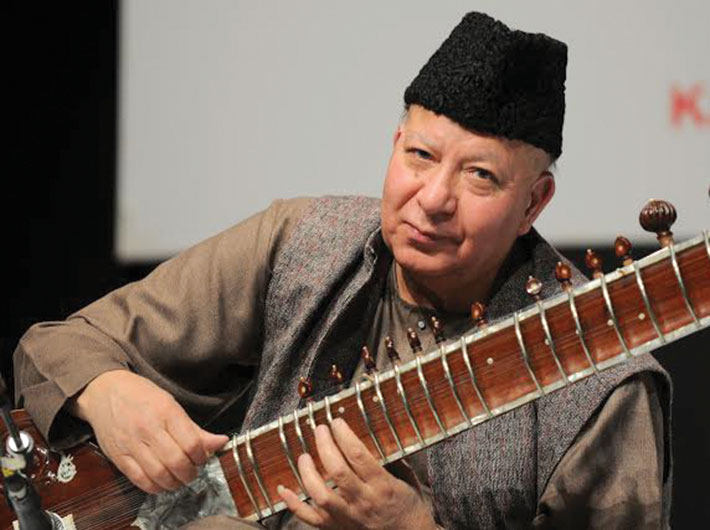
Ustad Mahmud Mirza is an unusual musician. A top-ranking sitar player who has impressed audiences in India and abroad with his chaste classicism, he is a widely read man who can raise the level of any conversation with his profound observations on literature, art, music, Indian and world politics, religion and philosophy. He was initiated into sitar playing at the early age of six by his maternal uncle Ustad Haider Husain Khan who was a doyen of the Jaipur Senia gharana. He made the music world sit up and take notice when he became the first artiste to join the staff of All India Radio at the tender age of 14. After the premature death of Ustad Haider Husain Khan, he learnt music from Pandit Jeevan Lal Mattoo, a well-known disciple of the legendary Ustad Abdul Waheed Khan of the Kirana gharana.
Since the late 1960s, he has been living in the UK and spreading awareness about Hindustani classical music in Europe and the US through his concerts. Kuldeep Kumar spoke to Ustad Mahmud Mirza on issues of governance in the field of arts and culture during his recent visit to Delhi.
In a democracy, should the government try to manage the affairs of arts and culture? In the UK, there is an Arts Council that performs this function. How successful has it been?
In a democracy, it is even more the duty of the government to promote arts and culture because it represents the people. In the UK, the Arts Council on the whole functions well but it is not immune to controversies. Each year awards are announced and controversies arise. Most matters are sorted out by the council itself but if something really terrible happens, then it goes right up to the minister in-charge of arts. It’s another matter that like in India, in Britain too the minister generally upholds the earlier decision. However, one has to admit that the British have performed better than us in this regard simply because they have had much more time to evolve a system and conventions while we have an experience of only 60-odd years. But, like us, they do have their share of wrong decisions and, consequently, controversies.
The entire question of governance boils down to just one thing – promotion of the right kind of people without personal likes or dislikes. We too have government-controlled institutions in India to manage cultural affairs and every year when various awards are announced, you witness a kind of theatre. Before the announcement, you would find certain people doing intense lobbying and after the announcement, you would find fierce controversies. The fact remains that if an undeserving or a less deserving person is selected and a more deserving person is ignored, it does harm to our arts and culture which, after all, belong to our people. Therefore, India being a democracy, our government should in fact pay more attention to managing the affairs of arts and culture in a better, transparent and effective manner. Our bureaucracy here works almost along the same lines that the British bureaucracy works. But, in India, we have a more relaxed attitude towards following rules and regulations.
Should the government have a cultural policy? Would it not be viewed as interference? Should arts and culture not be left free to develop on their own?
The government should maintain a distance and not try to have a tight grip on it. It should not be like a noose, but rather like a leash. The government should be very relaxed and open towards affairs of arts and culture and promote the deserving individual who is really the source of all arts and culture, who creates literature and music and so on. But often we see that the individual who has got creativity is suppressed.
Is it because in our country, institutional mechanisms are not adequately evolved?
You are right, but those who are managing these institutions are on the right track. They are learning their trade and trying to do things in the right spirit. The government is really sincere. You can’t doubt its intention. It is allocating money for arts and culture and brining in people to run these institutions. The only thing is that we don’t know what these people’s intentions are. They only become clear once these people start promoting this or that individual. Then you know whether the person is acting in a partisan or a non-partisan manner.
How different is the Arts Council from, say, our Akademis? As you know, we have Sahitya Akademi, Lalit Kala Akademi and Sangeet Natak Akademi in Delhi and their counterparts in almost every state.
The Arts Council too, like our Akademis, comes under the purview of a ministry, but the parliament is the ultimate authority. It gives grants to institutions as well artistes of different persuasions. Like our Akademis, it also aims at promoting culture – not only European but also non-European cultures. It gives grants to Indian music and dance societies. For example, the Indian Music Circle has been receiving grants from the Arts Council for several decades. So, in a way, both our Akademis here and the Arts Council are trying to perform the same function.
The three Akademis were created in the 1950s to promote literature, art and culture in an independent India. Looking back at their track record, how satisfied are you about their functioning, especially that of Sangeet Natak Akademi?
People are not very satisfied. What happened that some times, the Sangeet Natak Akademi got very good people as its chairperson. I would not like to cite names but, for example, Narayana Menon was such a person. He had a vision of his own. Some people were critical of him too because they felt that he was tilting towards the South a bit too much. But I feel that it should be allowed to some extent. If a person belongs to the South and he somewhat tilts towards it, there is nothing wrong in it. But then, the SNA got some others as its head who had really wangled the job by lobbying hard for it. Being insecure, they would like to be flattered. They would be surrounded by sycophants and would indulge in self-promotion as well as promotion of those who did not deserve it. So, in the ultimate analysis, it is the individual who matters. If an institution has got a good individual to run it, it will perform well.
What about the policies of these Akademis? Are they good and the problem lies only in the way they are executed? Or is there something wrong with the policies themselves?
No, the policies are generally good. On paper, they read well and look achievable. But the problem arises with their execution. It depends on the individual who implements these policies.
How do you view the role of organisations such as All India Radio, Doordarshan and Indira Gandhi National Centre for Arts in preserving and promoting our classical music heritage?
All India Radio’s contribution is enormous. It kept music going when music was really in doldrums. It kept the musicians alive when they were bereft of patronage. AIR regularly invited musicians to perform and broadcast their performances live. So, in a sense, it cultivated and promoted a much better understanding of national music. Earlier, people would say this is music from Bengal, or from Punjab, or from Maharashtra. But by broadcasting music nationally, the AIR made its journey to and fro possible. Consequently, the regional barriers started thinning out. Though a Punjabi, Ustad Bade Ghulam Ali Khan was very popular in Bengal. Then came television. But it is not the same thing as radio. It has its own limitations as a medium. It depends on so many other things to make a telecast possible. A performance has to be compressed into a half-an-hour slot while actually it may require an hour. Radio was not so much constrained by it. So far as the IGNCA is concerned, last year it organised a wonderful four-day Gharana Festival featuring prominent vocalists of the Patiala, Kirana, Gwalior, Agra, Delhi and Jaipur styles. I was in Delhi those days and I went every day to listen to the vocalists. This programme went very well with the audiences and some singers were noticed by discerning listeners. This is the real purpose of organising a musical event – to promote good artistes, to present them to discerning audiences who would form their opinion about them. I hope such programmes will be regularly held in future and will provide a good platform to senior as well as junior musicians.