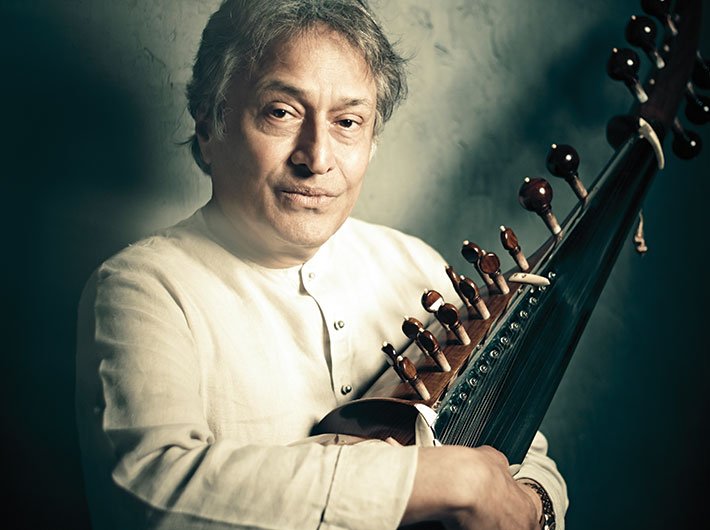
In conversation with sarod maestro Amjad Ali Khan

Sarod maestro talks about his passion for classical music and more

yoshika

Yoshika Sangal | July 26, 2016


#Personal Note   #Sarod   #Amjad Ali Khand   #Music  


Sarod maestro Ustad Amjad Ali Khan, who has enthralled music lovers across the globe, was born to Gwalior court musician Hafiz Ali Khan and Rahat Jahan. He is the sixth generation sarod player in his family. The veteran artiste is the recipient of second highest civilian honour, Padma Vibhushan, in 2001; having also received Padma Shri in 1975 and Padma Bhushan in 1991.


How has  the world of music changed over time?

I don’t think there is any change. Every musician has the liberty of planning his or her concert, its
duration and the choice of raaga. Today, we have brilliant young musicians performing.

Does fusion affect classical music?

There is no fear of loss of originality because classical music is like the sun and the moon and will exist till the time these solar bodies will exist. It is  natural that fusions and collaborations are happening. Also, not all fusions are successful. Some are appealing while some are not. Music should be appealing, whether it is folk, fusion or classical. Every genre has its own importance. There is no fear of dilution, nothing has gone away. Every genre was and is there just like water, fire, air, fragrance and colours.

How tough is it to pursue classical music?

It is almost like entering a dark tunnel with a hope of seeing sunbeams some day. It is beyond glamour. Here, music is a way of life. Earlier, saints of the likes of Swami Haridas and Tyagaraja were devotees of classical music. However, if you want to make money, you can go to the film industry. There you have the chance of becoming a millionaire overnight.

Have you ever thought of composing for films?

I am open to giving music to films. I have great regard for Bollywood.

Is technology a boon for musicians or is it a bane?

It’s a great achievement. People are using YouTube, CDs and iTunes, etc. to listen to music. We [musicians] depend a lot on our sound engineer. Acoustically well built concert halls like Carnegie and Kennedy hall in Washington are very important.

Have you ever been at the receiving end of misgovernance?

Out of all musicians who were sent for an Indian fest held in England, only one or two were paid. I raised my voice on this issue and finally the matter was sorted out and all musicians were paid eventually.

How was your last journey in Indian Railways?

I enjoy travelling in railways. Earlier, I used to undertake long-distance journeys from Delhi to Kolkata or to Mumbai. I used to look forward to the food available in trains. My last journey in railways was from Delhi to Gwalior.

When did you vote last time?

Most of the time, during elections, I have been away from India but whenever I am available, I make sure my family and I cast vote.

Any message for youngsters?

Humans have become the most dangerous animals. Education alone cannot create compassion and kindness. One should be tolerant and patient to achieve their goals.


(The interview appears in the July 16-31, 2016 issue of Governance Now)
 

Comments


Other News

How Rafi, Raj Kapoor helped pave the way for a great uranium deal

There`s a certain moment in diplomacy that`s too personal to be captured in a communiqué, too small to make the front page, but more revealing than the front page. This week, prime minister Narendra Modi reached Tashkent and, amid the pomp of state visits, managed to evoke the old Bollywood tunes

Distinguishing Fish 1 and Fish 2: The pragmatism behind India’s WTO ratification

 India became the 123rd WTO member to ratify the multilateral Agreement on Fisheries subsidies (AoFS) when it deposited the Instrument of Acceptance for Phase 1 on July 20, 2026. The ratification is restricted to disciplining Illegal, Unreported and Unregulated fishing (IUU), protection for overfished

The 7% growth problem: Why the next 7% will be harder

India has become accustomed to hearing the 7% growth number. It is now less a milestone than an expectation. Yet the paradox is becoming clearer: maintaining 7% growth may be considerably harder than achieving it once. India’s real GDP grew 7.7% in FY2025–26, following growth of 6.5% in FY202

The Constitution cannot be altered: Justice Abhay Oka

Justice Abhay Oka, who retired from the Supreme Court in May 2025, has said that the Constitution of India cannot be altered. Explaining the landmark Kesavananda Bharati judgment (1973) on the basic structure of the Constitution, he said, “This is one judgment that has saved democracy in India.&rdq

How the flora and fauna evolved in the Indian subcontinent

Mammals of India  By A.J.T. Johnsingh and P.O. Nameer HarperCollins India in association with Bombay Natural History Society  

India`s renewable race is moving beyond megawatts

When Shell bought Sprng Energy in 2022, India`s renewable energy market appeared to offer precisely what global energy majors were seeking: scale, growth and a place in one of the world`s largest energy transitions. Four years later, Shell is selling the same business to Aditya Birla Group for an enterpris

Upcoming Conferences


-->

Archives

Current Issue

Opinion

Facebook Twitter Google Plus Linkedin Subscribe Newsletter

Twitter